---
title: "Airbus A380: specifications and range — OnlyPlanes"
description: "Airbus A380 (A380-800): 555 seats; range up to 14,800 km (8,000 nautical miles). Characteristics, engines and interior."
canonical_url: "https://onlyplanes.ru/en/aircraft/airbus-a380"
locale: en
meta:
keywords: "Airbus A380, Airbus A380 characteristics, Airbus A380 range, Airbus A380 capacity, two-deck wide-body aircraft"
"og:description": "Airbus A380 (A380-800): 555 seats; range up to 14,800 km (8,000 nautical miles). Characteristics, engines and interior."
"og:image": "https://onlyplanes.ru/images/aviation/aircraft/boeing-787.webp"
"og:title": "Airbus A380 - characteristics of the aircraft"
---
> Index of every page on this site: [llms.txt](https://onlyplanes.ru/llms.txt)
Airbus · double-deck wide-body aircraft
# Airbus A380Airbus A380
The largest serial passenger aircraft: two full-fledged passenger decks run almost the entire length of the fuselage. The A380 was designed to carry a large flow between major airports.
- Speed
- M 0,85
- Range
- up to 14,800 km (8,000 nautical miles)
- Capacity
- 555 seats in a typical three-class layout; certified maximum 853
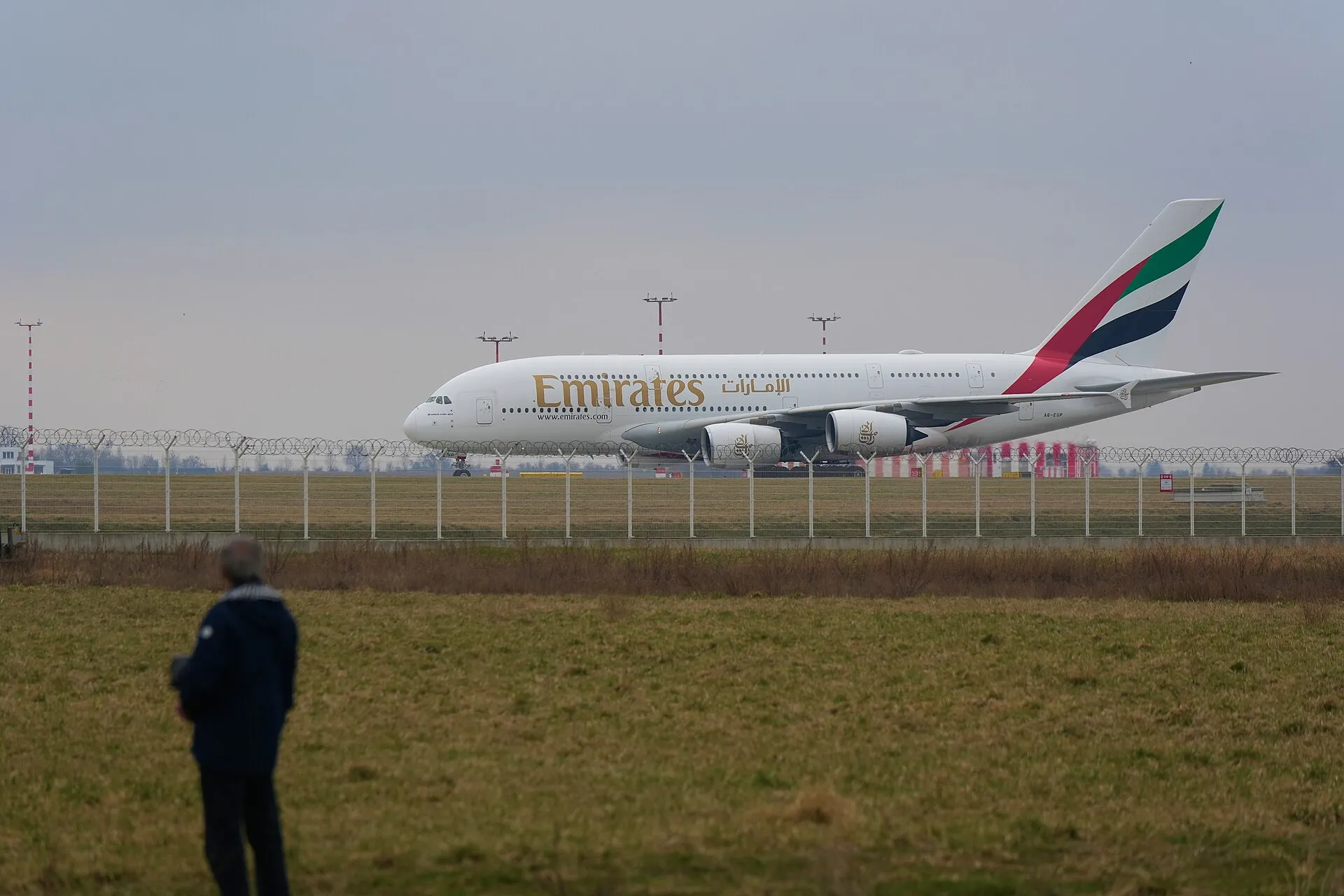
*Airbus A380 - photo from the open aviation archive.*
## Specifications Airbus A380
The figures in this table refer to one specific variant — **A380-800**. This avoids combining the range, capacity and dimensions of different versions into an inaccurate set of figures.
- Variant shown in the table
- A380-800
- Type
- double-deck wide-body aircraft
- Family's first flight
- Year 2005
- Passenger capacity
- 555 seats in a typical three-class layout; certified maximum 853
- Flight range
- up to 14,800 km (8,000 nautical miles)
- Mach's Cruising Number
- M 0,85
- Length
- 72,72 m
- Wingspan
- 79,75 m
How the aircraft came about
## History Airbus A380
The A380 first flew in 2005 and began carrying passengers in 2007. Production ended in 2021, but the aircraft continue to operate on busy international routes.
Airbus began researching a very large passenger aircraft in the late 1980s, and officially launched the A380 program in 2000. The first flight took place in 2005, the first flights with passengers were performed by Singapore Airlines in 2007. Serial production ended in 2021, but the cars built continue to fly.
Milestones and decisions
## Programme development
The A380 was designed in the era of expectations for growth in traffic between the largest transfer airports. The full-size upper deck made it the largest serial passenger aircraft, but complicated ground handling. Airports needed suitable parking, taxiways and landing exits. After changing demand and increasing capabilities of long-range twin-engine aircraft, Airbus finished production of the A380 in 2021.
Model features
## Design and variants
Unlike the partial upper deck of the Boeing 747, the A380 has two full-size passenger decks almost the entire length of the fuselage. Four engines and a large wingspan required a number of airports special parking, teletraps and taxi procedures. On board, the cabin volume allows for very different layouts.
Serial passenger model was the A380-800. The cargo A380F and extended variants were discussed, but did not enter regular production. Therefore, the published capacity figures should be associated with a specific A380-800 scheme: the maximum allowed number of seats is much higher than the typical multi-class layout.
Powerplant
## Engines
Four Rolls-Royce Trent 900 or Engine Alliance GP7200.
The engine variant fitted to an individual aircraft is recorded in its documentation. The powerplant affects thrust, fuel consumption, noise and maintenance requirements.
On board
## Cabin and passenger capacity
Two decks and two aisles on each passenger deck. The layouts include economic, premium, business and first classes; individual carriers install bars and showers.
Passenger capacity is 555 seats in a typical three-class layout; certification maximum is 853. The exact number of seats is determined by the operator: business class, kitchens, toilets and recreation areas of the crew take place. Therefore, the layout of the cabin differs even with the same models.
In practice
## Operations and uses
Four engines and two passenger levels are justified primarily on flights with a very large flow. Carriers used the volume of the cabin in different ways: from dense schemes to spacious first classes with rest areas. Even with the same A380-800 index, the number of seats and services vary greatly. The built aircraft continue to operate on separate major international lines after production stops.
Technical analysis
## How it works Airbus A380
The A380’s design grew out of the idea of carrying a very large flow between major airports in a single flight. Two passenger decks run almost the entire length of the fuselage, which distinguishes the aircraft from the Boeing 747 with a short upper deck. Such a scheme required a reinforced airframe, a large wing and special solutions for landing and evacuation. Four engines were selected taking into account the size and technical capabilities of the development time. The final result was an independent type, not an enlarged A340.
The size of the aircraft also changes the ground part of the flight. The airport needs suitable parking lots, taxiways, service areas and airways that can work quickly with a large number of people. If there is not enough passenger traffic on the flight or the airport is not prepared, the advantages of capacity are less useful. That’s why the A380’s route network is limited more than that of the more compact wide-body aircraft, although its certified range allows it to operate intercontinental flights.
The only production passenger version was the A380-800. The A380F cargo project and the idea of an elongated aircraft did not go to regular production. Within the existing model, the space is organized differently: two floors allow separate class cabins, stairs and additional service areas. The maximum capacity on the certificate is not equal to the number of seats in a multi-class far salon. The weight of the interior, luggage and cargo together determine the payload of each flight.
History and operations
## Role Airbus A380 in airline service
Singapore Airlines launched A380 passenger flights in 2007. Other carriers used it primarily on dense international routes between major hubs. The large salon allowed to divide the flow into economic, business and first classes, and some companies added special recreation areas. At the same time, four engines and complex maintenance mean that the filling of seats plays a particularly important role in the flight economy.
The appearance of long-haul twin-engine aircraft changed the choice of airlines. Instead of one huge flight, the carrier can sometimes send two smaller aircraft with a convenient schedule or open a direct route between cities where the flow for the A380 is insufficient. This shift was one of the reasons for the completion of its production in 2021. Stopping assembly does not mean type extinction: built aircraft continue to serve destinations where their large capacity is in demand.
For a passenger, the A380 can be quiet and spacious, but the impression depends on the airline. A plane with a dense economic scheme and a car with a large number of individual cabins have the same index, but differ in the number of seats and available space. When choosing a flight, it is useful to look at the scheme of the designated board. For the carrier, in turn, the airport’s destination capabilities and steady demand throughout the year are important, not just the high flow on individual holidays.
For comparison
## Location Airbus A380 among other aircraft
The Airbus line is useful to consider the task of the route, and not as a sequence of "better - worse". A319, A320 and A321 belong to the same single-pass family, but give different capacity and, in some versions, different range. The A330 and A350 are designed for double-passage and long international flights; the A380 solves the special problem of maximum flow between major airports. The carrier does not choose the largest aircraft at all, but the size that corresponds to the load and the desired frequency. If you send too large a car, empty seats can negate the benefits of its passport effectiveness. If it's too small, there won't be enough space or you'd have to limit your luggage. Therefore, one airline can simultaneously operate several types of Airbus on routes of different length and density.
The general school of cockpit and control systems is noticeable for many Airbus, but it does not make certificates, engines and gliders the same. Even the close A319 and A321 differ in mass, output and layout, and there are much more engineering differences between the A320 and A350. The words ceo, neo, LR, XLR, and ULR refer to specific generations or tasks. When reading the technical table, you should first find the full index of the modification, then check the range conditions: the number of passengers, cargo, cruising mode and fuel reserves. The declared maximum in capacity and the declared maximum in range often refer to different scenarios. This order allows you to compare aircraft on a real flight, rather than a combination of the two most attractive numbers from different advertising lines.
Where it flies
## Airline operators
Examples of current or historically notable operators of the model and its variants:
- [Emirates](https://onlyplanes.ru/en/airlines/emirates)
- Singapore Airlines
- British Airways
- Qantas
- [Lufthansa](https://onlyplanes.ru/en/airlines/lufthansa)
Fleets change. Check the aircraft type and seat map on the airline's official website before your flight.
Updates
## News Airbus A380 on Telegram
New deliveries, routes and events with the participation of Airbus A380 are published in the Telegram channel at legkoenebo.
[Open the Telegram channel](https://t.me/legkoenebo)
```json
{"@context":"https://schema.org","@type":"Article","headline":"Airbus A380: characteristics and history","description":"Airbus A380 (A380-800): 555 seats; range up to 14,800 km (8,000 nautical miles). Characteristics, engines and interior.","mainEntityOfPage":"https://onlyplanes.ru/en/aircraft/airbus-a380","publisher":{"@type":"Organization","name":"OnlyPlanes","url":"https://onlyplanes.ru/en"},"about":{"@type":"Thing","name":"Airbus A380"}}
```
```json
{"@context":"https://schema.org","@graph":[{"@id":"https://onlyplanes.ru/en#website","@type":"WebSite","description":"News, stories and rare images from the world of aviation","inLanguage":"en-GB","name":"OnlyPlanes","url":"https://onlyplanes.ru/en","publisher":{"@id":"https://onlyplanes.ru/en#identity"},"translationOfWork":{"@id":"https://onlyplanes.ru/en#website"}},{"@id":"https://onlyplanes.ru/en/aircraft/airbus-a380#webpage","@type":"WebPage","description":"Airbus A380 (A380-800): 555 seats; range up to 14,800 km (8,000 nautical miles). Characteristics, engines and interior.","name":"Airbus A380: specifications and range","url":"https://onlyplanes.ru/en/aircraft/airbus-a380","isPartOf":{"@id":"https://onlyplanes.ru/en#website"},"potentialAction":[{"@type":"ReadAction","target":["https://onlyplanes.ru/aircraft/airbus-a380"]}],"primaryImageOfPage":{"@id":"https://onlyplanes.ru/en#logo"}},{"@id":"https://onlyplanes.ru/en#identity","@type":"Organization","name":"OnlyPlanes","url":"https://onlyplanes.ru/en","logo":{"@id":"https://onlyplanes.ru/en#logo"},"sameAs":["https://t.me/legkoenebo"]},{"@id":"https://onlyplanes.ru/en#logo","@type":"ImageObject","caption":"OnlyPlanes","contentUrl":"https://onlyplanes.ru/search-logo.png","inLanguage":"en-GB","url":"https://onlyplanes.ru/search-logo.png"}]}
```
## Sitemap
See the full [sitemap](https://onlyplanes.ru/sitemap.md) for all pages.