---
title: "Boeing 777: specifications and range — OnlyPlanes"
description: "Boeing 777 (777-300ER): 396 seats; range up to 13,650 km (7,370 nautical miles). Characteristics, engines and interior."
canonical_url: "https://onlyplanes.ru/en/aircraft/boeing-777"
locale: en
meta:
keywords: "Boeing 777, Boeing 777 characteristics, Boeing 777 range, Boeing 777 capacity, wide-body long-haul aircraft"
"og:description": "Boeing 777 (777-300ER): 396 seats; range up to 13,650 km (7,370 nautical miles). Characteristics, engines and interior."
"og:image": "https://onlyplanes.ru/images/aviation/aircraft/boeing-787.webp"
"og:title": "Boeing 777 - characteristics of the aircraft"
---
> Index of every page on this site: [llms.txt](https://onlyplanes.ru/llms.txt)
Boeing · long-haul wide-body aircraft
# Boeing 777Boeing 777
Large twin-engine liner for long-distance routes. The Boeing 777 is known for its spacious cabin, long range and one of the most powerful turbofan engines in civil aviation.
- Speed
- M 0,84
- Range
- up to 13,650 km (7,370 nautical miles)
- Capacity
- 396 seats in a typical two-class layout
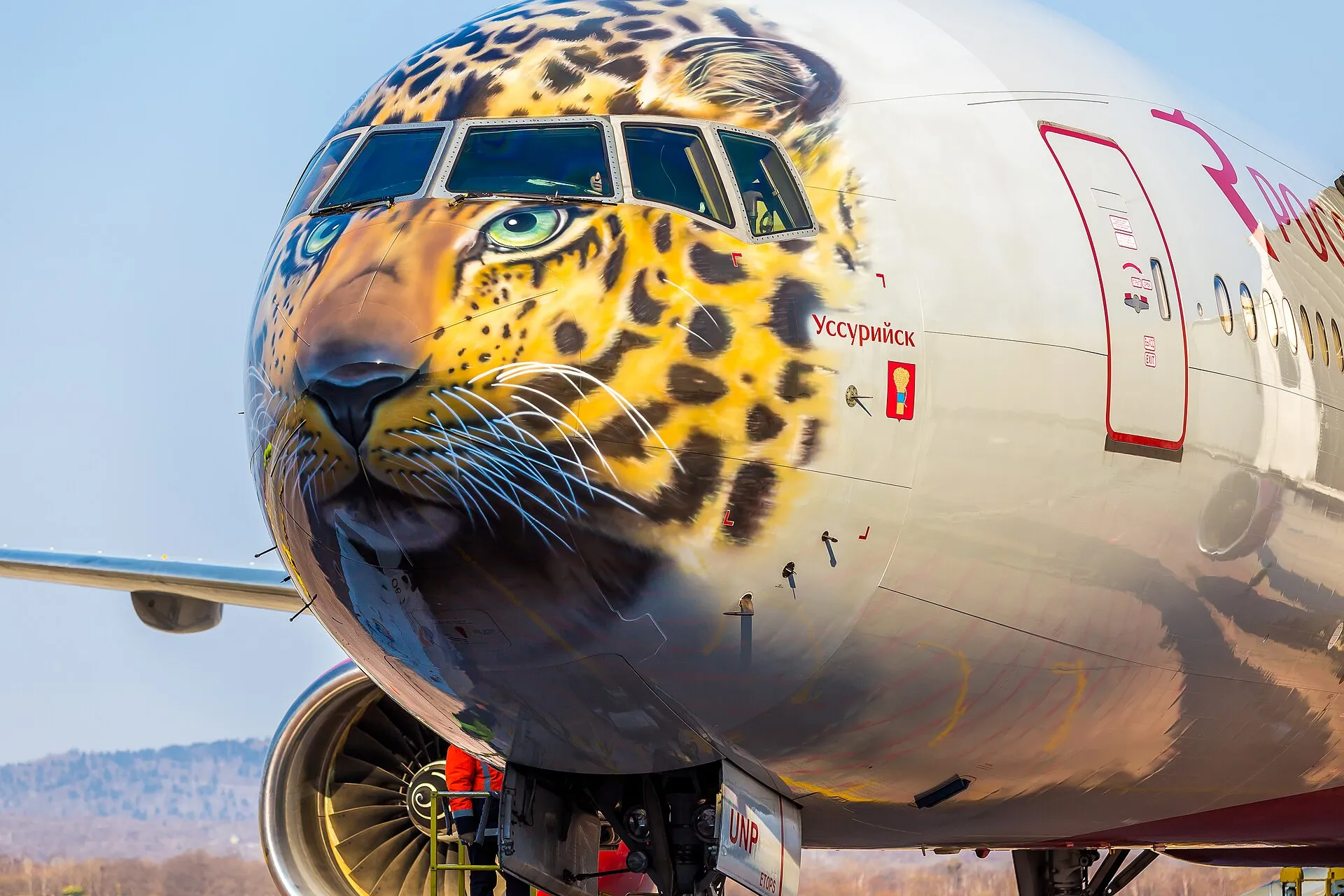
*Boeing 777 - photo from the open aviation archive.*
## Specifications Boeing 777
The figures in this table refer to one specific variant — **777-300ER**. This avoids combining the range, capacity and dimensions of different versions into an inaccurate set of figures.
- Variant shown in the table
- 777-300ER
- Type
- long-haul wide-body aircraft
- Family's first flight
- Year 1994
- Passenger capacity
- 396 seats in a typical two-class layout
- Flight range
- up to 13,650 km (7,370 nautical miles)
- Mach's Cruising Number
- M 0,84
- Length
- 73,86 m
- Wingspan
- 64,80 m
How the aircraft came about
## History Boeing 777
The first 777 flew in 1994. The project was the first Boeing aircraft fully developed in the digital environment; the family developed from the 777-200 to the 777-300ER and the new generation of the 777X.
The 777 was designed with the participation of major airlines for the interval between 767 and 747 and to replace the old three-engine aircraft. The program was launched in 1990; the first flight took place in 1994, and in 1995 the aircraft left on the line of United Airlines. The project was an important step in Boeing’s digital design.
Milestones and decisions
## Programme development
The 777 was created in close dialogue with airlines that wanted a large twin-engine aircraft for long-haul flights. In the design, a digital three-dimensional model was widely used, and the cabin received electric remote control. Later, the family expanded with options with increased range and capacity, as well as cargo 777F. The 777X program develops this idea, but undergoes separate tests.
Model features
## Design and variants
A large twin-engine glider combines range with a capacious two-pass cabin. The family is characterized by electric remote control and very powerful engines; a specific power plant depends on the generation. On long flights, the layout may include crew rest areas and several passenger classes.
The original 777-200 and -300 were supplemented by the long-range 777-200LR and 777-300ER, as well as the cargo 777F. The table shows the 777-300ER with GE90-115B engines. The new generation 777X has its own test program and should not be described by serial numbers 777-300ER.
Powerplant
## Engines
Two General Electric GE90-115B.
The engine variant fitted to an individual aircraft is recorded in its documentation. The powerplant affects thrust, fuel consumption, noise and maintenance requirements.
On board
## Cabin and passenger capacity
Two passes. In the economy class, schemes 3+3+3 and 3+4+3 are common, premium classes are located in front.
Passenger capacity is 396 seats in a typical two-class layout. The exact number of seats is determined by the operator: business class, kitchens, toilets and recreation areas of the crew take place. Therefore, the layout of the cabin differs even with the same models.
In practice
## Operations and uses
A large range reserve and a roomy cabin allowed the 777 to replace part of the four-engine and three-engine aircraft in intercontinental directions. On the 777-300ER, airlines often place several classes and crew rest areas. The number of seats, flow rate and achievable route change along with the layout, payload and specific version of the engine.
Technical analysis
## How it works Boeing 777
The 777 was conceived as a large twin-engine aircraft for routes on which the 767 was already lacking in capacity, and the 747 was redundant. Boeing has worked closely with airlines in shaping the requirements. In the design, three-dimensional digital models were used, which allowed to coordinate large nodes before the assembly of an experimental aircraft. The cabin received an electric remote control system, but instead of a side handle, Boeing kept the steering wheel familiar to pilots.
A large wide-body glider requires powerful engines. In different versions, the 777 used different families of power plants, and the 777-300ER is associated with GE90-115B engines. Fuel supply and mass determine the capabilities of long-haul flights. The extension of the fuselage adds space, but in itself does not increase the range: this requires changes in the wing, mass and fuel system. Therefore, the 777-200LR and 777-300ER respond to different requests of carriers.
The family has passenger 777-200 and -300, long-range LR/ER, cargo 777F and a new 777X program. The cargo plane uses volume for containers instead of passenger rows. The 777X received a different engine and folding wing tips, which means it is undergoing its own tests. Table data 777-300ER can not be extended to either the early 777-200, or not yet described by them 777X.
History and operations
## Role Boeing 777 in airline service
United Airlines was the first to introduce the 777 into scheduled services in 1995. Large capacity and range allowed carriers to use a twin-engine car where three- and four-engine aircraft used to fly. The change in the rules of operation of long-haul twin-engine flights helped expand the route network over the oceans. But even a very long-range 777 should have suitable spare airfields and appropriate operator clearance.
On the 777-300ER, the airline can accommodate several classes of service, a large kitchen and crew rest areas. These elements are especially important on long-haul flights, but reduce the number of passenger seats. Some carriers choose a dense layout, others rely on premium seats and cargo in the lower compartment. Therefore, the maximum capacity in the directory rarely coincides with the actual flight scheme.
The 777 has a long service in the passenger and cargo segments. To compare it with the A350 or 787 is not enough one number of range: the aircraft differ in size, engines, time of creation and costs on a particular line. The carrier’s decision depends on sustained demand and how much paid cargo can be taken along with passengers. The 777-300ER variant is most useful to compare with cars of close capacity, and not with the entire Boeing family at once.
For comparison
## Location Boeing 777 among other aircraft
Boeing models in this catalog were created for different stages of development of route networks. The 737 serves mass lines with one pass; the 747 ushered in an era of very large long-haul passenger aircraft. The 757 and 767 were designed in parallel as aircraft of different sizes with close crew cabins. The 777 showed just how much passenger load the long-haul twin-engine airliner can carry, and the 787 relied on new materials and routes with less flow. This story explains why a later index doesn’t necessarily mean more capacity. The airline can choose 787 instead of 777 precisely because it needs a smaller cabin for a direct flight. Conversely, the 777 is appropriate where sustained demand allows you to fill more seats and take commercial cargo.
The Boeing family name often covers decades of technical change. The early 737, the Next Generation and the 737 MAX require separate characteristics; similarly, the passenger 747-8 cannot be replaced with 747-400 data. The 767-300ER, 777-300ER and 787-9 suffixes denote specific variants, but not one common range calculation standard. When comparing, it is useful to take into account payload, number of engines, airport restrictions and available spare airfields. The layout of the cabin also depends on the carrier: two aircraft of the same type can have a different number of seats and different conditions for the passenger. Historical facts about the first flight or the beginning of production give context, but for today's flight, the age of a particular board, the improvements made and its maintenance are additionally important.
The 777 showed that a large, two-engined long-range aircraft could serve routes that were previously often associated with four-engined machines. Inside the family, there are versions with different fuselage lengths and fuel reserves: 777-200, 777-300ER and new programs with an index of 777X should not be mixed. In practice, the type is chosen not only for passenger seats. The large lower cargo deck adds to the commercial load, and the distance and weather conditions change the allowable combination of passengers, cargo and fuel.
Where it flies
## Airline operators
Examples of current or historically notable operators of the model and its variants:
- [Emirates](https://onlyplanes.ru/en/airlines/emirates)
- [Qatar Airways](https://onlyplanes.ru/en/airlines/qatar-airways)
- [Turkish Airlines](https://onlyplanes.ru/en/airlines/turkish-airlines)
- [Air France](https://onlyplanes.ru/en/airlines/air-france)
Fleets change. Check the aircraft type and seat map on the airline's official website before your flight.
Updates
## News Boeing 777 on Telegram
New deliveries, routes and events with the participation of Boeing 777 are published in the Telegram channel at legkoenebo.
[Open the Telegram channel](https://t.me/legkoenebo)
```json
{"@context":"https://schema.org","@type":"Article","headline":"Boeing 777: characteristics and history","description":"Boeing 777 (777-300ER): 396 seats; range up to 13,650 km (7,370 nautical miles). Characteristics, engines and interior.","mainEntityOfPage":"https://onlyplanes.ru/en/aircraft/boeing-777","publisher":{"@type":"Organization","name":"OnlyPlanes","url":"https://onlyplanes.ru/en"},"about":{"@type":"Thing","name":"Boeing 777"}}
```
```json
{"@context":"https://schema.org","@graph":[{"@id":"https://onlyplanes.ru/en#website","@type":"WebSite","description":"News, stories and rare images from the world of aviation","inLanguage":"en-GB","name":"OnlyPlanes","url":"https://onlyplanes.ru/en","publisher":{"@id":"https://onlyplanes.ru/en#identity"},"translationOfWork":{"@id":"https://onlyplanes.ru/en#website"}},{"@id":"https://onlyplanes.ru/en/aircraft/boeing-777#webpage","@type":"WebPage","description":"Boeing 777 (777-300ER): 396 seats; range up to 13,650 km (7,370 nautical miles). Characteristics, engines and interior.","name":"Boeing 777: specifications and range","url":"https://onlyplanes.ru/en/aircraft/boeing-777","isPartOf":{"@id":"https://onlyplanes.ru/en#website"},"potentialAction":[{"@type":"ReadAction","target":["https://onlyplanes.ru/aircraft/boeing-777"]}],"primaryImageOfPage":{"@id":"https://onlyplanes.ru/en#logo"}},{"@id":"https://onlyplanes.ru/en#identity","@type":"Organization","name":"OnlyPlanes","url":"https://onlyplanes.ru/en","logo":{"@id":"https://onlyplanes.ru/en#logo"},"sameAs":["https://t.me/legkoenebo"]},{"@id":"https://onlyplanes.ru/en#logo","@type":"ImageObject","caption":"OnlyPlanes","contentUrl":"https://onlyplanes.ru/search-logo.png","inLanguage":"en-GB","url":"https://onlyplanes.ru/search-logo.png"}]}
```
## Sitemap
See the full [sitemap](https://onlyplanes.ru/sitemap.md) for all pages.