
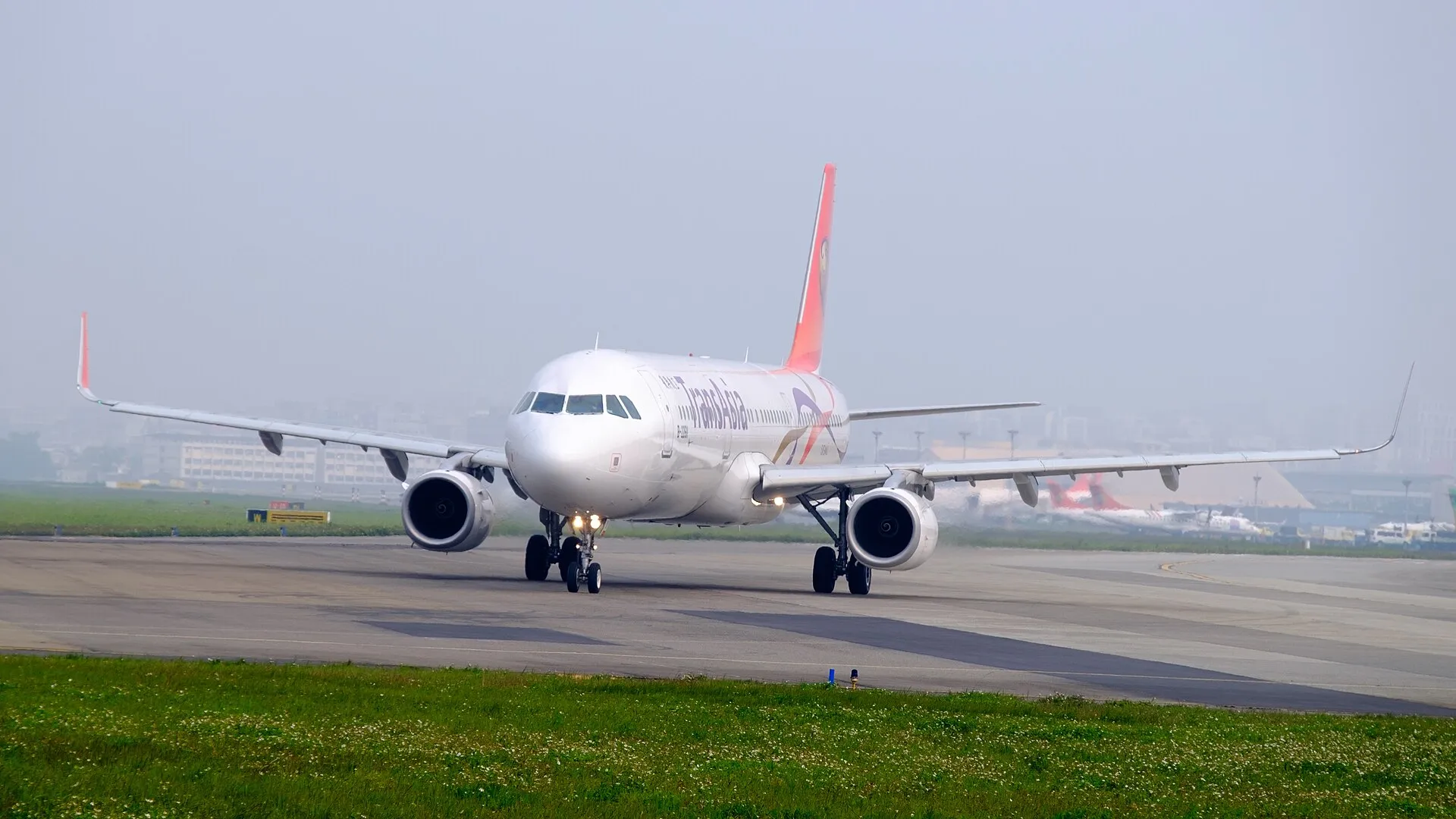
Specifications Airbus A321
The figures in this table refer to one specific variant — A321neo. This avoids combining the range, capacity and dimensions of different versions into an inaccurate set of figures.
- Variant shown in the table
- A321neo
- Type
- narrow-body passenger aircraft
- Family's first flight
- Year 1993
- Passenger capacity
- 180–220 seats in a typical two-class layout; maximum 244
- Flight range
- up to 7,400 km (4,000 nautical miles)
- Mach limit
- M 0,82
- Length
- 44,51 m
- Wingspan
- 35,80 m
How the aircraft came about
History Airbus A321
The first flight took place in 1993. Modern A321neo, A321LR and A321XLR expanded the scope of the family: the aircraft went on long-distance routes, including across the Atlantic.
The A321 was the first extended derivative of the A320. It was put into operation in 1994, retaining a common crew cabin and approach to management for the family. The lengthening of the fuselage allowed more passengers to be carried on loaded lines without moving to a two-pass liner.
Milestones and decisions
Programme development
The lengthening of the A320 required taking into account a large takeoff weight, a different capacity and the location of emergency exits. In the neo generation, Airbus went beyond the usual engine replacement: the LR and XLR variants received solutions for additional fuel and longer flights. So the family moved from dense European lines to routes that used to be more often served by small wide-body aircraft.
Model features
Design and variants
The additional length of the cabin changes the number of seats, the location of exits and the possibility of placing kitchens, but the main scheme remains narrow-body. On long-haul flights, airlines can use part of the space for a more spacious business class and service areas, reducing the number of seats relative to the maximum layout.
The A321ceo was followed by the A321neo, A321LR and A321XLR. They extend the range through a combination of new engines, aerodynamics and fuel system changes; these are different certified variants. LR or XLR values cannot be automatically attributed to any aircraft labeled A321.
Powerplant
Engines
Two CFM International LEAP-1A or Pratt & Whitney PW1100G-JM.
The engine variant fitted to an individual aircraft is recorded in its documentation. The powerplant affects thrust, fuel consumption, noise and maintenance requirements.
On board
Cabin and passenger capacity
One pass, usually six seats in a row. On long-haul versions there are a full business class, armchairs-beds and enlarged kitchens.
Passenger capacity - 180-220 seats in a typical two-class layout; a maximum of 244. The exact number of seats is determined by the operator: business class, kitchens, toilets and recreation areas of the crew take place. Therefore, the layout of the cabin differs even with the same models.
In practice
Operations and uses
The A321 is beneficial in busy directions, where you want to increase the number of seats without introducing a second pass. In long-range modifications, airlines place more spacious seats and additional service areas, which reduces the capacity compared to a dense layout. On a transatlantic flight, passenger experience and achievable range depend significantly on the LR or XLR version, the number of seats and the wind.
Technical analysis
How it works Airbus A321
The A321 extended the original A320 concept by almost seven meters. A longer cabin allowed the addition of rows of seats, but required to take into account the mass, placement of exits and the work of the wing on takeoff and landing. Airbus kept the familiar crew cabin and family-wide operating principles, making it easier for pilots to transition. As a result, the A321 was a stand-alone response to the growing demand for single-passenger, rather than just the A320 with extra seats.
Early A321s used CFM56 or IAE V2500 engines; neo received the LEAP-1A and PW1100G-JM families. The change of engines was accompanied by modifications of the wing and systems. For long-haul flights, Airbus introduced the A321LR, followed by the A321XLR with a different fuel supply organization. Their capabilities can not be attributed to the usual A321neo: additional fuel changes the calculation of mass and certification. The long route also requires a suitable crew cabin, resting places and passenger service.
The length of the fuselage affects the layout of the outputs. In different versions of the A321, the airline gets different options for placing doors and seats, so the maximum number of seats does not describe a typical flight. On dense routes, the carrier seeks to use almost the entire volume of the cabin. On transatlantic routes, part of the space can be occupied by wider chairs, kitchens and toilets. Two A321s of the same external shape can give passengers a very different flight experience.
History and operations
Role Airbus A321 in airline service
The first commercial use of the A321 was for routes where the A320 was already lacking in number of seats, but it was unprofitable to introduce a wide-body aircraft. In European and Asian networks, he helped to transport a large flow between major cities, maintaining the frequency of flights. As neo appeared, the economic role of the model increased: the capacity of the narrow-body aircraft began to be combined with a greater range than the earlier variants.
The A321LR and XLR have expanded the idea of where a single-passer aircraft can operate. They are suitable for some long routes with passenger traffic that would not fill a large two-pass liner. But the word “distant” here does not mean the same conditions for each flight: the headwind, the need to fly around the zone, the fuel reserve and luggage can limit the payload. The airline chooses the schedule and configuration based on the real network, rather than one maximum figure.
For the passenger, the most important thing is to know the exact version and salon. One carrier uses the A321 for a tight flight for several hours; the other places on a long-haul flight full-size bed-chairs and separate service areas. On the same route, the aircraft can compete with a small wide-body type, but the level of comfort is determined by the layout, not the number of passes. The A321 shows how the role of the narrow-body aircraft in the world route network has gradually changed.
For comparison
Location Airbus A321 among other aircraft
The Airbus line is useful to consider the task of the route, and not as a sequence of "better - worse". A319, A320 and A321 belong to the same single-pass family, but give different capacity and, in some versions, different range. The A330 and A350 are designed for double-passage and long international flights; the A380 solves the special problem of maximum flow between major airports. The carrier does not choose the largest aircraft at all, but the size that corresponds to the load and the desired frequency. If you send too large a car, empty seats can negate the benefits of its passport effectiveness. If it's too small, there won't be enough space or you'd have to limit your luggage. Therefore, one airline can simultaneously operate several types of Airbus on routes of different length and density.
The general school of cockpit and control systems is noticeable for many Airbus, but it does not make certificates, engines and gliders the same. Even the close A319 and A321 differ in mass, output and layout, and there are much more engineering differences between the A320 and A350. The words ceo, neo, LR, XLR, and ULR refer to specific generations or tasks. When reading the technical table, you should first find the full index of the modification, then check the range conditions: the number of passengers, cargo, cruising mode and fuel reserves. The declared maximum in capacity and the declared maximum in range often refer to different scenarios. This order allows you to compare aircraft on a real flight, rather than a combination of the two most attractive numbers from different advertising lines.
The A321 is important for route networks because it increased the capacity of the narrow-body family without switching to a wide-body aircraft. Later A321LR and A321XLR extended the range of individual versions, but this does not make any A321 long-haul. The carrier has to simultaneously take into account the number of seats, the volume of luggage compartments, the fuel supply and the permissible take-off weight. On a long line, the combination of these parameters can be decisive: an additional supply of fuel takes place and increases the mass, and on a short loaded line, the number of seats available and the speed of turn at the airport are more important.
Where it flies
Airline operators
Examples of current or historically notable operators of the model and its variants:
- Turkish Airlines
- Lufthansa
- Wizz Air
- JetBlue
- Aeroflot
Fleets change. Check the aircraft type and seat map on the airline's official website before your flight.
Updates
News Airbus A321 on Telegram
New deliveries, routes and events with the participation of Airbus A321 are published in the Telegram channel at legkoenebo.
Open the Telegram channel