
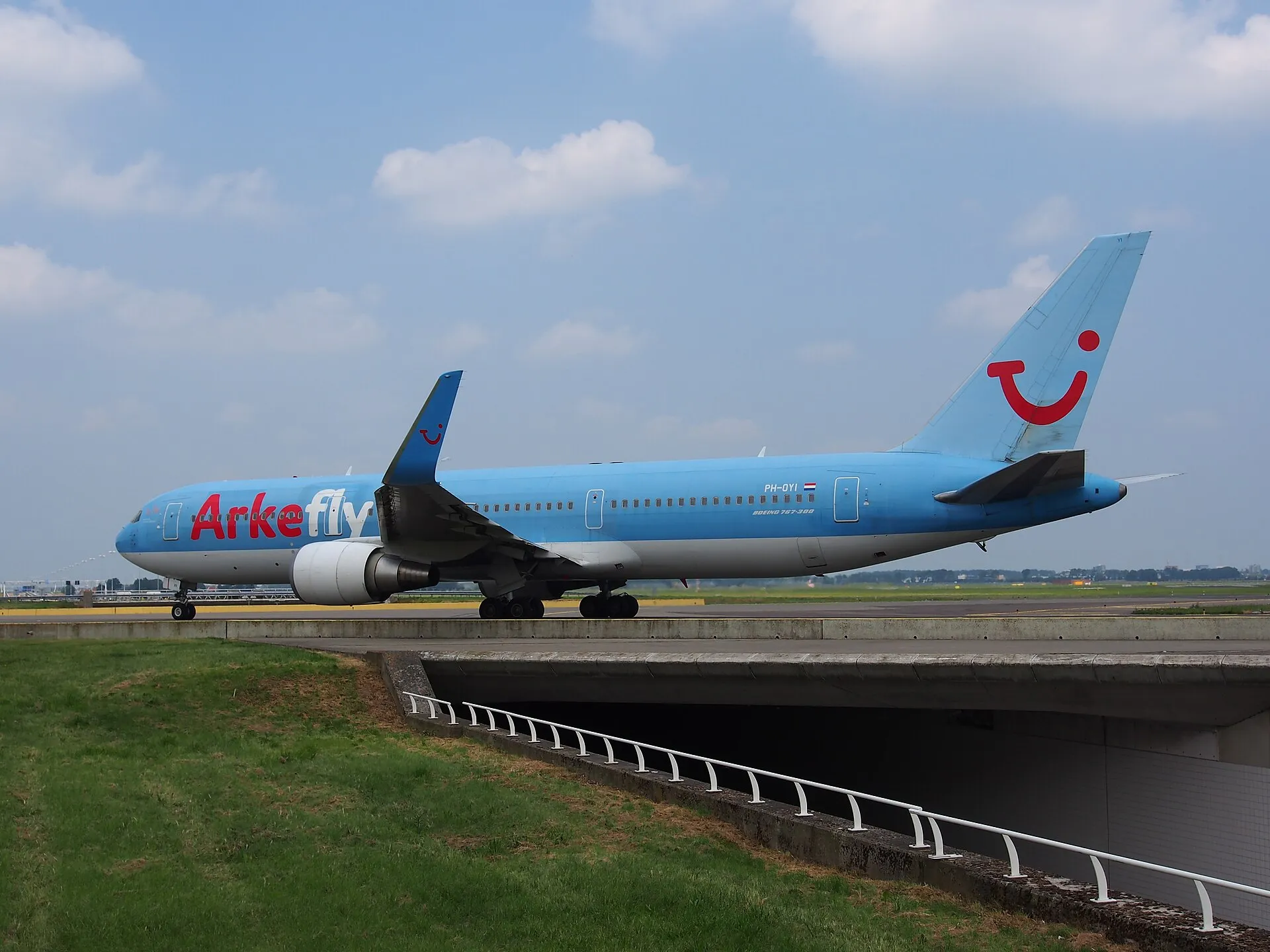
Specifications Boeing 767
The figures in this table refer to one specific variant — 767-300ER. This avoids combining the range, capacity and dimensions of different versions into an inaccurate set of figures.
- Variant shown in the table
- 767-300ER
- Type
- wide-body aircraft
- Family's first flight
- Year 1981
- Passenger capacity
- 218 seats in a typical three-class layout; maximum 350
- Flight range
- up to 11,070 km (5,980 nautical miles)
- Mach's Cruising Number
- M 0,80
- Length
- 54,94 m
- Wingspan
- 47,57 m
How the aircraft came about
History Boeing 767
The first flight took place in 1981. Boeing designed the 767 in parallel with the 757 and unified the cockpits, making it easier to train pilots for both types.
The 767 was Boeing's first twin-engine wide-body aircraft. The project was in parallel with the 757: the unification of the cabin helped train and distribute crews. After the start of operation in 1982, the family gradually received longer and longer versions, and later - cargo and special options.
Milestones and decisions
Programme development
The 767 appeared as a twin-engine wide-body aircraft smaller than the 747. The joint development of the cockpit with the 757 made it easier for pilots to transition between the two types. Later, the rules for long-range flights of twin-engine aircraft expanded its application over the ocean. The family then received extended versions, factory cargo 767-300F and special-purpose platforms, including refueling aircraft.
Model features
Design and variants
Wide, but relatively compact by the standards of long-range liners, the fuselage allows two passes and a common scheme 2+3+2. The development of the rules for long-range flights of twin-engine aircraft expanded the geography of application of the 767, especially on transatlantic lines. The specific tolerance depends on the aircraft, carrier and route.
Passenger 767-200, 767-300 and 767-400ER differ in length; the suffix ER denotes increased range. There is a factory cargo 767-300F and many converted sides. Characteristics on the page refer to the passenger 767-300ER.
Powerplant
Engines
Two General Electric CF6, Pratt & Whitney PW4000 or Rolls-Royce RB211.
The engine variant fitted to an individual aircraft is recorded in its documentation. The powerplant affects thrust, fuel consumption, noise and maintenance requirements.
On board
Cabin and passenger capacity
Two aisles; a typical 2+3+2 economic scheme means that most passengers are at the window or aisle.
Passenger capacity - 218 seats in a typical three-class layout; a maximum of 350. The exact number of seats is determined by the operator: business class, kitchens, toilets and recreation areas of the crew take place. Therefore, the layout of the cabin differs even with the same models.
In practice
Operations and uses
Passenger 767 has long been used on transatlantic and domestic routes with moderate demand. The two-pass scheme allows seven seats to be placed in a row in a common economic layout. As passenger fleets have been updated, the value of the cargo 767 has grown; the cargo plane or tanker cannot be described by the number of passenger seats and the layout of the 767-300ER cabin.
Technical analysis
How it works Boeing 767
The 767 was a new type of twin-engine wide-body aircraft for Boeing. It was developed together with the 757 while retaining close cockpits, although the dimensions and number of aisles in the passenger compartment vary. Two engines instead of four reduced the complexity of the power plant, but for a long flight over the ocean required proven reliability and special operating rules. The development of these tolerances has broadened the range of destinations available for the 767.
The cross section of the 767 is relatively compact for a wide-body aircraft. In the common economic scheme in the row of seven seats according to the formula 2+3+2. This geometry allows you to use two passages, without increasing the size of the cabin to the level of the largest liners. The 767-200, -300, and -400ER variants are longer; the ER versions have a longer range. The number of seats and cargo in the lower compartment together determine the mass of the flight.
In addition to the passenger 767-300ER, the family includes a factory cargo 767-300F, converted trucks and special platforms. On the basis of 767 created American tanker aircraft KC-46. The relationship of the airframe is useful for understanding the origin of the project, but the features of the military refueling system or cargo door can not be transferred to the description of the passenger compartment.
History and operations
Role Boeing 767 in airline service
United Airlines began passenger service with the 767 in 1982. At first, the aircraft operated on busy domestic routes, and later became an important tool for flights across the Atlantic. Its size made it possible to maintain direct communication between cities where the 747 would be too large. The specific ability to fly over the ocean depends on the admission of the aircraft, crew training, route and reserve airfields.
The two-pass cabin helps passengers to move on a long flight, but the quality of seats and service is determined by the airline. Two 767-300ER can have different business classes, kitchens, crew rest areas and a total number of seats. When planning a flight, the carrier takes into account the commercial cargo at the bottom of the fuselage: it brings income, but takes away part of the permissible mass from fuel or passengers.
With the age of the passenger 767 has increased the role of freight options. Factory 767-300F and alterations of former passenger aircraft are used for regular delivery of goods. It’s not just a plane without seats: the floor, doors, cargo handling systems and operating procedures are changing. The ongoing cargo life of the family shows that the utility of the airframe can persist after the model disappears from the passenger schedule of an individual airline.
For comparison
Location Boeing 767 among other aircraft
Boeing models in this catalog were created for different stages of development of route networks. The 737 serves mass lines with one pass; the 747 ushered in an era of very large long-haul passenger aircraft. The 757 and 767 were designed in parallel as aircraft of different sizes with close crew cabins. The 777 showed just how much passenger load the long-haul twin-engine airliner can carry, and the 787 relied on new materials and routes with less flow. This story explains why a later index doesn’t necessarily mean more capacity. The airline can choose 787 instead of 777 precisely because it needs a smaller cabin for a direct flight. Conversely, the 777 is appropriate where sustained demand allows you to fill more seats and take commercial cargo.
The Boeing family name often covers decades of technical change. The early 737, the Next Generation and the 737 MAX require separate characteristics; similarly, the passenger 747-8 cannot be replaced with 747-400 data. The 767-300ER, 777-300ER and 787-9 suffixes denote specific variants, but not one common range calculation standard. When comparing, it is useful to take into account payload, number of engines, airport restrictions and available spare airfields. The layout of the cabin also depends on the carrier: two aircraft of the same type can have a different number of seats and different conditions for the passenger. Historical facts about the first flight or the beginning of production give context, but for today's flight, the age of a particular board, the improvements made and its maintenance are additionally important.
The 767 was created in parallel with the 757, but received a wide fuselage and two aisles. In the future, the family was applicable to passenger long-haul flights, and in freight traffic, where the volume and door of loading of the corresponding version are important. Common 767-300ER, cargo 767-300F and later special derivatives are not the same cabins with different stickers. When evaluating a passenger flight, it is necessary to clarify the modification and layout of the seats, and when evaluating a truck, the payload, volume and airport conditions.
The passenger and cargo life cycles of the 767 also go in different ways: the converted aircraft retains the age of the original glider, but receives a new task and a different loading schedule. For the passenger page, the engine, version and interior of a particular operator are essential.
Where it flies
Airline operators
Examples of current or historically notable operators of the model and its variants:
- Delta Air Lines
- United Airlines
- FedEx
- UPS Airlines
Fleets change. Check the aircraft type and seat map on the airline's official website before your flight.
Updates
News Boeing 767 on Telegram
New deliveries, routes and events with the participation of Boeing 767 are published in the Telegram channel at legkoenebo.
Open the Telegram channel