
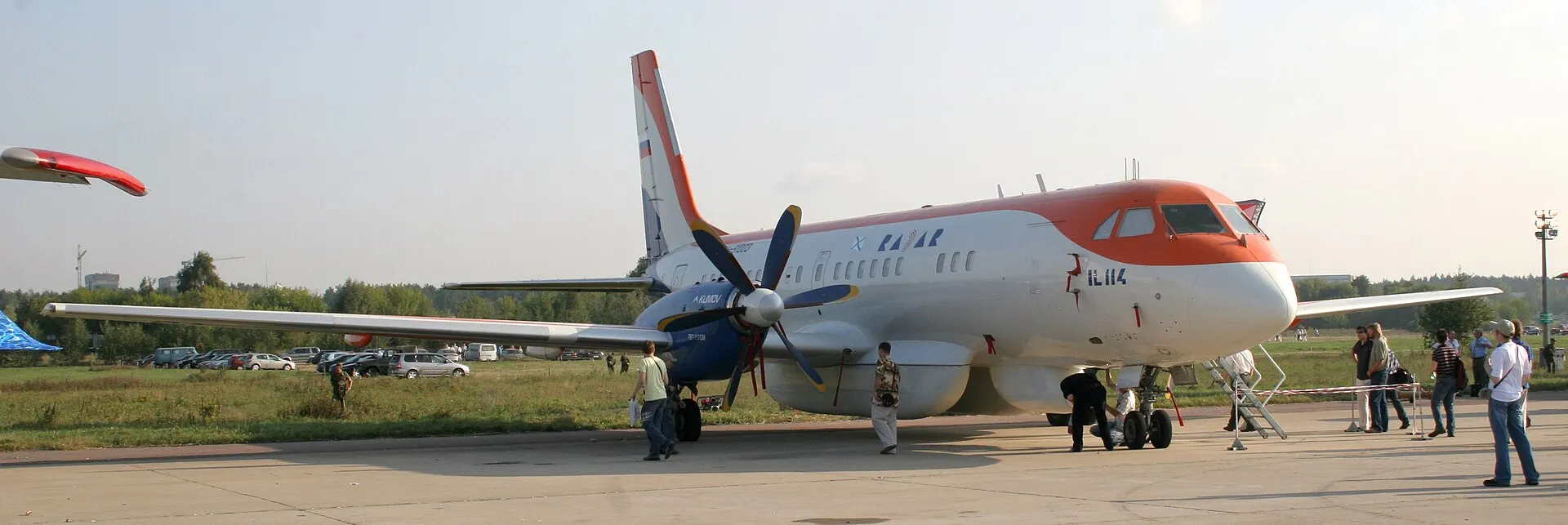
Specifications Il-114
The figures in this table refer to one specific variant — Il-114-300. This avoids combining the range, capacity and dimensions of different versions into an inaccurate set of figures.
- Variant shown in the table
- Il-114-300
- Type
- regional turboprop aircraft
- Family's first flight
- 1990; Il-114-300 - 2020
- Passenger capacity
- 64 seats in the standard layout; maximum 68
- Flight range
- 1,400 km with the maximum passenger load
- Cruising Speed
- 450 km/h
- Length
- 26,90 m
- Wingspan
- 29,87 m
How the aircraft came about
History Il-114
The Il-114 first flew in 1990. The upgraded Il-114-300 received new Russian engines, avionics and updated systems.
Il-114 was created for regional routes and the replacement of part of the An-24. The first flight took place in 1990. After the collapse of the USSR, a limited series was produced in Tashkent; later the program was resumed in Russia as Il-114-300 with updated systems and engines. The new version goes through its own test cycle.
Milestones and decisions
Programme development
Il-114 was designed at the end of the USSR for local lines. After the first flight, production was planned in Tashkent, but the collapse of the general industrial space limited the series. Passenger operation began in the late 1990s. With the resumption of the program as Il-114-300 changed engines, avionics and release organization, so the updated aircraft undergoes separate tests.
Model features
Design and variants
It is a twin-engine turboprop aircraft with a low wing and one aisle. The turboprop scheme is suitable for regional distances, where fuel consumption and work on the airfields of the local network are important. The Il-114-300 has engines of the TV7-117ST family and updated on-board equipment.
The original Il-114, modified powerplant modifications and the new Il-114-300 belong to the same line, but differ in equipment and stage of readiness. The experience of limited operation of previous machines does not mean that the updated version already performs regular flights. The indicators on the page are tied to the marked option.
Powerplant
Engines
Two Russian turboprop engines TV7-117ST-01.
The engine variant fitted to an individual aircraft is recorded in its documentation. The powerplant affects thrust, fuel consumption, noise and maintenance requirements.
On board
Cabin and passenger capacity
One pass, usually four seats in a row according to the scheme 2 + 2. The compact cabin is designed for regional flights.
Passenger capacity - 64 seats in the basic layout; maximum 68. The exact number of seats is determined by the operator: business class, kitchens, toilets and recreation areas of the crew take place. Therefore, the layout of the cabin differs even with the same models.
In practice
Operations and uses
The Il-114 turboprop is designed for regional flights, where a larger jetliner may be redundant. The initial aircraft were operated by Uzbekistan Airways; the experience of this fleet shows the capabilities of the basic version, but does not automatically confirm the readiness of the new one. For Il-114-300, indicators at specific local airfields, technical support and engine tolerance are especially important.
Technical analysis
How it works Il-114
The Il-114 was developed as a regional turboprop aircraft for local lines and to replace part of the An-24. The program was launched at the end of the Soviet period, the first flight took place in 1990. Production was supposed to take place in Tashkent, but the collapse of the USSR changed the organization of supplies and the market. As a result, the initial series turned out to be much smaller than the earlier plans. The history of the type shows that technical readiness and the possibility of mass production depend on different conditions.
The aircraft has two turboprop engines, a low wing and a sealed passenger compartment. Turboprop power plant is especially useful at regional distances: the speed is lower than reactive, but the flow rate and operational task are different. For a particular airfield, the length and condition of the runway, the temperature and weight of the aircraft are still checked; the word "regional" itself does not mean admission to any site.
The updated Il-114-300 received a new composition of equipment and engines of the TV7-117ST family. These changes require tests of the power plant, avionics and their joint work in different modes. The data of the old Il-114 cannot be automatically used for the new version. The same caution should be applied to early delivery dates: a regular flight is possible after certification of the final configuration and preparation of service.
History and operations
Role Il-114 in airline service
The original Il-114 was operated by Uzbekistan Airways, which gave real experience of transportation on regional routes. With a small park, the availability of spare parts and specialists familiar with the type are especially important. If there is no backup board, one technical fault can affect a large number of flights. Therefore, for the future of the Il-114-300, not only the readiness of an individual aircraft is significant, but also the system for maintaining the entire series.
Regional lines often connect cities with limited passenger traffic. The aircraft of lower capacity allows you to fly more often, without waiting for the filling of a large main liner. For the passenger, the value of such a network is in direct communication and a regular schedule. The range in the directory sets only the technical boundary under certain conditions; on the real route it depends on the load and the necessary fuel reserve.
Il-114-300 is considered for the restoration or development of a regional network, but its application will depend on the readiness of specific airports, crew training and sustainability of service. The new version should confirm its characteristics with tests, even if the common name and design scheme are familiar from previous aircraft. Comparison with the old An-24 or new foreign turboprop types makes sense only with the same route and passenger task.
The turboprop aircraft is particularly sensitive to the structure of the regional network. If the flight is short, part of the time is spent on takeoff, climb and descent; the advantage of a faster jet type may be less than it seems at cruising speed. But over a long line, the time difference increases. Therefore, the Il-114 should be evaluated for specific distances and airfields, and not compare its speed with the main aircraft without taking into account the entire schedule.
The revival of the program requires not only a new board, but also spare engines, training engineers and a service network. The regional carrier often has a small fleet, so a simple single car has a noticeable effect on the performance of flights. Tests Il-114-300 should confirm the operation of the updated systems in the conditions for which it is intended. Only then can one judge the practical regularity and economics of the new version.
For comparison
Location Il-114 among other aircraft
Russian models in the catalog belong to several independent tasks and generations. Tu-204, Tu-214 and Il-96 were created at the end of the Soviet period and later used in passenger and special aviation. Regional Il-114 chose a turboprop scheme. The Superjet 100 became a later jet program for relatively short routes, and the SJ-100 continues it with a changed system composition and engine. MC-21 belongs to the class of new medium-haul airliners. These programs can not be combined into one line of characteristics: they differ in the size of the cabin, role, engines and degree of readiness. Yak-130 generally refers to the military training of pilots and requires a separate approach to comparison.
In the history of each program, you need to distinguish between the first flight, certificate, the beginning of serial production and a real passenger flight. These events can be separated by years. For the updated version of the test of the original aircraft does not automatically prove the readiness of new engines and systems. This approach is especially important when reading information about the MC-21, SJ-100 and Il-114-300: the timing of deliveries was repeatedly announced in advance, and the technical stages must be evaluated according to the inspections actually performed. For older types, the exact modification and purpose of the board is more important - the passenger Tu-214 or Il-96 differs from a special aircraft on a close platform. Even when size fits the route, an airline needs sustainable service and spare parts availability.
Where it flies
Airline operators
Examples of current or historically notable operators of the model and its variants:
- Il-114-300 undergoes testing and preparation for operation
Fleets change. Check the aircraft type and seat map on the airline's official website before your flight.
Updates
News Il-114 on Telegram
New deliveries, routes and events with the participation of Il-114 are published in the Telegram channel at legkoenebo.
Open the Telegram channel