
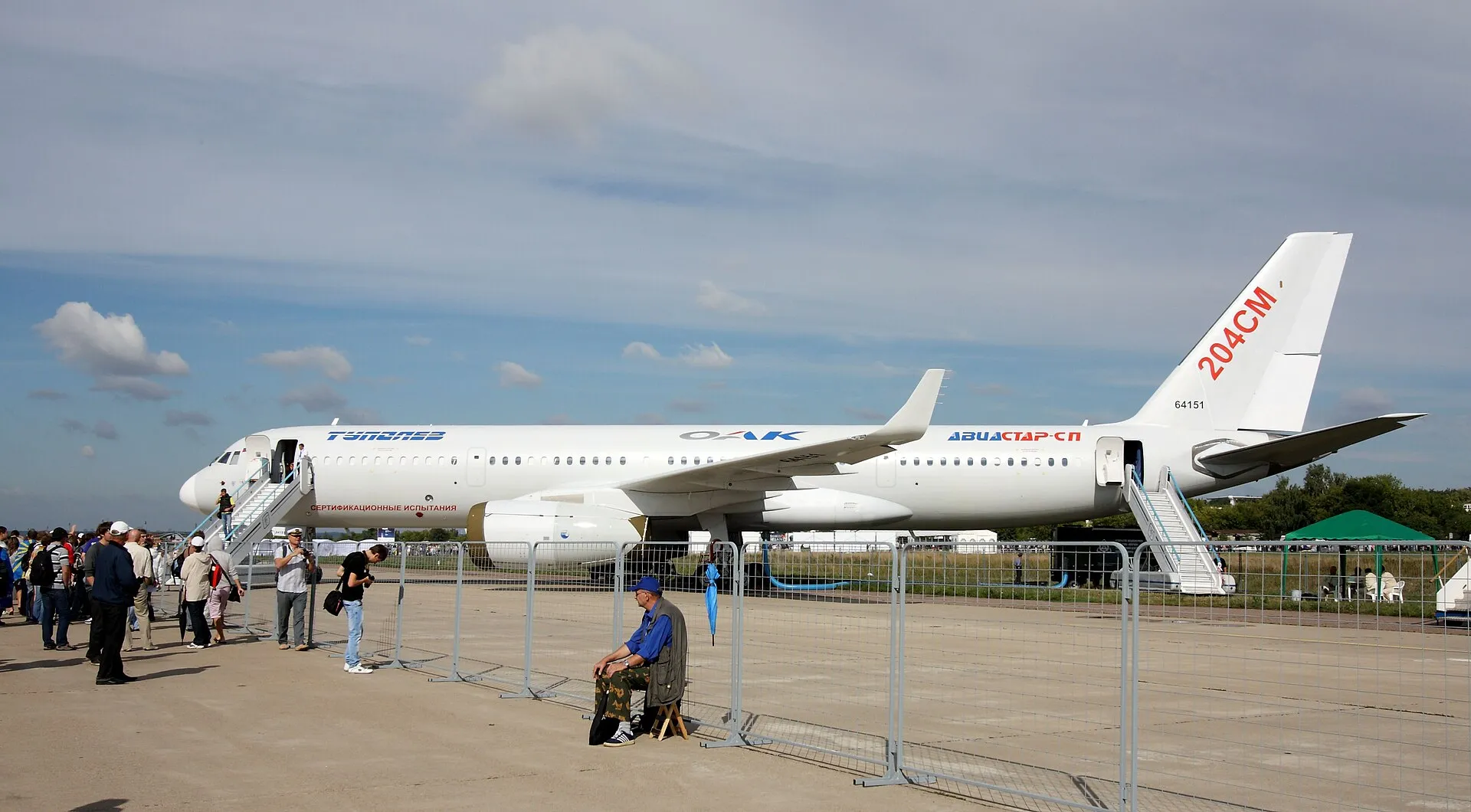
Specifications Tu-204
The figures in this table refer to one specific variant — Tu-204-100. This avoids combining the range, capacity and dimensions of different versions into an inaccurate set of figures.
- Variant shown in the table
- Tu-204-100
- Type
- medium-haul narrow-body aircraft
- Family's first flight
- Year 1989
- Passenger capacity
- up to 210 passengers
- Flight range
- up to 4,300 km with commercial payload
- Cruising Speed
- 850 km/h
- Length
- 46,14 m
- Wingspan
- 41,80 m
How the aircraft came about
History Tu-204
The Tu-204 first flew in 1989. The aircraft used modern digital avionics, electric remote control and a two-member crew in later versions.
Tu-204 began to be designed in the USSR as a replacement for the Tu-154 on trunk lines. The first flight took place in 1989; operation began in the mid-1990s. The program experienced a change in economic conditions after the collapse of the USSR, so the pace of release and the circle of customers differed from the original plans.
Milestones and decisions
Programme development
The Tu-204 family was developed on the transition from the Soviet planned aviation system to new market conditions. After the certification of the basic version, cars with Russian PS-90A and an export branch with Rolls-Royce RB211 appeared. For longer routes, a shortened Tu-204-300 was created, and cargo versions received doors and equipment for a different payload. These options cannot be reduced to a single passenger specification.
Model features
Design and variants
The aircraft has one pass, two engines under the wing and a digital flight control system. For the main line, the PS-90A was used, and some of the variants received other engines, including the Rolls-Royce RB211. The common platform served as the basis for both passenger and cargo aircraft.
The family includes the basic Tu-204, variants Tu-204-100 and Tu-204-120 with different engines, shortened long-range Tu-204-300 and cargo versions; Kazan Tu-214 is described on a separate page. They differ in length, weight, fuel supply and equipment. The range of one index cannot be transferred to the others.
Powerplant
Engines
Two Russian PS-90A turbofan engines.
The engine variant fitted to an individual aircraft is recorded in its documentation. The powerplant affects thrust, fuel consumption, noise and maintenance requirements.
On board
Cabin and passenger capacity
One pass, usually a 3+3 scheme. The passenger configuration can include economic and business class.
Passenger capacity is up to 210 passengers. The exact number of seats is determined by the operator: business class, kitchens, toilets and recreation areas of the crew take place. Therefore, the layout of the cabin differs even with the same models.
In practice
Operations and uses
Passenger Tu-204 worked with Russian and some foreign carriers; cargo used for regular and special shipments. The short Tu-204-300 could fly further than the base aircraft with fewer seats, showing a link between fuselage length and range. Features of the crew cabin also changed: the late Tu-204SM project provided for a different composition of equipment and the work of two pilots.
Technical analysis
How it works Tu-204
The Tu-204 was designed in the USSR as a replacement for the widely used Tu-154. Switching from three engines to two, the new wing and control systems were part of an attempt to reduce fuel consumption and upgrade the fleet. The first experimental aircraft flew in 1989, and the certification and development of the issue came at a time of profound changes in the industry. Economic conditions after the collapse of the USSR significantly influenced the scale of the series.
The basic Tu-204-100 used Russian PS-90A engines and equipment. For the export branch Tu-204-120 used Rolls-Royce RB211 and other avionics. Thus, the overall geometry of the aircraft does not guarantee the same maintenance procedures. The shortened Tu-204-300 received fewer passenger seats, but could perform longer flights in the appropriate configuration. This is an example of how length reduction sometimes changes route capabilities in favor of range.
Cargo versions of the family received equipment and doors for transporting goods instead of passengers. Kazan Tu-214 is close in origin, but separated into a separate production and operational branch. The late Tu-204SM project provided for the upgrade of the cabin and systems based on a different crew composition. A complete index is required to accurately describe a particular aircraft, as the range of options covers different engines, masses, and tasks.
History and operations
Role Tu-204 in airline service
Passenger Tu-204 worked on Russian lines and with some foreign operators. They were used for routes that required an aircraft of approximately medium class capacity. However, real transportation depended on the availability of engines, technical support and the economy of a particular airline. The long-term existence of the project was not accompanied by the same scale of production as that of the main Western competitors.
The cargo application gave the line a different role. The carrier of goods is important the size of the doors, the volume of the deck, the permissible mass and regularity of service, and not the number of passenger seats. The transition from the passenger version to the cargo version cannot be described by a single rearrangement of the interior: equipment and load distribution are changing. Historic variants with different engines also require their own spare parts and personnel.
When comparing Tu-204-100 with Tu-204-300, it is easy to make a mistake if you look only at the numerical suffix. The second plane is shorter, not longer, and its long-range version is designed for a different combination of passenger numbers and fuel. Tu-214, in turn, has its own production history in Kazan. The full nomenclature of the family helps to understand the evolution of the program, but the characteristics of each modification should be checked separately.
The export Tu-204-120 shows that variants of the same airframe can have different supply chains. The Rolls-Royce RB211 engine required different technical services than the PS-90A on the Tu-204-100. For the operator, this affected spare parts, service agreements, and training. The difference is also important for historical comparisons: data on the consumption or limitations of one power plant do not apply to another just because the name of the airframe coincides.
Tu-204 cargo variants also occupy their own niche. They are important in the size of the opening, the permissible mass on the deck and the method of fastening the items. Even if the range is close to a passenger aircraft, its calculation will depend on the weight of the cargo instead of the number of seats occupied. Such an example helps to read the family as a set of specific engineering solutions, rather than as one universal model.
For comparison
Location Tu-204 among other aircraft
Russian models in the catalog belong to several independent tasks and generations. Tu-204, Tu-214 and Il-96 were created at the end of the Soviet period and later used in passenger and special aviation. Regional Il-114 chose a turboprop scheme. The Superjet 100 became a later jet program for relatively short routes, and the SJ-100 continues it with a changed system composition and engine. MC-21 belongs to the class of new medium-haul airliners. These programs can not be combined into one line of characteristics: they differ in the size of the cabin, role, engines and degree of readiness. Yak-130 generally refers to the military training of pilots and requires a separate approach to comparison.
In the history of each program, you need to distinguish between the first flight, certificate, the beginning of serial production and a real passenger flight. These events can be separated by years. For the updated version of the test of the original aircraft does not automatically prove the readiness of new engines and systems. This approach is especially important when reading information about the MC-21, SJ-100 and Il-114-300: the timing of deliveries was repeatedly announced in advance, and the technical stages must be evaluated according to the inspections actually performed. For older types, the exact modification and purpose of the board is more important - the passenger Tu-214 or Il-96 differs from a special aircraft on a close platform. Even when size fits the route, an airline needs sustainable service and spare parts availability.
Where it flies
Airline operators
Examples of current or historically notable operators of the model and its variants:
- Red Wings - historically
- cargo and special operators
Fleets change. Check the aircraft type and seat map on the airline's official website before your flight.
Updates
News Tu-204 on Telegram
New deliveries, routes and events with the participation of Tu-204 are published in the Telegram channel at legkoenebo.
Open the Telegram channel