
Helicopters
Leonardo AW139 in business aviation: platform capabilities and cabin design
AW139 for corporate travel: cabin dimensions, five to eight seats in selected business layouts, baggage and route requirements.
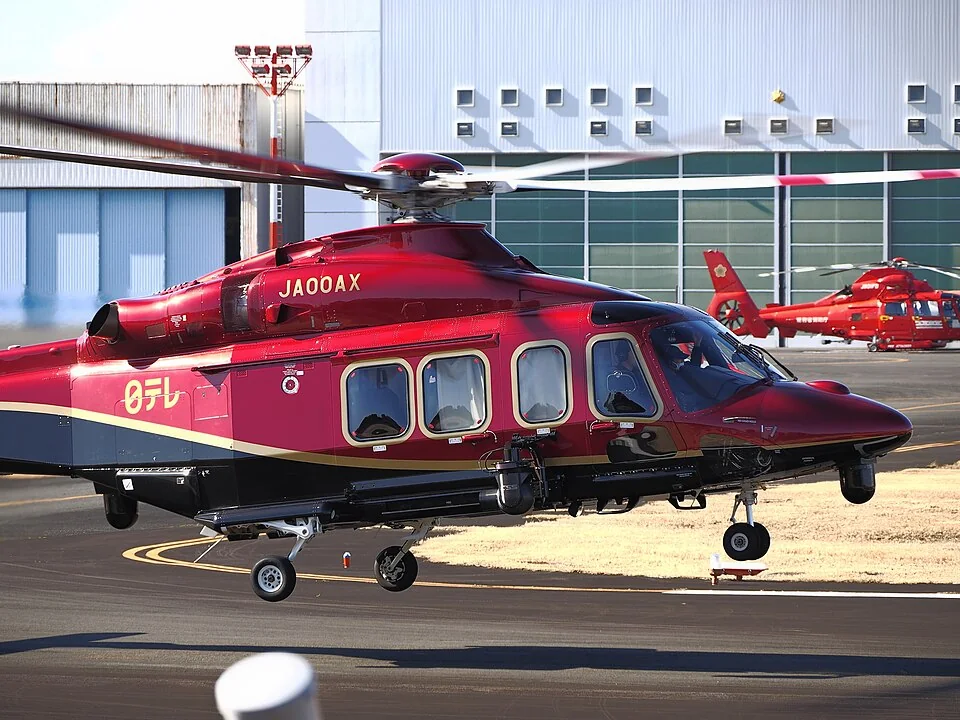
The AW139 is found in a variety of missions: passenger transport, work at sea, medical and special flights. The corporate version uses the same basic idea of a roomy twin-engine helicopter, but manages the space inside differently. Instead of the maximum number of passengers, comfortable accommodation for a small group, luggage and conditions for a long trip come to the fore. It is the selected configuration that determines how the AW139 will be seen by the passenger after boarding the cabin.
In descriptions of business aviation, it is easy to conflate the characteristics of a platform with the capabilities of a particular interior. The fifteen passenger seats of the transport version, the wide sofa of the corporate aircraft and the long range from the specification sheet may refer to different initial conditions. To get a clear picture, it is useful to look at the AW139 in parts: dimensions, interior, powerplant, equipment, route and maintenance. This approach allows us to evaluate the model without superlatives and promises of universality.
Place of the AW139 in the Leonardo line-up
The Leonardo family of helicopters, along with the AW139, includes the more compact AW169 and the larger AW189. This helps explain the model's position: it offers an intermediate combination of cabin size and carrying capabilities. Family technical materials for the AW139 indicate two Pratt & Whitney Canada PT6C-67C turboshaft engines. At the same time, existing weight options and configurations must be distinguished when talking about a specific aircraft.
The presence of two engines has engineering and operational significance, but does not describe the entire flight support system. Transmission, controls, equipment, technical condition and crew training are also important. The passenger does not need to calculate these parameters independently; It is useful to understand why the choice of helicopter for a route is made based on a combination of conditions. The same type is capable of performing different tasks thanks to the equipment and operating organization, and not just the installed power plant.
What eight cubic metres of cabin space offer
For the main cabin of the AW139, Leonardo gives a volume of about eight cubic metres. The family's materials list the dimensions as approximately 2.70 metres long, 2.10 metres wide and 1.42 metres high. These numbers help represent space more accurately than the word “spacious.” For example, the height of the cabin does not imply that an adult will be able to walk freely at full height, as in a large passenger aircraft.
At the same time, the width allows for different placement of seats and organization of passenger interaction. The available space can be used for additional seating, looser seating or furnishings. When comparing photographs, it is worth considering the lens and angle: a wide angle can noticeably change the sense of size. A practical idea is given by the interior layout, the distance between the seats and the ability to place familiar things. These features are aircraft specific and may vary within the family.
Corporate layout differs from transport layout
In a separate Executive and Private Transport brochure, the manufacturer shows corporate variants with five to eight passenger seats. Transport materials for the AW139 indicate a capacity of up to fifteen passengers. There is no contradiction here: we are talking about different configurations. Reducing the number of seats allows for a different use of space, but this does not automatically mean an increase in all other operational capabilities. The weight of the selected interior is also included in the characteristics of the equipped aircraft.
For a business trip, it is useful to determine in advance how the group spends its time during the flight. Some passengers value the opportunity to discuss issues face to face, while others want to look outside or relax quietly. Chairs placed in an attractive composition in a photograph can suit these scenarios in different ways. Therefore, the choice of interior starts with people's habits and the usual duration of trips. The helicopter cabin remains a workspace with limited dimensions, even if the finishing is customized.
Passenger boarding and luggage
Cabin access is part of comfort that photographs of the interior can easily overlook. Step height, handrail positions, aisle width and the order in which passengers board all matter. The AW139 corporate brochure describes an automatically extending step, but its availability must be confirmed for the particular aircraft. Equipment differences become especially noticeable when passengers travel with children or large bags, or need boarding assistance.
For luggage, the manufacturer indicates a separate volume of approximately 3.4 cubic metres. Space is available on both sides of the helicopter, which is convenient for ground loading. But the volume of the compartment and the permissible weight of things remain different parameters. Large, lightweight bags and compact, heavy items pose different challenges. It is important to confirm actual baggage before travel, as baggage stowage is related to the overall weight, balance, fuel capacity and limitations of the particular aircraft.
Range makes sense only together with route
A corporate helicopter is often used as a link between an airport and a destination. In this case, the value is determined by the entire trip: waiting time, site availability and ground transportation after landing. Even a large rated range may be of little use if the usual routes are short. On the other hand, a long section over water places additional demands on planning and equipment. Both tasks cannot be compared only in terms of kilometres.
Published range figures are calculated under certain conditions. The number of passengers, the weight of baggage, the wind and the required reserves affect the practical ability to operate the flight. Therefore, the route between cities needs to be discussed with the operator in relation to the date and load. The radius on the map helps to understand the general class of equipment, but does not replace calculations. For regular travel, it's useful to evaluate the most common scenarios, including seasonal changes, rather than just one record-breaking route.
Landing sites and aircraft dimensions
AW139 family documentation gives an overall length, with the rotors turning, of about 16.66 metres. The space a helicopter occupies is therefore quite different from the size of its passenger cabin. A landing site is not suitable merely because the fuselage fits. Published limitations, surrounding obstacles, allowable surface loads and approach conditions must also be considered. Rooftop and shipboard helipads have their own specifications and operating rules.
Therefore, the promise to deliver passengers directly to the desired location must be accompanied by confirmation of the ability to use a specific pick-up location. For one route, a suitable site already exists; for another, a nearby airfield and ground transfer will be needed. This check helps to determine in advance the real time savings. The helicopter itself provides vertical takeoff and landing, but the transport result consists of equipment, available infrastructure and permitted organization of flights along the entire route.
Silence and interior equipment
The experience of a corporate helicopter depends on noise, vibration, temperature, visibility and occupancy. Finishing materials and interior systems help create the desired environment, but acoustic comfort cannot be assessed by appearance alone. For comparison, information about a specific configuration and travel experience in similar conditions are useful. A conversation on a short flight and several hours of work place different demands on the same passenger space and communications equipment used.
Multimedia equipment also requires clarification. The presence of a screen, telephone system or local wireless network does not describe Internet access, coverage and terms of service. The result is important to the user: whether he can communicate, transfer documents, or simply charge devices on the go. It is useful to check exactly the functions you need. A long list of options doesn't always make the trip more convenient, especially if most of the equipment isn't used on the owner's regular routes.
What connects the model to a reliable schedule?
Regular operation is dependent on maintenance, crew training, parts availability and redundancy arrangements. Even a helicopter with suitable characteristics periodically requires scheduled maintenance. Therefore, a corporate transportation plan must take into account what happens on service days and who arranges alternative transportation. For a frequent flying company, the predictability of such processes may be more important than a separate interior option. This is part of the operator's choice and the conditions of use of the aircraft that is not visible in the photograph.
The AW139 offers plenty of space for a variety of corporate scenarios, but the specific benefit comes from the right combination of cabin and route. For a meaningful choice, you need an accommodation plan, information about luggage, suitable sites and a clear organization of service. After this, the technical characteristics take on practical meaning. A well-chosen configuration allows you to use the platform’s capabilities regularly, and allows passengers to understand what to expect from the trip, regardless of the advertising description of the model and the external design of the aircraft.