
Business aviation
Dassault Falcon 7X: long range, three engines and three cabin zones
Understanding the Falcon 7X: a 5,950-nautical-mile range, three-engine configuration, cabin layout and the limitations of individual missions.
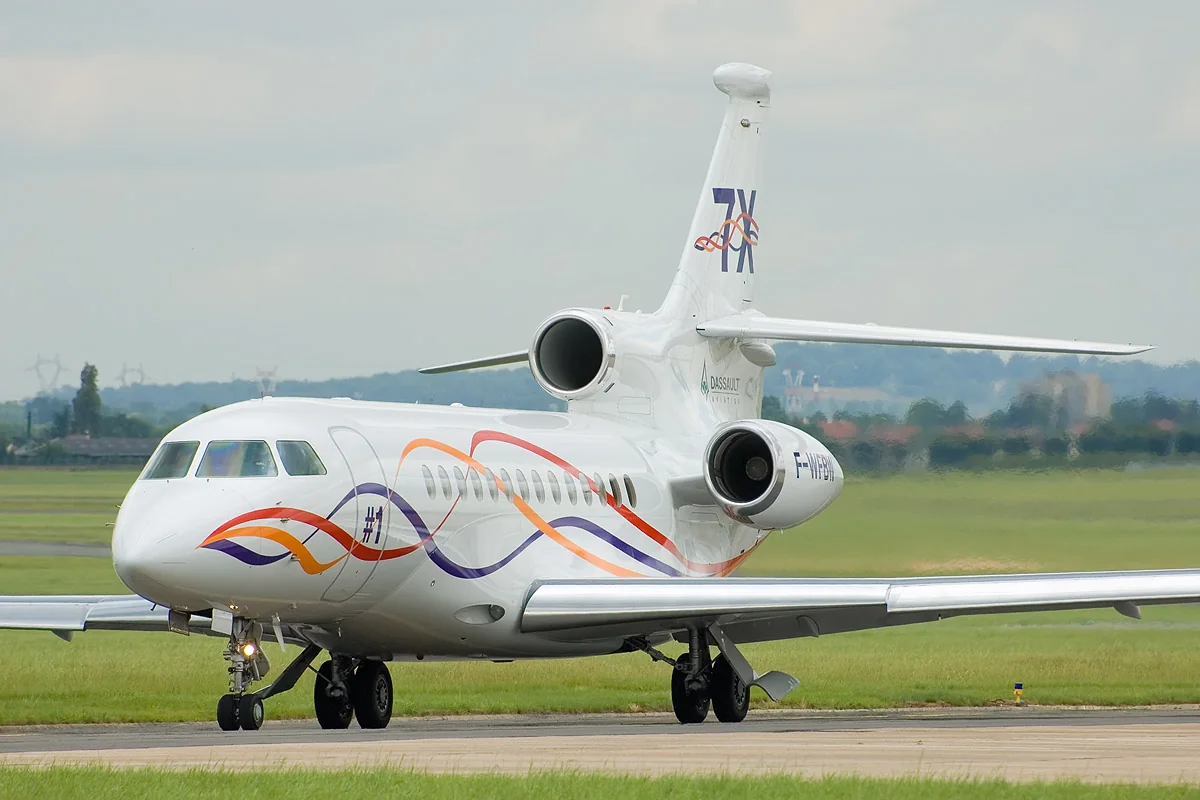
The Falcon 7X is recognized by its three engines in the tail and its slender wing. But its place in business aviation is determined primarily by the ability to perform long flights with a small number of passengers. For such an aircraft, range, space organization and the ability to fit into the customer’s route are all important. No single characteristic describes this set completely, so it is useful to start getting acquainted with the model with the real task of the trip.
Dassault technical materials for the Falcon 7X give a range of 5,950 nautical miles, approximately 11,020 kilometres. This is an estimate with specified conditions, including speed, number of people and fuel reserves. It shows the class of the aircraft, but does not guarantee any flight between two points at that distance. Let's figure out how to correctly read the characteristics of the 7X and what details turn the model description into a clear idea of a specific aircraft.
What the three-engine configuration means
The Falcon 7X is powered by three Pratt & Whitney Canada PW307A turbofan engines. Two are located on the sides of the rear fuselage, the third is in the central part of the tail. This arrangement is part of the overall design of the aircraft: the location of the units, balancing, systems and maintenance program are associated with it. Considering the number of engines separately from other engineering decisions is not enough for a meaningful comparison with another business jet of the same class.
Three engines by themselves do not make the route shorter. The trajectory depends on air traffic management, weather, permits and operational restrictions. It is also impossible to derive a universal safety rating based on one number of engines. The condition of the aircraft, the training of the crew and the implementation of established procedures are important. It is more useful for the passenger to clarify who operates the aircraft and how the flight is organized than to perceive a noticeable external feature as an independent guarantee of the result.
Range always comes with conditions
The table published by Dassault shows a range of 5,950 nautical miles for a Mach 0.80 flight with eight passengers, three crew and NBAA IFR reserves. If you change the initial conditions, the result will also change. Additional load, headwinds or a different flight profile may affect the ability to operate a flight without a stopover. Therefore, the route map serves as a guide, and the final decision requires calculation of a specific flight.
Let's imagine the same pair of airports on different days. On one day the wind helps the plane, on another it slows down its movement relative to the ground. The flight duration and fuel consumption change. Additionally, possible detours of adverse weather and the availability of an alternate airfield are taken into account. This is why the promise of a direct flight must be linked to the date, load and conditions, and not just to the straight line distance between cities.
Maximum speed and cruise settings
The Falcon 7X has a maximum operational Mach number of 0.90. This limitation cannot be automatically applied to the calculation of the entire duration of the voyage. The flight includes climb, cruise, descent, approach and ground stages. The speed is selected taking into account the task, weather and fuel consumption. Faster cruise may be useful for scheduling purposes, but its impact on range is also part of the planning.
For the passenger, the total duration of the trip is especially important. Gain in the air can be lost during a long ground journey or inconvenient airport service times. Conversely, a suitable airfield near your destination can significantly shorten the trip. Therefore, the aircraft model is evaluated along with available airports, their operating hours and border service capabilities. Business aviation provides flexibility, but this flexibility is realized within a specific transport infrastructure.
Digital control and crew work
The Falcon 7X was an important program for Dassault to bring an all-digital flight control system to business aviation. With this architecture, the pilot's commands are processed by electronic systems that control the actuators. This is the engineering basis for aircraft behavior, interacting with aerodynamics and other equipment. To understand the technology, it is important to separate the control principle from the specific functions of the installed avionics and the software version of a particular aircraft.
For business jets that have been in operation for a long time, the equipment can be updated. Two Falcon 7Xs from different years or after different upgrades do not necessarily have the same displays, communications, or set of available features. However, a new system in the cockpit does not automatically mean an updated passenger interior. The history of modernization requires separate consideration: technical improvements, interior condition and maintenance relate to different aspects of the same aircraft and are checked against the relevant documents.
Three cabin zones and real travel needs
The organization of the passenger space, characteristic of the Falcon 7X, allows us to distinguish several zones. In one version, these are places for communication, a dining group and a space for relaxation. In another, the owner devotes more space to workspaces or sleeping configurations. The separation is especially useful on a long flight, when some passengers want to talk and others want to relax. However, the specific location of the seats is determined by the interior of the aircraft, and not by the model name alone.
When choosing a charter flight, it is important to look at its current diagram. The number of certified passenger seats and the number of full-length beds answer different questions. The sofa can be used differently at certain stages of the flight, and the organization of sleep depends on the size and mechanism of transformation of the furniture. Photos help to assess the situation, but the convenience of a long trip is better associated with the actual placement of each group member and the rules for using the cabin.
Baggage and payload
The factory table for the Falcon 7X indicates a luggage volume of about four cubic metres. Volume shows space, but does not mean the ability to load things of any mass and shape. Suitcases, sports equipment and odd-sized items require placement and securing to be checked. The permissible baggage weight is related to the overall load of the aircraft, fuel capacity and restrictions of individual compartments. For a large group, it is useful to agree on these details before selecting a specific flight.
The situation is especially clear on a long-distance route. Additional passengers and heavy items change the load, and the need for a large supply of fuel leaves less freedom for other components of the mass. Sometimes an intermediate landing makes the trip more practical than trying to maintain maximum range under all conditions. There is no universal answer here without background data. A clear proposal for transportation should take into account the actual list of passengers and baggage, as well as the characteristics of the selected airports.
A short runway needs its own assessment
Falcon descriptions often emphasise the aircraft’s ability to use a wide range of airports. A published landing distance, however, applies to stated measurement conditions. It is not the minimum length of every runway the aircraft could use at any time. Surface condition, precipitation, wind, airport elevation, obstacles and operating requirements all affect the calculation. Even for one aircraft, arrival and departure capabilities can differ because its weight differs at those stages.
It is useful for the passenger to discuss the desired airport with the operator in advance and have a clear backup option. Proximity to your destination is important, but schedules, maintenance and site limitations may make another airfield more convenient overall. The same applies to well-known airports with special entry conditions: the technical capabilities of the model must be combined with the necessary clearances of the crew and operator. The mere presence of the airport name in advertising does not replace this verification.
How to evaluate a flight offer
An hourly flying rate says little about total trip cost without context. The quotation depends on where the aircraft is based, any positioning flight to the departure point, the length of the stay, airport handling and the itinerary. To compare offers fairly, describe the same mission to each provider and establish what each price includes. Otherwise, a lower initial quote may exclude costs already covered by another provider’s total.
The Falcon 7X is interesting due to its combination of a long-distance route and a cabin in which you can separate work and rest. To evaluate these benefits for your trip, you should check your flight configuration, baggage, communications, airport locations and flight conditions. A well-chosen aircraft meets most of the actual needs of passengers. A datasheet becomes useful when each significant number is associated with a clear use case and proven operating conditions.