
Business aviation
Fast business jets: what Mach 0.95 means for your journey
Global 8000, G700, G800, Citation X+ and Falcon 7X: how top speed differs from cruising speed and how much time it saves on a trip.
In lists of the fastest private jets, the difference between neighboring models is often within hundredths of Mach number. In an advertising comparison, this looks like a clear victory. In a real trip, the result also depends on the distance, wind, chosen airport and time on the ground. To understand the value of speed, you first need to figure out exactly what value is being compared.
Notable high-speed models include the Bombardier Global 8000, Gulfstream G700 and G800, Citation X+ and Dassault Falcon 7X. They belong to groups of different sizes and purposes. The important thing here is not to assign a universal winner, but to separate the speed limit from the cruising mode and show how the characteristics transform during travel.
Mach number is not a fixed speed in kilometres per hour
The Mach number shows the ratio of the speed of movement to the speed of sound in the surrounding air. The speed of sound depends on temperature, so one Mach value does not correspond to a single figure in kilometres per hour for all conditions. The popular conversion to ground conditions can give a misleading impression of high altitude flight.
In addition, airspeed is different from groundspeed relative to the surface. A tailwind helps you cover the route faster, a headwind increases the time. Therefore, two trips on the same aircraft with a similar cruising mode can differ significantly in duration. To compare models, it is more useful to look at the same conditions and the same task than to compare random screen readings in the cabin.
Global 8000: high top speed
For the Global 8000, Bombardier specifies a maximum speed of Mach 0.95. In July 2026, the manufacturer reported a flight from Los Angeles to Farnborough in eight hours and 46 minutes; the flight report included the achieved speed of Mach 0.93. This example shows well the difference between the published maximum of the model and the parameters of a particular route.
Even a very fast aircraft does not have to continuously fly at the upper limit of its capabilities. The crew selects a mode taking into account the route, fuel and conditions. For the passenger, the value of the model is manifested in the ability to complete the desired trip on a convenient schedule. The record between the two cities demonstrates the possibilities, but does not promise the same duration of each subsequent flight.
G700 and G800: same limit, different capabilities
The Gulfstream G700 has a maximum operating Mach number of 0.935. The manufacturer separately specifies Mach 0.85 for long-range cruise and Mach 0.90 for high-speed cruise. This distinction explains why a maximum-range figure cannot simply be labelled “at maximum speed”: the specifications describe different operating conditions and assumptions.
The G800 also has a Mach limit of 0.935 and a Mach 0.90 high-speed cruise. The equality of these numbers does not make the aircraft interchangeable. When choosing, the dimensions and organization of the cabin, the range with a given load and the conditions of a particular flight are important. The two aircraft can move equally fast on the cruising leg, but offer different seating options and different non-stop flight options.
Citation X+: Why the version designation matters
For the Cessna Citation X+, the manufacturer reported a maximum speed of Mach 0.935. In the materials about the record flights of 2014, flight conditions and an imitation of normal passenger load are separately mentioned. This is an example of how speed performance is confirmed by specific flights, and not just by a large number in the list of advantages.
When searching for an aircraft, you should carefully read the model designation. It's easy to confuse the names Citation X and Citation X+, but the plus sign denotes a specific version. You cannot transfer its characteristics to any aircraft with the word Citation in its name. In a charter proposal, it is useful to clarify the modification and the actual layout: the high speed of the family does not tell how much space the passengers of the selected instance will have.
Falcon 7X: another point of comparison
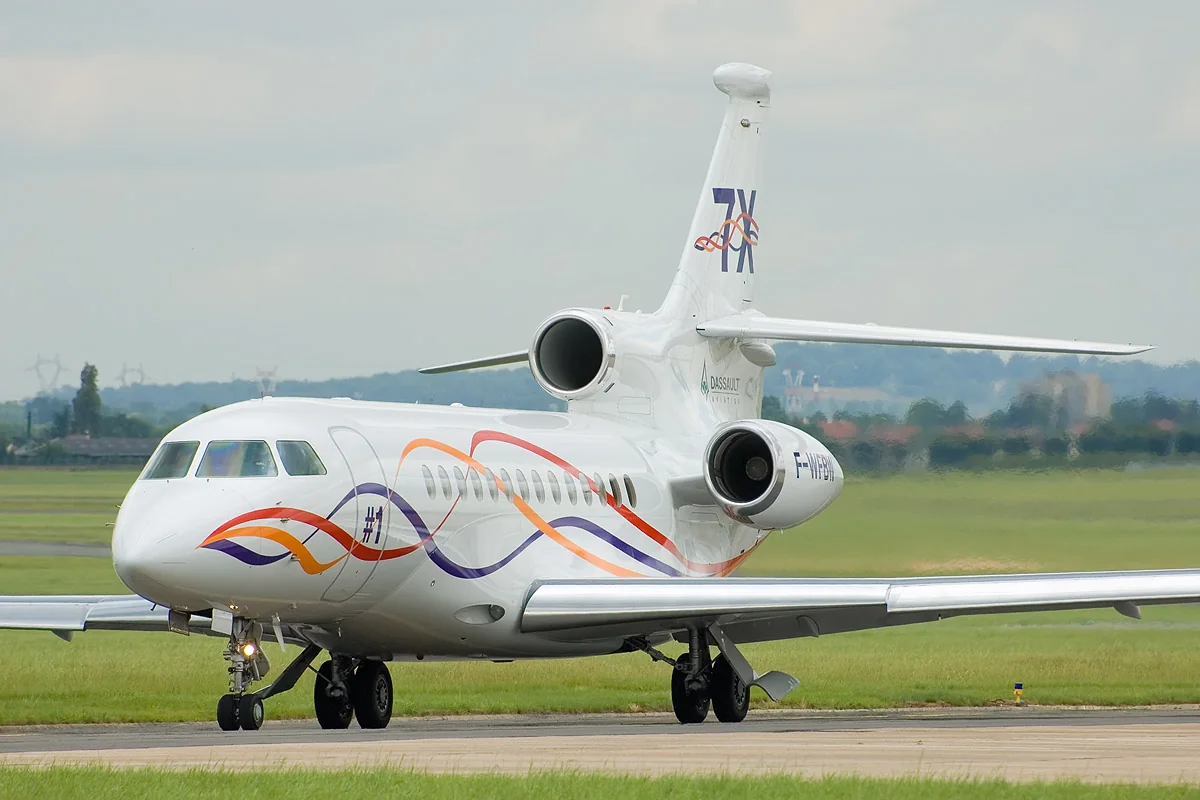
For the Falcon 7X, the published limit is Mach 0.90, and the stated range of 5,950 nautical miles is based on Mach 0.80 and a specified load. In a direct comparison of maximum values, it is inferior to the speed models listed above. But such a table answers only one question and says nothing about which plane is more convenient for a particular trip.
The route may be short enough that the difference in cruising modes provides a small time saving. In this case, a suitable aircraft is already nearby, has the required interior and is available on the required day. Then choosing by place in the speed rating loses some of its meaning. Speed remains a characteristic of the technology, and the convenience of flight consists of several conditions simultaneously.
How many minutes does the speed increase give?
Let's imagine a simplified cruising section 3,000 kilometres long. At a constant groundspeed of 900 kilometres per hour, it will take three hours and 20 minutes. At 950 kilometres per hour - approximately three hours and nine minutes. The difference is about 11 minutes. This is an arithmetic illustration without climb, descent, wind and control restrictions, and not a flight forecast on one of the named models.
Over a longer section, the difference will increase if all other conditions remain the same. However, in reality they rarely coincide completely. Aircraft may receive different flight levels, routes or departure times. The calculation is therefore useful for estimating the size of the effect: extra kilometres per hour may help, but its impact must be weighed against the overall duration of the trip.
Non-stop route and technical stop
Stopping for fuel adds more to your trip than the time it takes to fill up. You need to descend, land, taxi to the parking lot, go through the necessary procedures and take off again. The duration depends on the airport and service organization. Therefore, an aircraft with a more modest cruising speed, under suitable conditions, can deliver passengers earlier if it completes the route without such a stop.
The opposite situation is also possible: the speed limit turns out to be useful on a flight where the range is sufficient. The challenge is to choose a reasonable profile for this particular flight. To compare offers, it is better for the operator to transmit the same data about passengers, baggage and arrival time. Then comparable routes are discussed, rather than abstract maximums from different specification sheets.
The airport of arrival also affects the result
The passenger is usually aiming for a meeting or resting place, rather than simply crossing the threshold of the runway. After landing, there are ground procedures and the road to the final point. A nearby airport may shorten the trip, but its suitability is determined by the aircraft's capabilities and operating conditions. You cannot select a site solely by distance on the map.
There are also organizational constraints: parking availability, opening hours and agreed service. They are checked for the flight date. In assessing convenience, it is useful to compare the complete path from origin to destination. A slight advantage on the cruising leg can disappear after a long transfer, but a well-chosen airport can make the entire schedule noticeably smoother without changing the aircraft's speed.
How to read a speed ranking
A correct comparison identifies the specific modification, distinguishes the operating limit from normal cruising, and explains the conditions for calculating range. It is also advisable to understand whether we are talking about a production aircraft, a separate test flight or a record on a specific track. These categories describe different achievements, so combining them into one column may confuse the reader.
For trip planning, it is more useful to ask for expected route times and possible stops than to rely solely on Mach 0.95 or Mach 0.935. Then the ground part is added to it and the comfort of the cabin is assessed. A fast business jet gives the crew additional options, but the final schedule comes from a combination of the aircraft's characteristics, the specific route and the flight arrangements.