
Helicopters
Gyroplanes and helicopters: similar rotors, different ways of flying
What rotates the main rotor of a gyroplane, why a pre-rotator is needed, and why a regular gyroplane doesn’t hover the same way as a helicopter.
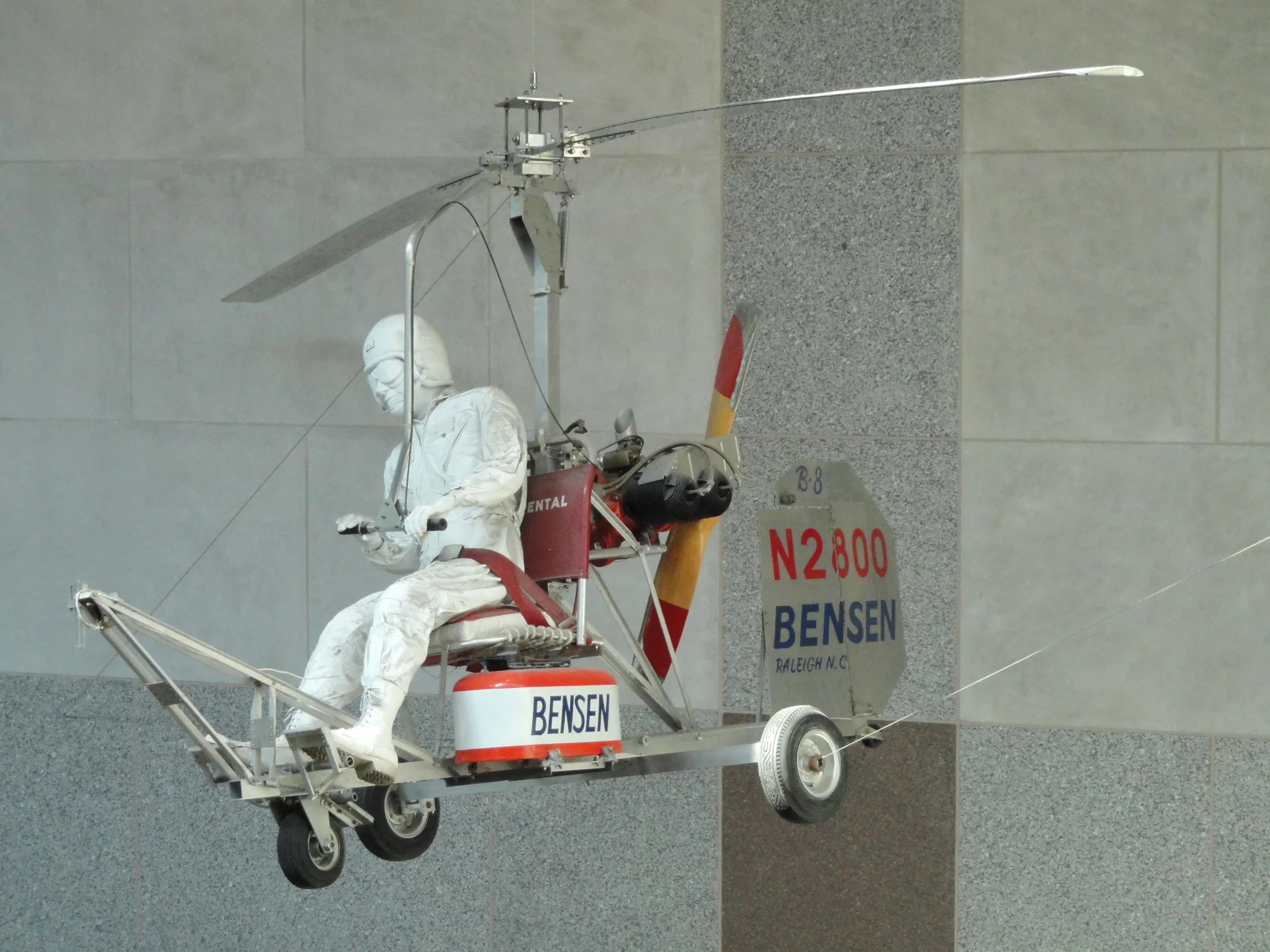
The small aircraft has a large rotor spinning above the cabin, but before takeoff it accelerates down the runway. It could be a gyroplane - a rotary-wing aircraft that can easily be mistaken for an unusual helicopter. The external similarity hides the main difference: in normal flight, the main rotor of a gyroplane rotates under the influence of air flow, and not due to constant drive from the engine.
From this difference follow the characteristics of takeoff, movement and landing. The helicopter is able to hover in the air thanks to the power transmitted to the main rotor. A conventional gyroplane requires adequate flow through the rotor to maintain flight. However, free rotation does not mean that the blades work randomly or that the device does not need precise control.
Two rotating systems with different jobs
A common modern gyroplane has a rotor on top and a separate propeller that generates thrust. The second propeller can be located behind the cabin and push the device, or be in front and pull it. The engine provides forward motion through this propeller, and the freely rotating rotor creates the main lift force.
On a helicopter, the main rotor receives power from the engine through a transmission. By changing its operation, the aircraft creates lift and directs the resulting force for movement. This difference is more important than the shape of the cab or the number of wheels. A closed gyroplane with a comfortable interior remains a gyroplane, but a small open helicopter does not cease to be a helicopter because of its simple appearance.
How does air keep the rotor spinning?
The mode of free rotation of the main rotor is called autorotation. The air flow interacts with the blades so that part of the aerodynamic forces maintains rotation, compensating for drag. In steady state, balance is achieved: the rotor receives the necessary energy from the flow and continues to create lift. For a gyroplane, this is a normal condition of flight and not automatically a sign of malfunction.
Think of the rotor as a rotating wing that needs suitable airflow to work. The engine drives a separate propeller to move the aircraft through the air; that motion and the rotor’s attitude establish the flow through the rotor. It is therefore wrong to say that the rotor is spun up once and then keeps turning on inertia alone. Inertia plays a part, but sustained flight requires a continuing exchange of energy with the air.
Why does a gyroplane usually accelerate before takeoff?
Before lift-off, the rotor must reach sufficient rotational speed. A pre-rotator transfers energy to it before take-off; what happens next depends on the particular design. Having a pre-rotator does not turn an ordinary gyroplane into a helicopter. Spinning the rotor up before departure and continuously powering it during flight serve different purposes.
An ordinary aircraft needs a take-off run to create suitable conditions for takeoff and further climb. Length depends on model, load, coverage, wind and atmospheric conditions. Therefore, the expression “a gyroplane takes off from a very short runway” cannot be converted into a promise to use any free area. The suitability of the location is determined by the characteristics of the apparatus and conditions, and not by its small size.
Are there any exceptions with jumping take-off?
There are special designs designed for jump takeoff. Before liftoff, they store energy in a spinning rotor and use it for the initial ascent, then proceed to forward flight. This is a feature of a certain design, and not a standard feature of every gyroplane. It would be a mistake to transfer such a video to any device with a similar top rotor.
Even a jump takeoff is not the same as a long hover. In the first case, the stored energy helps to pass the initial section, in the second it is necessary to continuously maintain a mode without forward motion relative to the air. That is why specialized gyroplanes and hybrid rotorcraft are discussed separately. Their capabilities cannot be used to describe the entire class of small recreational aircraft.
Can a gyroplane hover in place?
A conventional gyroplane is not capable of performing helicopter hovering in still air. If in the recording it appears to have stopped over one point on the ground, you need to take the wind into account. The device can have a low groundspeed while continuing to move relative to the air mass. The observer sees an almost motionless silhouette, but the operating conditions of the rotor remain associated with the flow.
This distinction is also useful when comparing aircraft. Ground speed does not always describe what is happening to the wing or rotor. Airspeed is important for aerodynamics, and route movement is important for arrival time. Therefore, from one video without information about the wind, it is impossible to reliably determine whether an unusual aircraft can hover in the same way as a helicopter.
What is the tail for?
Gyroplanes often have visible horizontal and vertical tail surfaces, which contribute to stability and control. The direction of thrust from the propulsion propeller also affects aircraft behaviour. The precise arrangement depends on the engine, centre of gravity, rotor and control layout. Designers coordinate these elements rather than treating them as interchangeable decorative parts.
A freely turning rotor does not transmit the same continuous engine-driven reaction torque to the fuselage as the powered rotor of a conventional single-rotor helicopter. A gyroplane therefore generally does not need an equivalent anti-torque tail rotor. That does not remove the need for directional stability, which is provided by other parts of the design.
Autorotation in helicopters and gyroplanes
A helicopter can also use autorotation, for example when power transmission to the main rotor stops. However, the transition to this mode and landing are the tasks of a trained pilot. In a gyroplane, the autorotational rotor mode is a normal flight condition. The same word denotes a related aerodynamic principle, but not the same actions of the crew and not the same characteristics of the aircraft.
This does not mean that an engine failure in a gyroplane has no consequences. Without propeller thrust, the aircraft cannot maintain level flight indefinitely. Its subsequent flight path and landing options depend on conditions, height, the chosen landing area and the pilot’s actions. A freely turning rotor gives the aircraft particular characteristics, but does not remove its limitations.
Cabin and passenger experience
Among gyroplanes there are open aircraft and devices with closed cabins. Passengers can sit next to each other or behind each other. These differences affect visibility, communication and the flight experience, but do not change the basic operating principle of the rotor. A trip in an open aircraft differs in impressions from a trip in a closed cabin, even with a similar route.
Before getting acquainted with such a flight, it is more useful to clarify the actual layout and conditions of the program than to focus on the general name. Setup times, weather restrictions and baggage allowance vary by operator and aircraft. The promise of “like a helicopter, only easier” says little about the passenger experience and can create the wrong expectations about takeoff or hovering.
Where is the practical limit?
The history of the gyroplane began long before the spread of modern light helicopters. The successful flight of Juan de la Cierva's C.4 took place in January 1923. Its design helped solve the important problem of uneven lifting force when the rotor moves forward. Therefore, the gyroplane is interesting not only as a modern small aircraft for flying, but also as a separate stage in the development of rotary-wing aviation.
For work that requires stationary hovering, the helicopter has a fundamentally important capability. The gyroplane attracts with a different combination of properties: a free rotor, a separate propulsion system and the ability to fly from short suitable runways. These are different tools, so comparing them only on price, size or number of engines is not enough.
The most reliable way to distinguish the patterns is to find out what rotates the main rotor in normal flight and how thrust is generated. Then it’s worth looking at the specific model, takeoff modes and purpose. This understanding allows us to evaluate an unusual device without the myth of a “helicopter without an engine” and without attributing the same capabilities to all rotorcraft.