
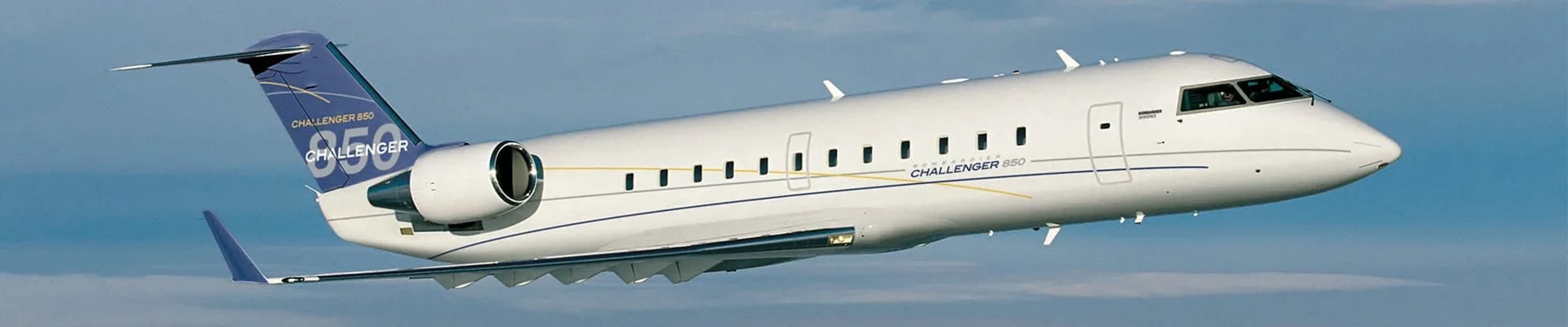
Model profile
Challenger 850: history and features
The Challenger 850 refers to the Challenger 800 line based on the regional passenger CRJ200. An updated version of the 850 was released from 2006 to 2012.
Programme development
Unlike the specially designed Challenger, the 800 line used a regional CRJ glider. Such a basis gave a large and long salon, which could be divided into zones. Challenger 850 was a late stage of the program after the initial business versions of this passenger aircraft.
Design
The passenger origin explains the long cabin and the different scale of the fuselage compared to the Challenger 300 or 600. In this case, the published range depends on the layout and loading.
Technical features
The Challenger 850 is based on a regional CRJ200 with two General Electric CF34 tail engines. Remodeling the cabin for private use has given a lot of interior space, but the increased dimensions do not mean a range equal to special long-haul business jets.
Purpose and uses
The aircraft is suitable for accommodating a large group or a spacious interior, but its size and passport range are not equal to the capabilities of more compact long-distance business jets. The specific result depends on the selected VIP layout and download; it is incorrect to compare the 850 with the Challenger 650 by one name of the series.
Its place in the family
The Challenger 850 is a member of the CRJ200 family, not the larger Challenger 650.
The platform and its development
The Challenger 850 is derived from the regional CRJ200, so its long fuselage and cabin dimensions are markedly different from the specially designed Challenger 300 or 650. General Electric CF34 jet engines are located at the tail end. The conversion of the passenger platform for private travel made it possible to divide a large interior space into separate zones. This is a different origin than the other Challenger in the catalog.
A large cabin does not mean a record distance: the original regional airframe and additional VIP equipment have their own balance of mass and fuel. For a group of passengers, 850 can be convenient on a route where space and the ability to work on board are important. On a very long-haul flight, a specialized Global solves a different problem. When choosing a specific aircraft, you should look at the actual layout and condition of the board after conversion.
Space in the salon
The Challenger 850 has a published cabin height of 1.85 m, width - 2.49 m, length - 14.76 m. Height helps to assess the convenience of movement along the aisle, width - the space between the seats. These are the dimensions of the cabin, not the free passage: decoration, furniture and the location of the seats affect the feeling of spaciousness. For a specific board, it is worth looking at the plan and photos of the interior.
Which means distance.
For the Challenger 850, the catalogue lists a maximum range of 5,206 km (2,811 nautical miles). This is a benchmark for comparison, not a promise of non-stop travel with any number of passengers. The oncoming wind, airspace bypasses, a lot of luggage and a supply of fuel for care at another airfield change the possible route. Maximum capacity and maximum range cannot be automatically added to a single scenario.
Luggage and travel preparation
The specified volume of the luggage compartment of the Challenger 850 is 9 m3. It is impossible to translate it into the exact number of suitcases without the size of bags: the shape of the compartment, the opening of the door and the permissible weight are important. Skis, baby carriages or equipment should be matched in size. Separately, the availability of baggage in flight is specified - the volume of the compartment itself does not say anything about it.
Position on the range among the models of the manufacturer
Bombardier's catalogue for Challenger 850 lists 2,811 nautical miles. Among the 14 models of the manufacturer of the same type with published range, the aircraft takes the 1st place when sorting from a smaller value to a larger one. The nearest Challenger 300 has 3,100 nautical miles published: the difference is 289 nautical miles, or about 9% of the comparable model. This shows the scale of the difference more accurately than the conditional division of aircraft into “medium” and “long-range”. For the current model, this is a comparison of passport values; a separate flight is planned according to the actual mass and weather conditions.
Proportion of salon in comparison
The Challenger 850 has published a cabin length of 14.76 m, width of 2.49 m and height of 1.85 m. These three sizes describe different properties: length determines how many separate groups of furniture can be placed, and width and height affect the convenience of each zone. For comparison, Global Express published a length of 14.73 m, a width of 2.49 m and a height of 1.91 m. The difference in length is 0.03 m; it can affect the ability to separate the working group of seats from the rest area. The published width is the same, but the finish of a particular side may vary. The comparison relates to the dimensions of the empty cabin, and not to the available area after installing the kitchen, partitions and seats.
Capacity and payload
The Challenger 850 has a maximum passenger capacity of 14 people. The Challenger 300 has up to 9 passengers. The difference is 5 seats; this can change the composition of the group or allow you to give up part of the seats for the sake of a freer layout. The luggage volume of the Challenger 850 is 9 m3. For Challenger 300 published 3 m3; difference 6 m3. When comparing aircraft, a combination of passengers, fuel and luggage should be checked: the maximum figure for each of these parameters usually describes different design cases. It is this combination that determines how much the published range fits a group with a specific number of things.
Close to Model Capabilities
The Challenger 850 is part of the Challenger lineup. When sorted by published range, the closest are Challenger 300 (3,100 nautical miles, up to 9 passengers), Challenger 350 (3,200 nautical miles, up to 10 passengers), Challenger 3500 (3,400 nautical miles, up to 10 passengers). These options differ not only in the route: the number of seats, cabin proportions and the generation of equipment have to be compared separately. If you need another passenger or more luggage, the close range of two aircraft does not mean equal suitability for the trip. If the decisive is the airfield, additionally compare the runway restrictions of specific modifications. For the released board, the year of manufacture, installed avionics and the actual interior are significant.
The history of Bombardier: from snowy roads to intercontinental flights
The future aircraft manufacturer began with transport for snow-covered Quebec. Mechanic and inventor Joseph-Armand Bombardier sought a way to help people travel in winter. After the commercial success of the seven-seat B7 in 1937, he founded L’Auto-Neige Bombardier Limitée in 1942. The company made snow vehicles, including those used to carry goods, mail and patients, and later entered the rail transport market.
Its aviation history began in 1986 with the acquisition of Canadair, the manufacturer of the Challenger. Buying Learjet in 1990 added expertise in light business aircraft. In 1993, Bombardier announced the Global Express programme: the first flight followed in 1996 and service entry in 1999. Several engineering traditions thus grew into a range covering different business aviation needs.
Engineering philosophy: range with comfort
Modern Bombardier jets combine attention to the route with attention to life on board. On the Global 7500, this means four separate cabin zones, a galley and crew space. The arrangement allows passengers to hold a meeting, dine and rest during a single long flight without making the whole cabin serve one function.
Comfort is also linked to aircraft design. The Smooth Flĕx Wing was developed with high-speed performance, take-off, landing and ride quality in mind. The Nuage seat became a separate ergonomics project, featuring a deep recline. These examples illustrate the brand’s engineering approach: improving both flight capability and the details passengers experience directly.
Challenger, Global and the Learjet legacy
Challenger and Global represent different branches of development. Challenger combines a large cabin with regional and transcontinental capability; Global focuses on longer international routes. The Challenger 3500 and 650 also have different design foundations: the model numbers do not describe one progressively larger aircraft.
Historic Learjets remain part of Bombardier’s aviation heritage and continue to fly after the end of series production. For any aircraft from the brand, the exact variant, maintenance history and cabin plan shape the travel experience. The number of passenger seats is not the same as the number of full sleeping places.