
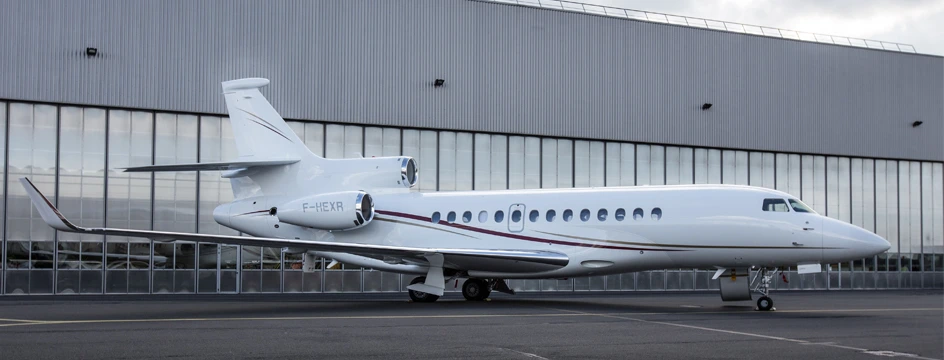
Model profile
Falcon 7X: history and features
The Falcon 7X first flew in 2005 and entered service in 2007. The Falcon 8X grew out of the 7X and began shipping later, with increased range.
Programme development
Falcon 7X has transferred the experience of Dassault in the field of digital control to a business three-engine aircraft. The later 8X received a longer fuselage, wing changes and a larger fuel supply. Evolution affected not only the design of the cabin, but also the possibility of a long flight.
Design
Both aircraft have three engines and a digital electric remote control. The 8X has received aerodynamic refinements, engine changes and a larger fuel supply; it can not be considered only a new interior of the 7X.
Technical features
The Falcon 7X is Dassault’s first fully digitally controlled commercial aircraft. The late 8X retained three engines, but received an extended fuselage and more fuel for longer routes.
Purpose and uses
The three-engine layout and long range determined the role of the family on international corporate routes. Versions of the 7X and 8X can perform similar tasks, but the actual layout of the cabin, the payload and the limitations of a particular airfield are important for selection.
Its place in the family
The 7X has become an important stepping stone for Dassault thanks to its digital electric remote control system.
The platform and its development
Falcon 7X has become an important stage of Dassault thanks to the digital electric remote control in the serial business jet. The three engines and the long-distance route were combined with a cockpit in which the computer processes the pilots' commands. The late 8X developed the same line, getting a longer cabin, modified engines, and more fuel. These changes concern not only the interior, but also the capabilities of the aircraft.
When comparing the 7X with the 8X, you should take into account the number of cabin zones, payload and range calculation conditions. In both cases, the passenger can spend many hours on board, so the layout for sleep and work is of practical importance. The three-engine scheme affects maintenance differently than the twin-engine Falcon 6X and 10X. None of these options can be estimated only by the largest number of nautical miles in the advertising material.
Space in the salon
The Falcon 7X has a published cabin height of 1.88 m, width - 2.34 m, length - 11.91 m. Height helps to assess the convenience of movement along the aisle, width - the space between the seats. These are the dimensions of the cabin, not the free passage: decoration, furniture and the location of the seats affect the feeling of spaciousness. For a specific board, it is worth looking at the plan and photos of the interior.
Which means distance.
For the Falcon 7X, the maximum range is 11,019 km (5,950 nautical miles). This is a benchmark for comparison, not a promise of non-stop travel with any number of passengers. The oncoming wind, airspace bypasses, a lot of luggage and a supply of fuel for care at another airfield change the possible route. Maximum capacity and maximum range cannot be automatically added to a single scenario.
Luggage and travel preparation
The specified volume of the luggage compartment of the Falcon 7X is 3.96 m3. It is impossible to translate it into the exact number of suitcases without the size of bags: the shape of the compartment, the opening of the door and the permissible weight are important. Skis, baby carriages or equipment should be matched in size. Separately, the availability of baggage in flight is specified - the volume of the compartment itself does not say anything about it.
Position on the range among the models of the manufacturer
The Dassault Aviation catalog for the Falcon 7X lists 5,950 nautical miles. Among the 9 models of the manufacturer of the same type with a published range, the aircraft takes 7th place when sorting from a smaller value to a larger one. At the nearest range Falcon 6X published 5,500 nautical miles: the difference is 450 nautical miles, or about 8% of the comparable model. This shows the scale of the difference more accurately than the conditional division of aircraft into “medium” and “long-range”. For the current model, this is a comparison of passport values; a separate flight is planned according to the actual mass and weather conditions.
Proportion of salon in comparison
The Falcon 7X has a cabin length of 11.91 m, width of 2.34 m and height of 1.88 m. These three sizes describe different properties: length determines how many separate groups of furniture can be placed, and width and height affect the convenience of each zone. For comparison, the Falcon 8X published a length of 13 m, width of 2.34 m and a height of 1.88 m. The difference in length is 1.09 m; it can affect the ability to separate the working group of seats from the rest area. The published width is the same, but the finish of a particular side may vary. The comparison relates to the dimensions of the empty cabin, and not to the available area after installing the kitchen, partitions and seats.
Capacity and payload
The Falcon 7X has a maximum passenger capacity of 16 people. The Falcon 6X has 16 passengers. Equal declared capacity leaves the main question of the size and arrangement of the cabin, as well as the ability to use all the seats on the selected route. The Falcon 7X has a cargo volume of 3.96 m3. The number of seats alone does not indicate how much luggage will actually fit on board. When comparing aircraft, a combination of passengers, fuel and luggage should be checked: the maximum figure for each of these parameters usually describes different design cases. It is this combination that determines how much the published range fits a group with a specific number of things.
Close to Model Capabilities
The Falcon 7X is part of the Falcon family. When sorted by published range, the closest are the Falcon 6X (5,500 nautical miles, up to 16 passengers), Falcon 8X (6,450 nautical miles, up to 16 passengers), Falcon 900LX (4,750 nautical miles, up to 19 passengers). These options differ not only in the route: the number of seats, cabin proportions and the generation of equipment have to be compared separately. If you need another passenger or more luggage, the close range of two aircraft does not mean equal suitability for the trip. If the decisive is the airfield, additionally compare the runway restrictions of specific modifications. For the released board, the year of manufacture, installed avionics and the actual interior are significant.
The history of Dassault Falcon: French engineering and an international market
Dassault Aviation’s origins are linked to engineer Marcel Bloch, later known as Marcel Dassault. In 1916 he developed the Éclair propeller, and in 1930 he assembled a new team to build aircraft. This work grew into an aviation tradition in which military and civil designs developed alongside each other.
The business aircraft family began with the Mystère 20, later the Falcon 20, which first flew on 4 May 1963. A Pan American delegation including Charles Lindbergh inspected the aircraft that same day. The American carrier’s interest helped bring the programme to the international market. New generations followed the Falcon 20, drawing on the company’s military design experience while obtaining their own civil certification.
Engineering philosophy: handling and precision
Dassault pays particular attention to how an aircraft responds to its pilot. The Falcon 7X became the first business jet with digital fly-by-wire controls. The system drew on experience from the company’s military programmes, including the Rafale: computers process pilot commands and control the deflection of flight control surfaces.
The system helps keep the aircraft within its operating limits and reduces crew workload. It developed alongside the EASy flight deck, which brings flight information together. In the passenger cabin, the same attention to detail appears in the use of space, acoustics and long-haul comfort. The Falcon approach combines precise handling with a carefully considered onboard environment.
Why Falcons differ
The Falcon 2000 and 6X have two engines; the 900, 7X and 8X families have three. Engine count alone does not determine a trip’s comfort or economy: the airfield, range, load and exact aircraft version matter. Even within the Falcon 2000 family, the S and LXS address somewhat different route requirements.
The Falcon 6X, which entered service in 2023, stands out for its wide, tall cabin. The 10X programme develops the large twin-engine jet segment further. When comparing generations, distinguish the specifications of production aircraft from the design targets of a model still under development.