
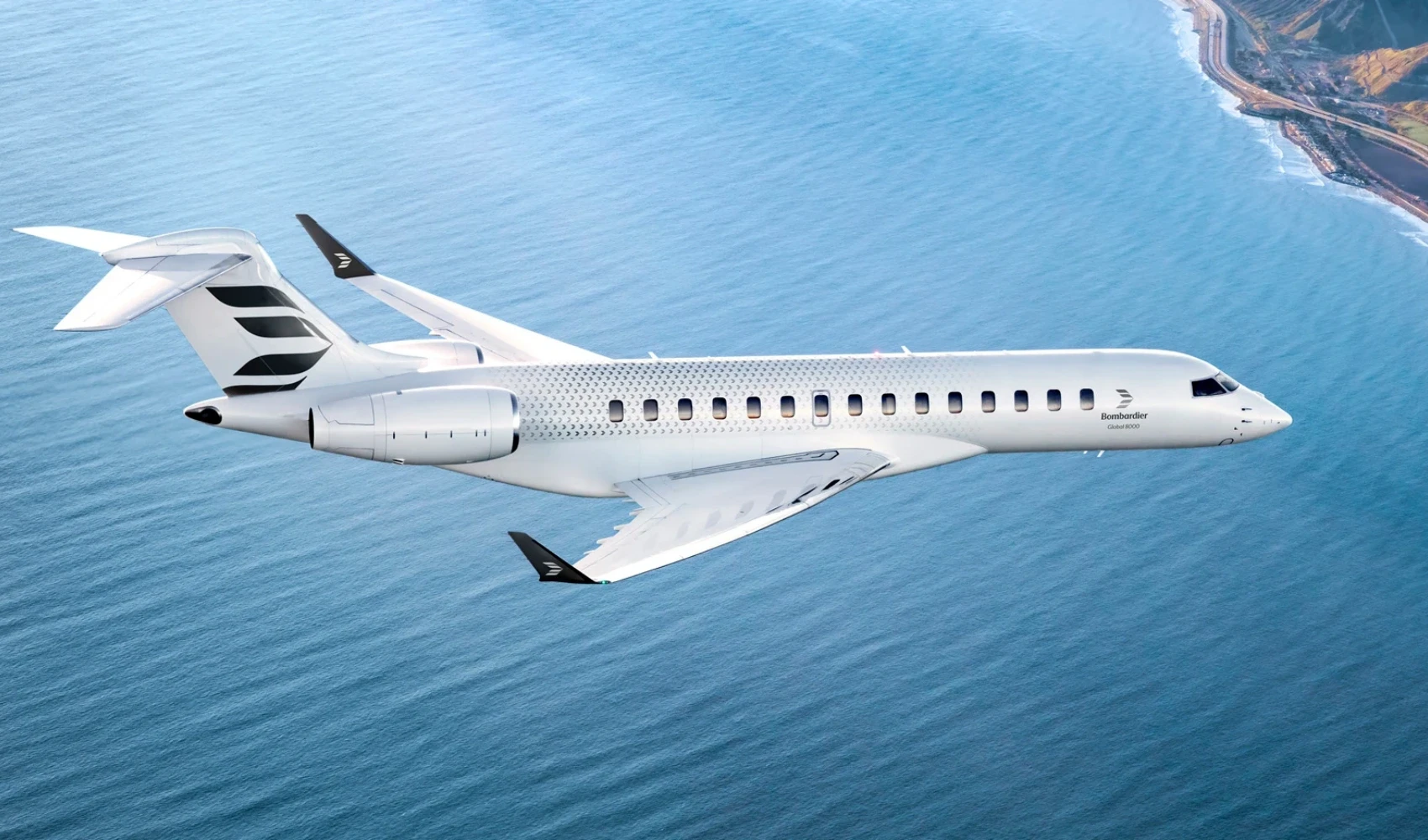
Model profile
Global 8000: history and features
The Global 7500 was originally called the Global 7000. The first flight took place in 2016, certification and the beginning of operation - in 2018. The Global 8000 develops this line with an emphasis on speed and maximum range.
Programme development
Global 7500 was created as a new generation of super-long-range aircraft, and not the next update of Global Express. The name change from 7000 to 7500 occurred before the start of operation. Based on this program, the Global 8000 is developing; its status and passport values require a separate check on current sources.
Design
A new wing and four-zone cabin were developed for the 7500. The 8000 is connected to the same modern platform, but has its own published characteristics and certification stages.
Technical features
The Global 7500 is built around a new transonic wing, GE Passport engines and electric remote control. Four zones of the salon are included in the project of the platform itself. Global 8000 develops it, but has separate indicators of speed and range.
Purpose and uses
A large four-zone cabin is designed for flights, where passengers spend many hours on board. For a real route, not only the maximum range from the catalog is important, but also the number of passengers, luggage, weather conditions and fuel reserves. These factors are particularly noticeable on limit flights.
Its place in the family
The 8000 is the development of a new Global line with changed flight performance; the 7,500 figures should not be replaced by passport data.
The platform and its development
The Global 7500 began as the Global 7000, but became an independent new platform with a transonic wing, GE Passport engines and electric remote control. Four areas of the cabin are laid out in the idea of a long stay on board. The development of the wing and systems required separate tests; the history of the program cannot be described as a normal Global 6000 elongation.
The Global 8000 is developing this line with a focus on speed and range. Even with constructive kinship, two models have their own indicators and stages of admission. In a real flight, the route depends on the number of passengers, baggage, cruising mode and the mandatory fuel reserve. A large cabin is useful when the duration of the flight justifies separate spaces for work and sleep; on a short trip, part of its capabilities may remain unclaimed.
Variant-specific features
The Global 8000 develops the Global 7500 design line while maintaining the character of a large multi-zone cabin. Bombardier allocates for it higher rates of speed and range. When comparing these two aircraft, the conditions of published tests and the exact configuration of the board are important: a similar appearance does not make passports interchangeable. The difference between the model indices should be checked by the documentation and the status of the program at the date of the particular flight.
Places and planning
The Global 8000 offers up to 19 passengers. The number of seats does not describe the entire interior: the club group of seats, sofa and dining table occupy the space in different ways. Before a long flight, it is useful to check the number of full-fledged beds, the location of the toilet and the ability to separate the recreation area. Maximum capacity does not mean that all these amenities are available at the same time.
Which means distance.
The Global 8000 has a maximum range of 14,816 km (8,000 nautical miles). Conditions of published calculation: passport indicator of the manufacturer. This is a benchmark for comparison, not a promise of non-stop travel with any number of passengers. The oncoming wind, airspace bypasses, a lot of luggage and a supply of fuel for care at another airfield change the possible route. Maximum capacity and maximum range cannot be automatically added to a single scenario.
Position on the range among the models of the manufacturer
Bombardier's Global 8000 catalogue lists 8,000 nautical miles. Among the 14 models of the manufacturer of the same type with published range, the aircraft takes 14th place when sorting from a smaller value to a larger one. At the nearest distance Global 7500 published 7700 nautical miles: the difference is 300 nautical miles, or about 4% of the comparable model. This shows the scale of the difference more accurately than the conditional division of aircraft into “medium” and “long-range”. For the current model, this is a comparison of passport values; a separate flight is planned according to the actual mass and weather conditions.
Capacity and payload
The Global 8000 has a maximum passenger capacity of 19 people. The Global 7500 has up to 19 passengers. Equal declared capacity leaves the main question of the size and arrangement of the cabin, as well as the ability to use all the seats on the selected route. There is no separate confirmed luggage compartment volume for this version in the catalog; the number of seats does not allow you to calculate it automatically. When comparing aircraft, a combination of passengers, fuel and luggage should be checked: the maximum figure for each of these parameters usually describes different design cases. It is this combination that determines how much the published range fits a group with a specific number of things.
Close to Model Capabilities
Global 8000 is part of the Global line. When sorted by published distance, the closest are Global 7500 (7,700 nautical miles, up to 19 passengers), Global 6,500 (6,600 nautical miles, up to 17 passengers), Global Express (6,100 nautical miles, up to 16 passengers). These options differ not only in the route: the number of seats, cabin proportions and the generation of equipment have to be compared separately. If you need another passenger or more luggage, the close range of two aircraft does not mean equal suitability for the trip. If the decisive is the airfield, additionally compare the runway restrictions of specific modifications. For the released board, the year of manufacture, installed avionics and the actual interior are significant.
The history of Bombardier: from snowy roads to intercontinental flights
The future aircraft manufacturer began with transport for snow-covered Quebec. Mechanic and inventor Joseph-Armand Bombardier sought a way to help people travel in winter. After the commercial success of the seven-seat B7 in 1937, he founded L’Auto-Neige Bombardier Limitée in 1942. The company made snow vehicles, including those used to carry goods, mail and patients, and later entered the rail transport market.
Its aviation history began in 1986 with the acquisition of Canadair, the manufacturer of the Challenger. Buying Learjet in 1990 added expertise in light business aircraft. In 1993, Bombardier announced the Global Express programme: the first flight followed in 1996 and service entry in 1999. Several engineering traditions thus grew into a range covering different business aviation needs.
Engineering philosophy: range with comfort
Modern Bombardier jets combine attention to the route with attention to life on board. On the Global 7500, this means four separate cabin zones, a galley and crew space. The arrangement allows passengers to hold a meeting, dine and rest during a single long flight without making the whole cabin serve one function.
Comfort is also linked to aircraft design. The Smooth Flĕx Wing was developed with high-speed performance, take-off, landing and ride quality in mind. The Nuage seat became a separate ergonomics project, featuring a deep recline. These examples illustrate the brand’s engineering approach: improving both flight capability and the details passengers experience directly.
Challenger, Global and the Learjet legacy
Challenger and Global represent different branches of development. Challenger combines a large cabin with regional and transcontinental capability; Global focuses on longer international routes. The Challenger 3500 and 650 also have different design foundations: the model numbers do not describe one progressively larger aircraft.
Historic Learjets remain part of Bombardier’s aviation heritage and continue to fly after the end of series production. For any aircraft from the brand, the exact variant, maintenance history and cabin plan shape the travel experience. The number of passenger seats is not the same as the number of full sleeping places.