
Model profile
HondaJet Elite II: history and features
The concept of HondaJet was developed in the late 1990s; the experimental aircraft flew in 2003. Certification of the original HA-420 and the first deliveries took place in 2015. Elite, Elite S and Elite II.
Programme development
After an experimental flight in 2003, Honda brought the unusual layout to the serial HA-420. Elite, Elite S and Elite II updates gradually changed the aerodynamics, equipment and range. A separate Echelon project belongs to a larger aircraft; its timing should be taken from current Honda Aircraft reports.
Design
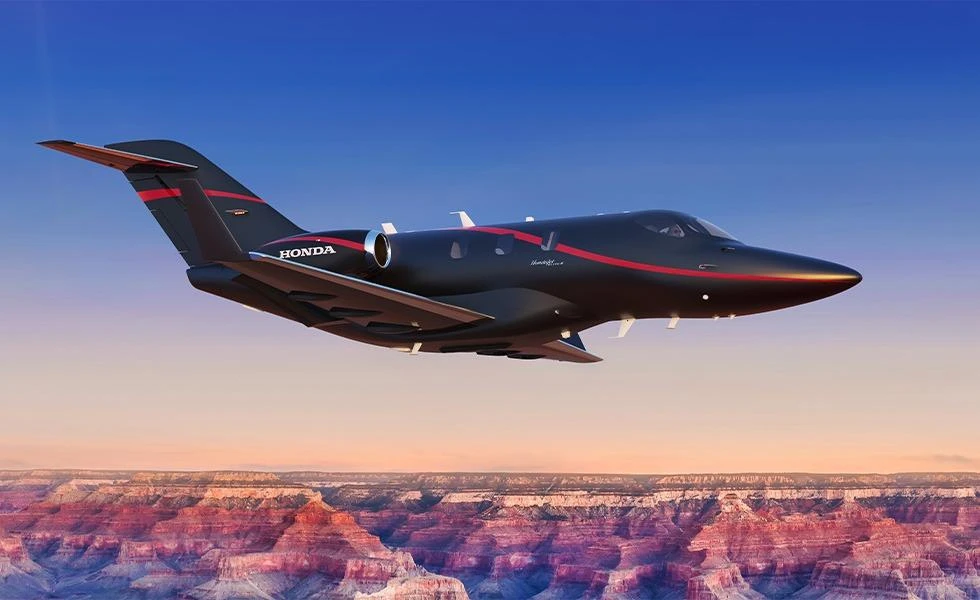
A recognizable feature is the engines on the pylons above the wing. Such placement frees up space in the rear part of the fuselage; composite fuselage and wing shapes designed for laminar flow are also used.
Technical features
The GE Honda HF120 engines are mounted on pylons above the wing rather than on the sides of the tail. In combination with the composite fuselage, this became a distinctive design feature of the HA-420; subsequent Elites updated the equipment and flight performance.
Purpose and uses
HondaJet is designed for travel of a small group, where compactness and jet speed are important. The engines above the wing free up some of the interior space, but the exact layout depends on the version. While Echelon is not certified, its planned capabilities can not be equated to the operational data of the serial HA-420.
Its place in the family
Elite II is the next production version with a large range and additional automation.
The platform and its development
HondaJet stands out with GE Honda HF120 engines on pylons above the wing. Such placement frees up space in the rear part of the fuselage, and the composite design and laminar streamlined shape serve as a general aerodynamic idea. Since the certification of the original HA-420 appeared Elite, Elite S and Elite II. These are successive updates of one line, which have changed equipment and published capabilities.
In a compact cabin, the choice of the number of passengers and luggage is especially important. Even a small increase in the range of the new version does not mean that it will perform the maximum route with full load. For the pilot, the automation and composition of the avionics of a particular generation are significant; for the passenger, the interior and the noise level. The larger Echelon is in another program: the similar location of the engines does not make it the next Elite.
Space in the salon
The HondaJet Elite II has a published cabin height of 1.47 m, a width of 1.52 m, and a length of 5.43 m. Height helps to assess the convenience of movement along the aisle, width - the space between the seats. These are the dimensions of the cabin, not the free passage: decoration, furniture and the location of the seats affect the feeling of spaciousness. For a specific board, it is worth looking at the plan and photos of the interior.
Which means distance.
For the HondaJet Elite II, the catalog shows a maximum range of 2,865 km (1,547 nautical miles). Conditions of published calculation: 4 people on board, NBAA IFR reserve; standard six-seat layout. This is a benchmark for comparison, not a promise of non-stop travel with any number of passengers. The oncoming wind, airspace bypasses, a lot of luggage and a supply of fuel for care at another airfield change the possible route. Maximum capacity and maximum range cannot be automatically added to a single scenario.
Luggage and travel preparation
The specified volume of the luggage compartment of HondaJet Elite II is 1.76 m3. It is impossible to translate it into the exact number of suitcases without the size of bags: the shape of the compartment, the opening of the door and the permissible weight are important. Skis, baby carriages or equipment should be matched in size. Separately, the availability of baggage in flight is specified - the volume of the compartment itself does not say anything about it.
Position on the range among the models of the manufacturer
The Honda Aircraft catalogue for the HondaJet Elite II lists 1,547 nautical miles. Among the 5 models of the manufacturer of the same type with published range, the aircraft takes the 4th place when sorting from a smaller value to a larger one. The nearest HondaJet Elite published 1437 nautical miles: the difference is 110 nautical miles, or about 8% of the comparable model. This shows the scale of the difference more accurately than the conditional division of aircraft into “medium” and “long-range”. For the current model, this is a comparison of passport values; a separate flight is planned according to the actual mass and weather conditions.
Proportion of salon in comparison
HondaJet Elite II published the length of the cabin 5.43 m, width 1.52 m and height 1.47 m. These three sizes describe different properties: length determines how many separate groups of furniture can be placed, and width and height affect the convenience of each zone. For comparison, HondaJet published a length of 5.43 m, a width of 1.52 m and a height of 1.47 m. The length of these models coincides, so the choice of generation should be associated primarily with equipment and planning. The published width is the same, but the finish of a particular side may vary. The comparison relates to the dimensions of the empty cabin, and not to the available area after installing the kitchen, partitions and seats.
Capacity and payload
HondaJet Elite II has a maximum passenger capacity of up to 6 people. HondaJet Elite has up to 6 passengers. Equal declared capacity leaves the main question of the size and arrangement of the cabin, as well as the ability to use all the seats on the selected route. The HondaJet Elite II has a cargo volume of 1.76 m3. For HondaJet Elite published 1.87 m3; difference 0.11 m3. When comparing aircraft, a combination of passengers, fuel and luggage should be checked: the maximum figure for each of these parameters usually describes different design cases. It is this combination that determines how much the published range fits a group with a specific number of things.
Close to Model Capabilities
HondaJet Elite II is part of the HondaJet line. When sorted by published range, the closest are HondaJet Elite (1 437 nautical miles, up to 6 passengers), HondaJet Elite S (1 437 nautical miles, up to 6 passengers), HondaJet (1 223 nautical miles, up to 6 passengers). These options differ not only in the route: the number of seats, cabin proportions and the generation of equipment have to be compared separately. If you need another passenger or more luggage, the close range of two aircraft does not mean equal suitability for the trip. If the decisive is the airfield, additionally compare the runway restrictions of specific modifications. For the released board, the year of manufacture, installed avionics and the actual interior are significant.
The history of Honda Aircraft: years of research and a new jet
Honda Aircraft Company was established in 2006 as a subsidiary of Honda Motor, based in Greensboro, North Carolina. The aviation programme began much earlier. Engineer Michimasa Fujino and his team studied the design of a compact business aircraft; an experimental jet first flew in December 2003.
HondaJet was presented to the public in 2005, and the creation of a dedicated company marked a step towards commercial production. The original HondaJet received FAA certification in December 2015. The programme combined Japanese engineering culture with aircraft development and manufacturing in the United States.
Engineering philosophy: rethinking the conventional layout
HondaJet’s most recognisable feature is its engines, mounted on pylons above the wings. Fujino formulated the concept in 1997. This placement frees up usable fuselage space and helps reduce cabin noise. The engine positions were developed alongside the wing shape: making this arrangement work aerodynamically required research and testing.
Other elements include a composite fuselage and nose and wing shapes designed for natural laminar flow: more orderly airflow close to the surface. Together, they aim to deliver efficient flight and a comfortable cabin within compact external dimensions. HondaJet’s unusual appearance is a consequence of its engineering objectives.
From HondaJet to the Echelon programme
HondaJet, Elite, Elite S and Elite II are successive versions of the light jet family, with different ranges and equipment. For a small group of passengers, the actual layout, baggage provision and lavatory comfort are particularly important: these details shape the everyday experience.
HondaJet Echelon is a separate programme for a larger aircraft. According to the manufacturer’s September 2026 update, the first flight is planned for 2028, with certification and the first delivery in 2031. These are development plans and may change; Echelon’s design targets should be considered separately from the capabilities of the HondaJet Elite II already in service.