
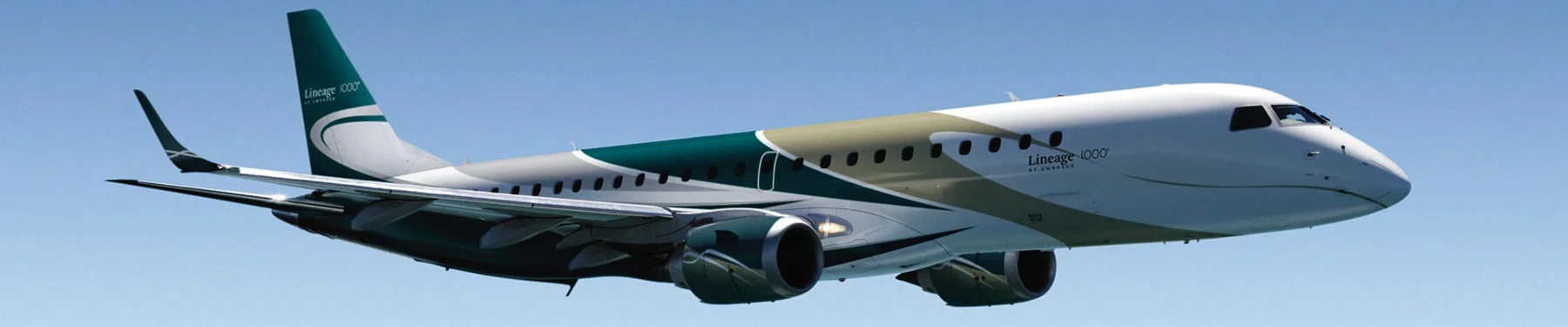
Model profile
Lineage 1000: history and features
The Lineage 1000 was introduced in 2006 as a business variant of the regional E190. Later, an updated version of the 1000E appeared.
Programme development
For the Lineage 1000, Embraer used a large E190 platform, adapting it to business aviation requirements. The late 1000E upgraded the equipment and expanded the program's capabilities. This development path distinguishes Lineage from the smaller Legacy, Phenom and Praetor, created for other segments.
Design
The origin of the passenger plane explains the large cabin and its division into zones. Lineage differs significantly in scale from Phenom and Praetor; capacity depends on the chosen interior.
Technical features
The Embraer 190 platform gave the Lineage 1000 a wide and long cabin, which can be divided into several independent zones. Additional fuel tanks helped to adapt the regional airliner to the tasks of long-haul business flights.
Purpose and uses
A large salon can be divided into several zones and equipped for a long stay of the group. The size of the passenger aircraft affects airport requirements and operating costs. When comparing with small business jets, it should be borne in mind that the volume of space and route efficiency solve different problems.
Its place in the family
Lineage 1000 is the original VIP version of the Embraer E190.
The platform and its development
The Lineage 1000 is based on the passenger Embraer 190, so its fuselage is much larger than that of Phenom or Praetor. The interior space can be divided into several areas for meetings, food and sleep. Additional tanks help to solve long-distance business tasks, which the original regional airliner did not set. The updated Lineage 1000E develops this platform with equipment changes.
A large cabin is useful for a long flight of a large group, but the size of the aircraft affects the choice of airport and costs. The number of seats in the business layout is much less than the passenger capacity of the usual E190; this is the result of a different task, not a loss of utility. When comparing 1000 and 1000E it is necessary to take into account the engine, equipment and the year of production of a particular side. One photo of the interior does not describe all individual VIP configurations.
Space in the salon
Lineage 1000 has a published cabin height of 2.01 m, width of 2.68 m, length of 25.58 m. Height helps to assess the convenience of movement along the aisle, width - the space between the seats. These are the dimensions of the cabin, not the free passage: decoration, furniture and the location of the seats affect the feeling of spaciousness. For a specific board, it is worth looking at the plan and photos of the interior.
Which means distance.
For the Lineage 1000, the catalogue lists a maximum range of 8,334 km (4,500 nautical miles). This is a benchmark for comparison, not a promise of non-stop travel with any number of passengers. The oncoming wind, airspace bypasses, a lot of luggage and a supply of fuel for care at another airfield change the possible route. Maximum capacity and maximum range cannot be automatically added to a single scenario.
Luggage and travel preparation
The specified volume of the luggage compartment Lineage 1000 is 12.54 m3. It is impossible to translate it into the exact number of suitcases without the size of bags: the shape of the compartment, the opening of the door and the permissible weight are important. Skis, baby carriages or equipment should be matched in size. Separately, the availability of baggage in flight is specified - the volume of the compartment itself does not say anything about it.
Position on the range among the models of the manufacturer
The Embraer Executive Jets catalog for Lineage 1000 lists 4,500 nautical miles. Among the 12 models of the manufacturer of the same type with published range, the aircraft takes 12th place when sorting from a smaller value to a larger one. The nearest Lineage 1000E has 4,400 nautical miles published: the difference is 100 nautical miles, or about 2% of the comparable model. This shows the scale of the difference more accurately than the conditional division of aircraft into “medium” and “long-range”. For the current model, this is a comparison of passport values; a separate flight is planned according to the actual mass and weather conditions.
Proportion of salon in comparison
Lineage 1000 published the length of the cabin 25.58 m, width 2.68 m and height 2.01 m. These three sizes describe different properties: length determines how many separate groups of furniture can be placed, and width and height affect the convenience of each zone. For comparison, the Legacy 650 published a length of 15.09 m, a width of 2.08 m and a height of 1.82 m. The difference in length is 10.49 m; it can affect the ability to separate the working group of seats from the rest area. The width differs by 0.6 m, which is important for the location of the seats and passage. The comparison relates to the dimensions of the empty cabin, and not to the available area after installing the kitchen, partitions and seats.
Capacity and payload
The Lineage 1000 has a maximum passenger capacity of 19 people. The Lineage 1000E has up to 18 passengers. The difference is 1 seat; this can change the composition of the group or allow you to give up part of the seats for the sake of a freer layout. The luggage volume of Lineage 1000 is 12.54 m3. The number of seats alone does not indicate how much luggage will actually fit on board. When comparing aircraft, a combination of passengers, fuel and luggage should be checked: the maximum figure for each of these parameters usually describes different design cases. It is this combination that determines how much the published range fits a group with a specific number of things.
Close to Model Capabilities
The Lineage 1000 is part of the Lineage line. When sorted by published range, Lineage 1000E (4,400 nautical miles, up to 18 passengers) is closest. These options differ not only in the route: the number of seats, cabin proportions and the generation of equipment have to be compared separately. If you need another passenger or more luggage, the close range of two aircraft does not mean equal suitability for the trip. If the decisive is the airfield, additionally compare the runway restrictions of specific modifications. For the released board, the year of manufacture, installed avionics and the actual interior are significant.
The history of Embraer: from Brazil to world aviation
Embraer was founded on 19 August 1969 as a mixed-capital company under state control. Its origins are linked to Brazil’s CTA and ITA engineering institutions and the Bandeirante project developed by Ozires Silva’s team. Manufacturing began in January 1970 in São José dos Campos. Passenger and military programmes laid the foundations for further growth.
Embraer entered business aviation with the Legacy 600, based on the regional ERJ. It then moved to purpose-built business jets: the Phenom and Legacy 450/500. The Praetor family was introduced in 2018. This progression shows how the experience of a large aircraft manufacturer gradually developed into a distinct approach to business aviation.
Engineering philosophy: building around the customer’s needs
Embraer Executive Jets links its approach to engineering innovation and continuous improvements in the customer experience. The work encompasses the aircraft, interior and maintenance, using feedback from owners and crews to develop models. Experience in passenger and military aviation provides a foundation for new business aircraft platforms.
One example is the digital fly-by-wire system on the Praetor 500 and 600, which actively reduces the effects of turbulence. It detects disturbances and adjusts control surfaces to help smooth the ride. The technology addresses a need passengers can readily understand: reducing the shaking they feel. Together with cabin development, it shows how engineering relates to the everyday travel experience.
Phenom, Praetor and the larger Legacys
The Phenom 100 is a very light jet and the Phenom 300 a light jet. The Praetor 500 and 600 offer larger cabins and greater long-range capability. In February 2026, Embraer introduced the updated Praetor 500E and 600E with passenger cabin changes; the additional letter identifies a specific version.
The Legacy 600/650 and Lineage 1000 retain links to regional passenger platforms and take a different approach to cabin volume. Compare them with the Phenom and Praetor against the intended journey: passenger numbers, baggage, flight duration and airport requirements. A larger aircraft is particularly valuable when its space will actually be used.