
Fighter aircraft / J-7
Chengdu J-7
The Chengdu J-7 is a Chinese supersonic fighter derived from the MiG-21F-13. Its long production history produced numerous domestic and export F-7 variants.
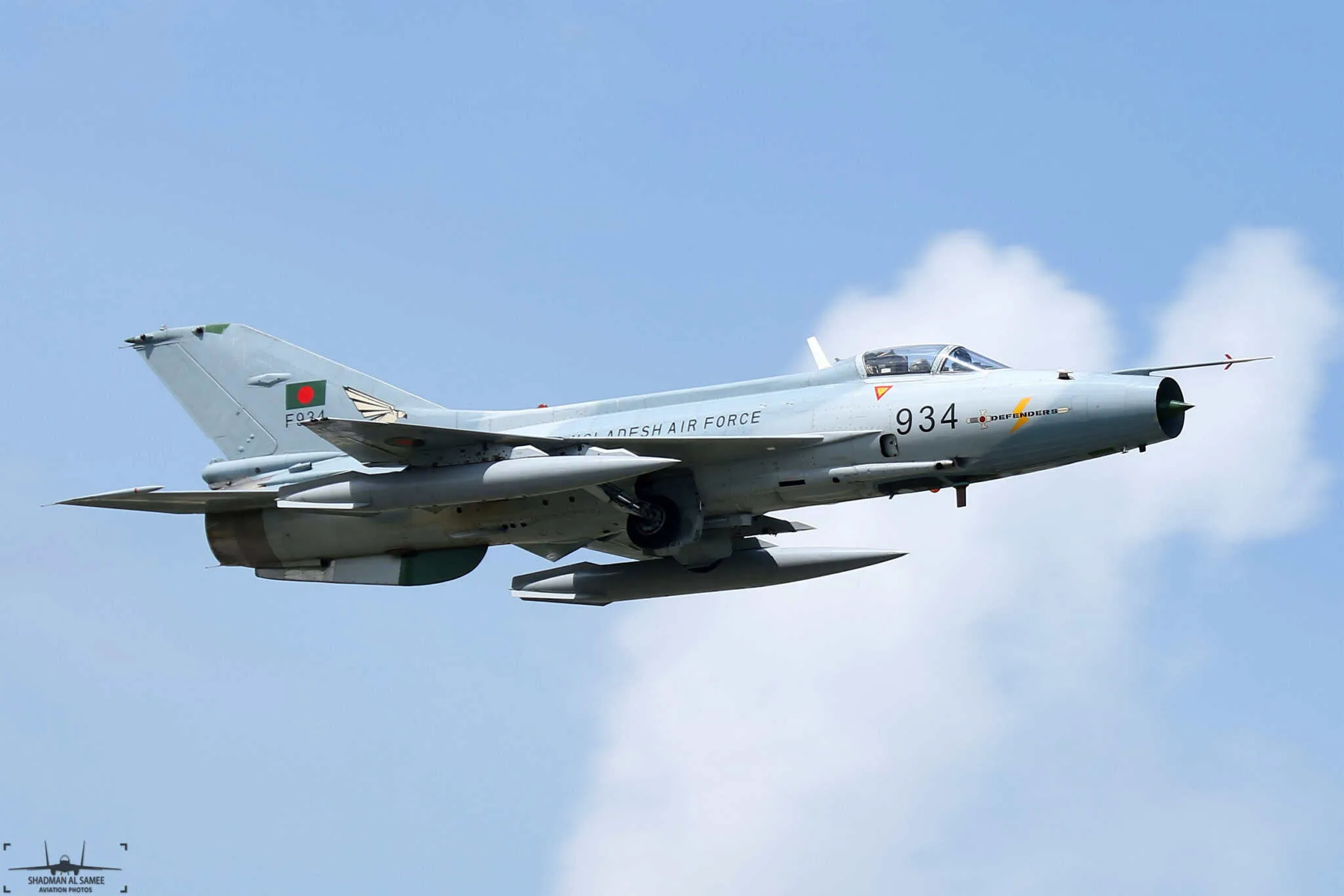
Development
History
The Chengdu J-7 is a Chinese development of the Soviet MiG-21 that became one of the country's longest-running and most varied fighter programmes. China received MiG-21 materials in the early 1960s, but deteriorating relations with the Soviet Union disrupted the transfer of technology. Chinese engineers had to reconstruct missing details and establish production themselves. The first locally assembled aircraft flew in January 1966. Chengdu later became the main centre for manufacturing and improving the family.
The basic J-7 retained the defining layout of the early MiG-21: one engine, a delta wing, a nose air intake, and a compact fuselage. This arrangement made a relatively small supersonic interceptor possible. Limited space in the nose, however, complicated the installation of a large radar, while fuel capacity and equipment varied between versions. The designation J-7 alone therefore does not establish the exact characteristics of a particular aircraft.
Early production batches addressed the immediate need to master manufacture and support Chinese units. Later variants introduced changes to engines, sights, communications, and weapons. Some late versions gained a revised wing and substantially updated avionics. The fighter evolved over decades, so an early J-7 and a later J-7G cannot be described with a single list of instruments. Development dates, installed systems, and flight qualities have to be attached to specific designations.
Export aircraft commonly carried the F-7 designation. They were supplied to different foreign customers, with equipment shaped by national requirements and the period of production. One export F-7 could differ from another in more than its markings: displays, weapon controls, and permitted armament might change as well. General specification tables are useful guides but do not replace descriptions of individual series. Two-seat trainers formed another distinct part of the wider family.
In service, the J-7 was primarily a fighter and interceptor. Its compact size, established industrial base, and many versions helped keep it useful after newer aircraft appeared. At the same time, advances in radar, missiles, and information sharing gradually limited the capabilities of early models. A comparison with later fighters must take the generation of equipment into account, rather than rely only on maximum speed or the visible shape of the airframe.
The J-7 story traces China's move from reconstructing an acquired design to sustaining a lengthy domestic modernization programme. Its importance lies in the many aircraft built on one aerodynamic foundation for both domestic use and export. A reliable account separates the original model, later revisions, and foreign-market versions, stating confirmed facts without attributing one production batch's capabilities to the entire family.