
Fighter aircraft / F-102
Convair F-102 Delta Dagger
Convair's F-102 Delta Dagger was designed as a specialised interceptor for the defence of North America during the Cold War.
Development
History
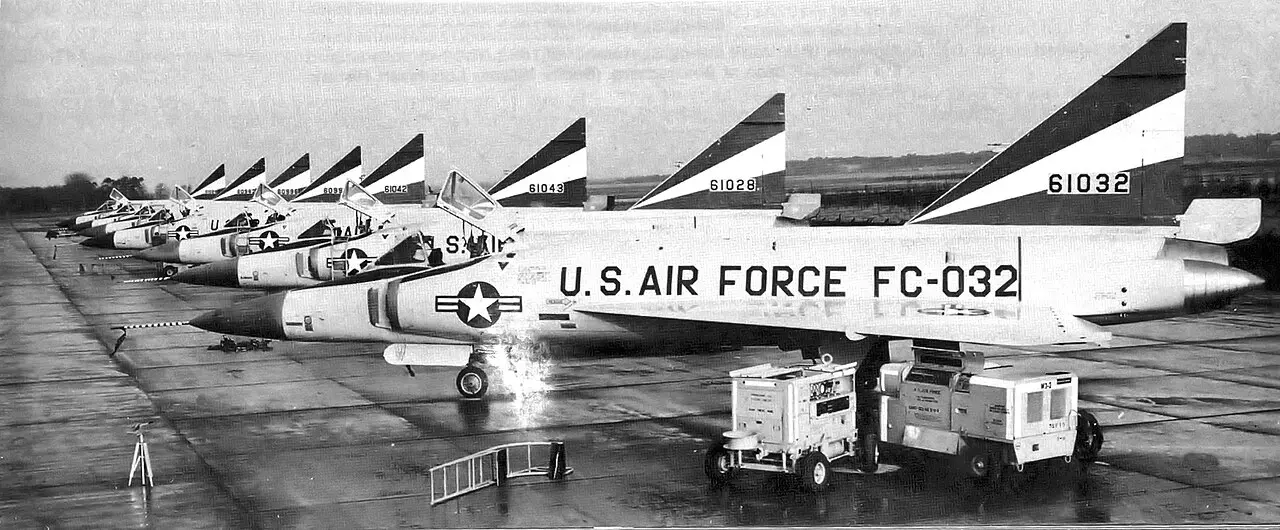
Convair's F-102 Delta Dagger was designed as a specialised interceptor for the defence of North America during the Cold War. It was expected to find and attack high-altitude bombers in all weather while working with a ground-based warning network. The prototype first flew on 24 October 1953. Before entering service, the programme faced a major aerodynamic problem: the initial configuration could not achieve the intended supersonic performance. Reshaping the fuselage according to the area rule helped overcome that limitation.
The F-102 became the first operational American delta-wing fighter and an early supersonic all-weather interceptor. A delta wing offered benefits at high speed but brought its own low-speed handling demands. The aircraft carried radar and a fire-control system intended to guide an interception using information from ground stations. Its weapons were housed inside the fuselage, reducing drag compared with external stores. The primary mission was defensive interception rather than sustained manoeuvring combat against other fighters.
After entering service in 1956, Delta Daggers equipped United States air-defence units. Crews kept alert, practised rapid climbs, and worked toward assigned targets using information from a wider network. This routine produced fewer dramatic combat stories than other fighter careers, but it demanded dependable radar, communications, and highly prepared ground teams. The interceptor's effectiveness depended on the whole detection and command system; the aircraft was a vital part of that system rather than a self-contained solution.
A two-seat TF-102A trainer was developed with a substantially altered nose. A more powerful successor was also planned, originally as the F-102B. The changes eventually became so extensive that the result received a separate designation, F-106 Delta Dart. These aircraft are related by development but are not simply identical variants. The F-102 programme illustrates how difficult requirements for supersonic speed and automated interception could force engineers to reconsider an initial design.
Some F-102s served beyond the continental United States, and aircraft were later supplied to allied operators. As more capable interceptors arrived, the Delta Dagger's role diminished. Its historical importance lies in the combination of delta-wing design, all-weather interception, and the aerodynamic lesson learned about transonic drag. The type is also a reminder that solving a serious flight-test problem can require extensive changes before a production aircraft fully enters frontline service.