
Fighter aircraft / Kfir
Israel Aircraft Industries Kfir
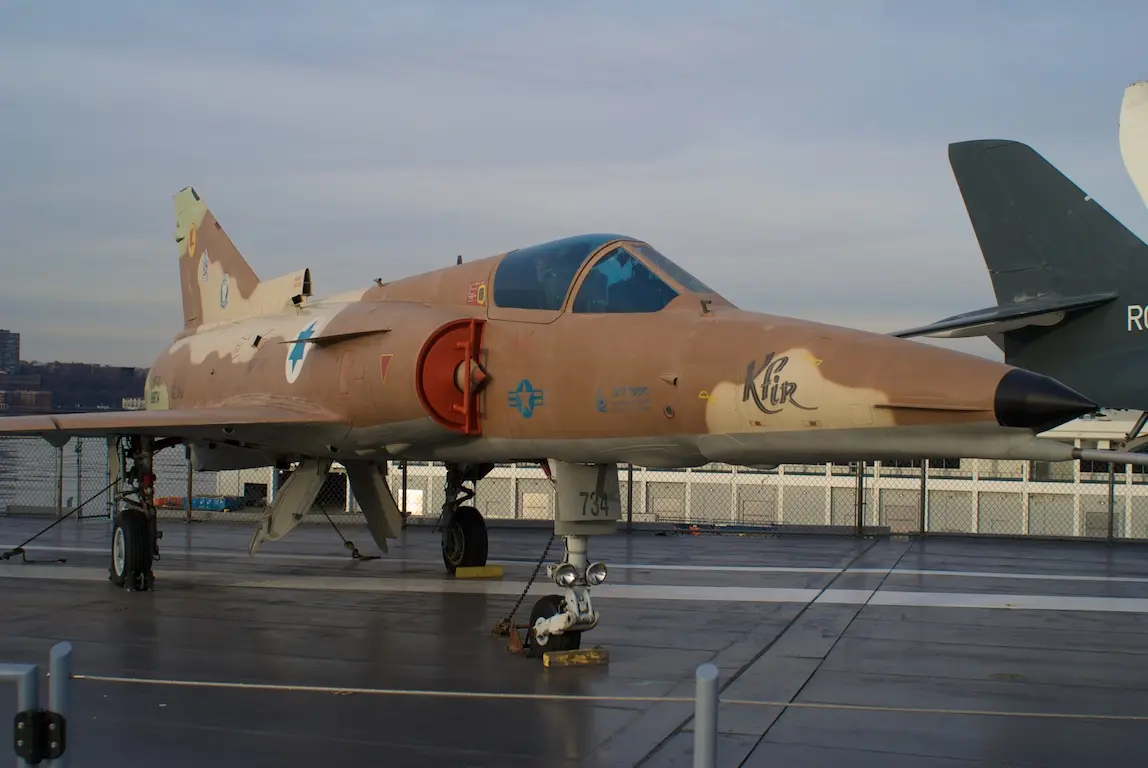
The IAI Kfir is an Israeli fighter-bomber developed from the Mirage 5 and Nesher line with a different engine and equipment. It entered Israeli Air Force service in the mid-1970s.
Development
History
The IAI Kfir was the next step in Israel's fighter programme after production of the Nesher. Both aircraft share a lineage connected to the Dassault Mirage 5, but the Kfir was not merely its predecessor under another name. Engineers adapted the design for a General Electric J79-family engine and changed several systems. Israel Aircraft Industries dates the Kfir's entry into Israeli Air Force service to 1975. The year 1969 appears in accounts of the project's early origins, but should not be presented as the verified first-flight date of the production Kfir.
Changing the engine affects much more than top speed. Intakes, cooling, equipment placement, weight, and balance must all be reconciled with the new powerplant. The move from Nesher to Kfir was therefore an engineering programme rather than a straightforward maintenance substitution. The aircraft kept a recognizable delta wing, but its capabilities came from the combination of airframe, engine, weapons, and avionics. Different versions evolved as experience accumulated.
In Israeli Air Force service, the Kfir was used as a fighter-bomber. It could undertake varied missions depending on its series and installed equipment. The C1, C2, and C7 designations represent stages of development, not merely changes in paint or minor fittings. The armament and avionics of a particular aircraft need to be tied to its variant and upgrade date. Treating the entire family as one fixed standard would be inaccurate, especially when comparing aircraft operated by different countries.
The Kfir also had a career abroad. Some aircraft were used to train American pilots against a simulated adversary; these machines carried the US F-21 designation. That training role was different from ordinary Israeli combat service. Other countries operated their own versions, which underwent maintenance and upgrades. The manufacturer has reported modernization of Sri Lanka's fleet, illustrating how support for the design continued many years after its initial production.
The Kfir's long life reflects the possibility of adapting an established airframe to new systems and missions. Yet a modernized example should not be judged solely by specifications of an early production aircraft. Radar, communications, cockpit, weapons, and remaining structural life may differ substantially. When studying public photographs, visible details need to be separated from the unseen equipment fit. Even a shared type name does not guarantee identical capabilities across decades of service.
Historically, the Kfir shows Israel's progress from manufacturing an aircraft related to a French design toward a more extensive platform redesign and export programme. It is connected to the Nesher but has its own history of propulsion, variants, and operators. A useful description preserves that sequence, avoids a disputed first-flight date, and distinguishes early Israeli service from later export versions and specialized training aircraft.