
Fighter aircraft / Ла-5
Lavochkin La-5
The La-5 emerged during the Second World War as an urgent redesign of the LaGG-3 fighter.
Development
History
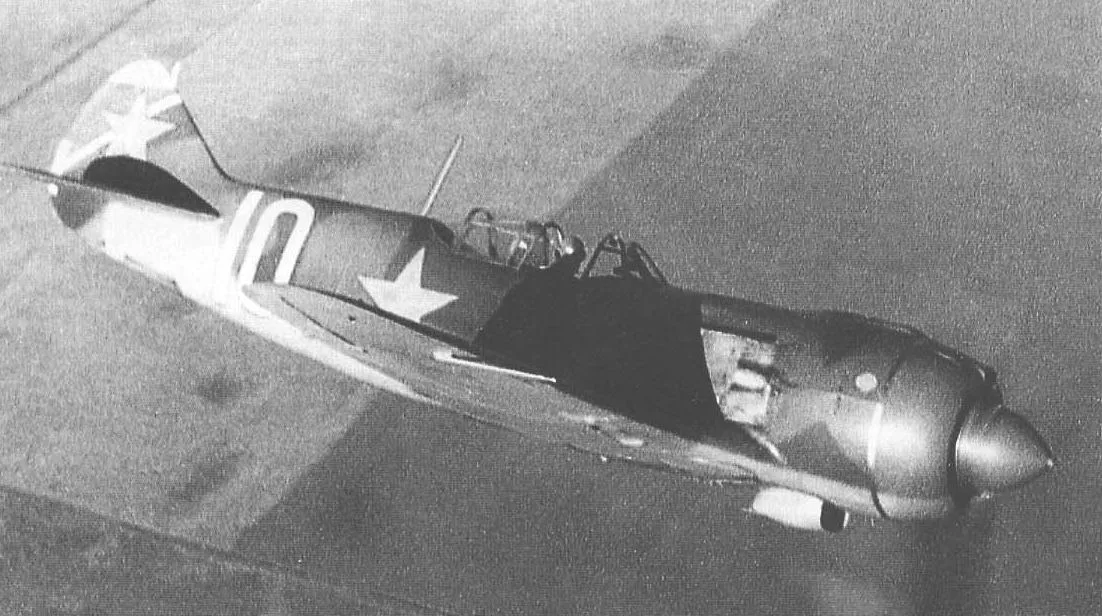
The La-5 emerged during the Second World War as an urgent redesign of the LaGG-3 fighter. The earlier aircraft lacked enough engine power for some frontline demands, so engineers installed the stronger air-cooled M-82 radial in place of its inline engine. A prototype first flew in the spring of 1942. The new powerplant required changes to the nose, weight balance, and cooling, but allowed much of an established production design to remain useful. The fighter soon entered series manufacture and frontline service.
The La-5 was particularly suited to combat at the heights common on the Eastern Front. Its radial engine offered greater power without a vulnerable liquid-cooling circuit, although the broad cowling affected visibility and aerodynamics. Cannon formed its principal armament, with details varying among production batches. Aircraft built at different times were not identical. The La-5F gained an improved engine and better visibility, while the La-5FN added direct fuel injection and further weight reduction.
Combat units used the La-5 to protect troops, escort attack aircraft, and fight opposing fighters. At low and medium altitudes, improved versions could be effective in manoeuvring combat, but that did not guarantee superiority in every encounter. Starting height, pilot skill, fuel state, and coordination within a formation shaped the result. The quality of mass production and the condition of engines also affected what a pilot could actually expect from an aircraft at a particular base.
Designers continued correcting shortcomings during production. Sealing, cockpit view, engine controls, and ease of manufacture were improved. Ground crews had to maintain a powerful engine and numerous mechanical systems at wartime airfields. For the Soviet air force, improving a prototype's flying qualities was only part of the task; it needed enough serviceable aircraft and a dependable supply chain. La-5 production reached a large scale, and further development eventually produced the La-7.
The La-5 story illustrates the value of redesigning an existing aircraft at the right moment. Changing the engine was more than exchanging one component: it altered performance and demanded solutions for cooling, strength, and handling. The fighter became an important part of Soviet aviation in the middle of the war, when rapid production and the capacity for further improvement mattered as much as individual record figures.