
Fighter aircraft / Ла-7
Lavochkin La-7
Lavochkin La-7 is a fighter aircraft. Its first flight took place in 1944.
Development
History
The La-7 emerged when Soviet front-line aviation needed a fast fighter for combat at low and medium altitudes. It was a substantial refinement of the La-5FN rather than a wholly new aircraft. Semyon Lavochkin's design bureau retained a single-seat fighter with a radial engine and concentrated on reducing drag, saving weight, and improving the pilot's view. That was a practical wartime choice: factories already knew how to build the La-5 family, and a replacement had to enter production without interrupting deliveries to operational units. The history of the La-7 is therefore a story of engineering gains achieved within the limits of an established production system.
By 1943 the La-5 had become a familiar aircraft in Soviet fighter regiments, but its designers and researchers believed that it could be improved. Engineers at the Central Aerohydrodynamic Institute studied the flow of air around the cowling, wing, and fuselage. An experimental La-5FN was modified with better cowling seals and rearranged equipment. The tests suggested that a useful increase in speed was possible without fitting a completely new engine. Lavochkin incorporated this work into a further development of the type. The first prototype, initially regarded as an improved La-5FN, flew in early 1944. Following trials, the revised fighter entered production under its own designation, La-7.
An important change was almost invisible from outside. The wing used metal spars in place of wooden ones, saving weight while retaining the required strength. The new structure also made better use of the available internal space. The fighter did not become an all-metal aircraft: wartime factories still relied on familiar materials and established methods. Designers streamlined the junction of wing and fuselage, closed gaps in the engine cowling, and reconsidered the path taken by air entering the engine. The oil cooler moved away from the front of the aircraft to a position beneath the cockpit, while the engine intakes were placed near the wing roots. The La-7 looked much like its predecessor, but the combined effect of these changes improved performance.
The production fighter was a single-seat low-wing aircraft with retractable main undercarriage and a tailwheel. Power came from an air-cooled piston engine of the Shvetsov ASh-82 family. For a pilot, the refinements meant better acceleration, climb, and opportunities to gain a useful position before attacking. Exact performance varied with altitude, production batch, and the condition of an individual aircraft. Reference works commonly give a maximum speed around 660 kilometres per hour at the appropriate height, but that number should not be treated as a guarantee for every machine. On an operational airfield, maintenance, engine adjustment, and fuel quality could all influence what a fighter was able to do.
Armament illustrates the difference between an experimental design and a production aircraft. The prototype was intended to carry three 20-millimetre B-20 cannon. Those guns were not yet available in sufficient numbers when production began, so early La-7s generally retained the two ShVAK cannon familiar from the La-5. Later aircraft could be equipped with three B-20s. A museum label stating only “La-7” therefore does not identify the exact gun installation or other equipment fitted to a particular airframe. The sight, radio, cockpit visibility, and reliability of the engine mattered in combat as much as the published top speed. Each of these features affected how quickly a pilot could find a target, coordinate with others, and return safely.
La-7 fighters reached Soviet units in 1944, as the war moved westward. Early combat use revealed both the value of the improved flying qualities and the maintenance difficulties that could accompany a new type. Pilots valued its speed and manoeuvrability, while ground crews had to work through engine faults and servicing demands. Regiments used the aircraft for escort, interception, and fighter combat; some also undertook reconnaissance tasks. No fighter succeeded on performance figures alone. Formation discipline, the relationship between leader and wingman, the height at which a group entered combat, and early sighting of an opponent could all decide an engagement. Better climb performance gave pilots more freedom to choose a position from which to attack.
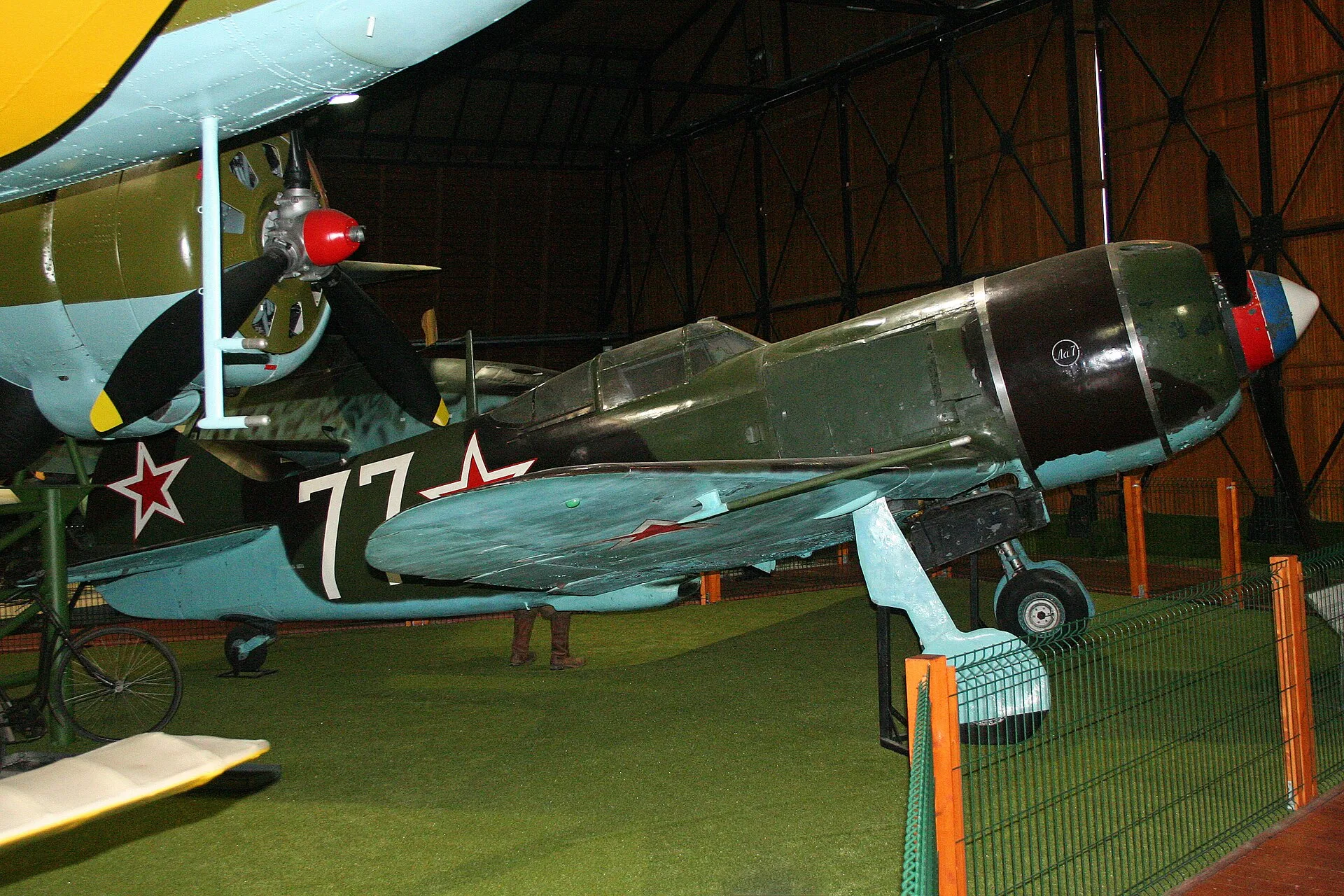
The aircraft is strongly associated with Ivan Kozhedub, one of the best-known Soviet pilots of the Second World War. His La-7 with the white number 27 survives at the Central Air Force Museum at Monino and has become a visual symbol of the type. Yet the history of the aircraft extends far beyond one pilot. Several factories built La-7s, production batches differed, and the experience of many fighter regiments shaped its reputation. Thousands had been made by the end of the war, and both production and service continued for a time after 1945. Czechoslovakia received a number of the fighters and used the designation S-97. One surviving Czechoslovak aircraft is displayed at the Prague Aviation Museum in Kbely.
Jet fighters soon changed the expectations placed on front-line aircraft, and the piston-engined La-7 gradually gave way to a new generation. Its significance is not limited to its relatively short service life. It demonstrates how careful aerodynamic work, lighter structural parts, and attention to existing production capacity could transform an established design. It also shows why a prototype, a wartime production example, and a restored museum exhibit should not be treated as identical. Paintwork and equipment on surviving aircraft may not precisely reproduce the appearance of a given wartime unit. Understanding the La-7 calls for the technical story, factory constraints, and pilots' operational experience to be considered together.