
Fighter aircraft / C.205
Macchi C.205 Veltro
The Macchi C.
Development
History
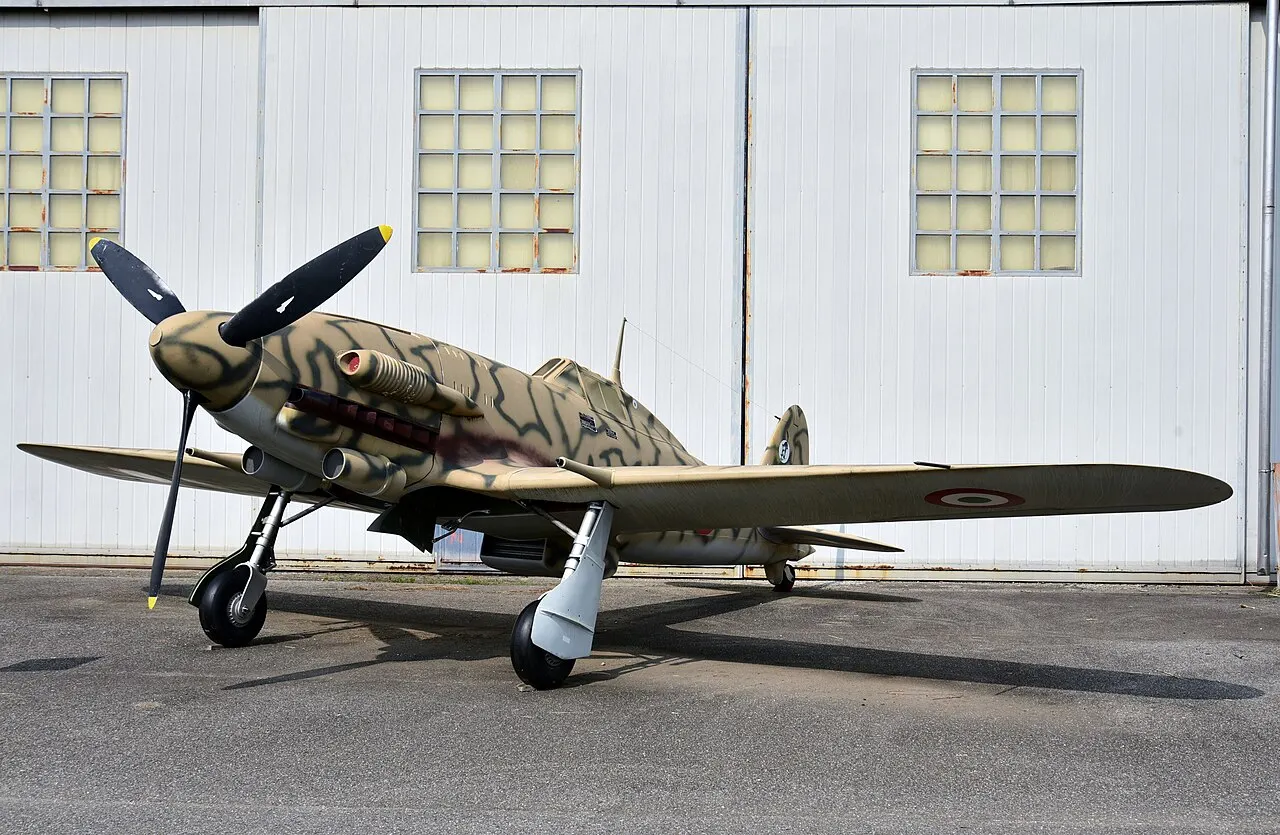
The Macchi C.205 Veltro was a further development of Italy's C.202 Folgore. Designers wanted a faster, more heavily armed fighter while retaining parts of an airframe already familiar to factories. The first C.205 flew in April 1942. Its principal change was a more powerful Daimler-Benz DB 605 engine, produced under licence in Italy. The new engine required alterations to the aircraft and a different supply effort, so Veltro was more than a C.202 given another name.
The aircraft remained a single-seat, low-wing fighter with retractable landing gear. Greater engine power improved speed and climb, while changing the balance of other flying qualities. Cannon fitted in the wings of some production series were an important addition to the machine guns. A specific Veltro must be identified by series before its weapons and equipment are described. A speed or range figure without a stated version and test conditions says little about what an operational unit could accomplish.
Production C.205s reached Italian fighter units in 1943, when the military situation was changing rapidly. They were employed in air defence and combat against opposing aircraft. After the September 1943 armistice, surviving machines appeared in different Italian air formations operating on opposite sides of the front. The phrase Italian service therefore covers several distinct histories. It cannot be reduced to one operator or one set of missions.
Veltro belonged to a generation of Italian fighters fitted with the DB 605. Fiat G.55 and Reggiane Re.2005 are often mentioned in the same group, but they were separate designs. The C.205 retained a close connection to the C.202 while having its own wing and handling characteristics. Production remained limited against the scale of the war. Even a capable fighter could not overcome shortages of fuel, trained crews, spare parts, and secure airfields.
Some surviving C.205s were used for training and other purposes after the war. The aircraft's historical significance lies in a rapid attempt to improve an established fighter under severe industrial constraints. It shows how greater power and stronger armament could change a family's capabilities without removing dependence on production and support. Any precise account needs the aircraft's series, engine, weapons, operator, and exact period of service.