
Fighter aircraft / P-51
North American P-51 Mustang
The P-51 Mustang began with a British requirement in 1940.
Development
History
The P-51 Mustang began with a British requirement in 1940. Britain asked North American to build Curtiss P-40 fighters under licence, but the company proposed a new design of its own. The NA-73X prototype was flying by the autumn of that year. Early Mustangs entered British service, and American forces later became interested in the aircraft. The short interval between a customer's request and a flying prototype became one of the programme's distinctive achievements.
Initial Allison-powered aircraft were especially useful at low and medium altitude. Fitting the Merlin engine, also built under licence by Packard, greatly improved high-altitude performance. Combined with efficient aerodynamics and external fuel tanks, this made the Mustang a long-range escort fighter. It could accompany heavy bombers far into Europe and help protect them through parts of the route where fighter cover had previously ended. That operational reach was at least as important as maximum speed.
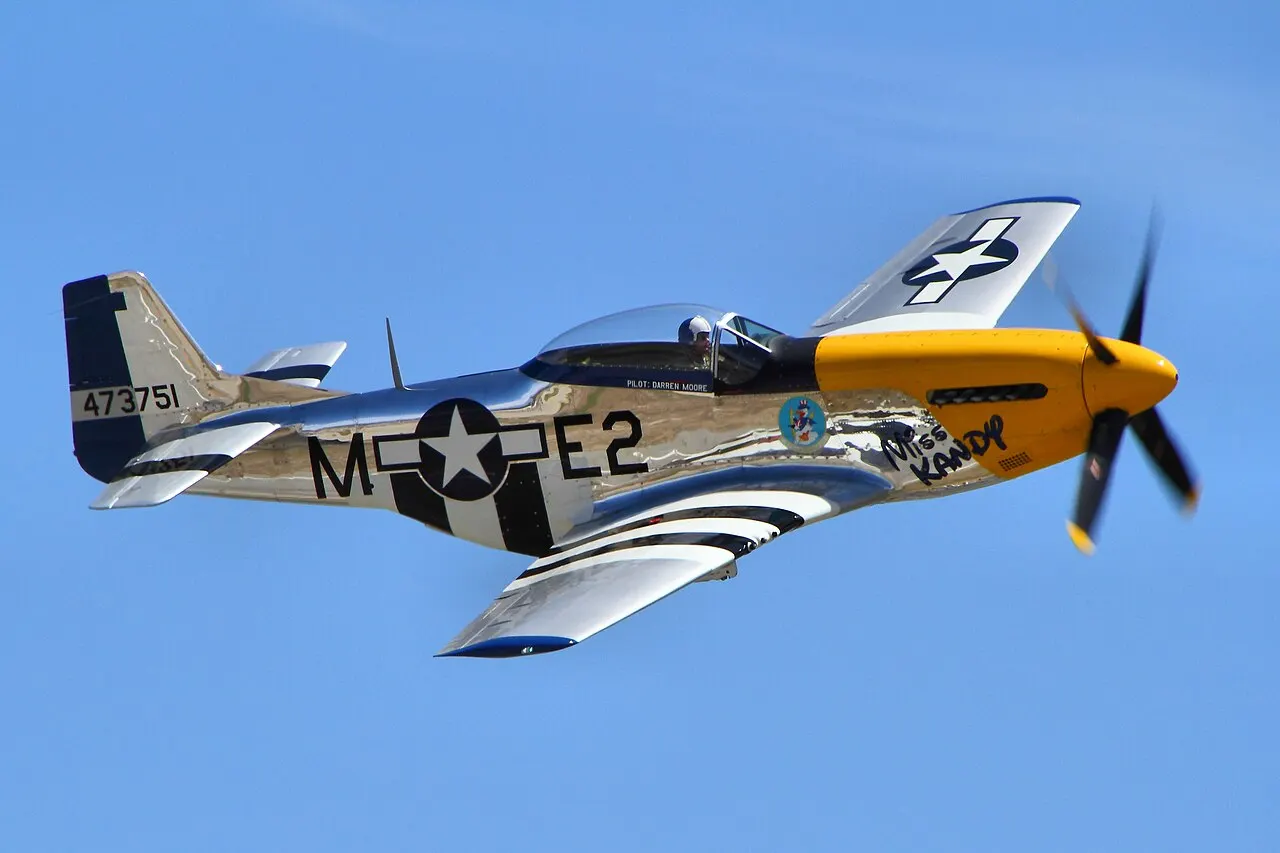
The best-known P-51D variant received a canopy that improved rearward visibility and carried six heavy machine guns. Equipment varied by production block, and reconnaissance and attack versions also existed. The Mustang combined speed, manoeuvrability, and endurance, but its liquid-cooling system could be vulnerable to damage. It was not automatically superior to every opponent in every encounter: altitude, tactics, pilot experience, and the specific situation all influenced the result.
In Europe, P-51s became central to the American bomber-escort campaign. Fighters defended the formations and also pursued opposing aircraft near their bases. Late in the war, Mustangs operated in the Pacific, escorting long-distance missions and attacking surface targets from island airfields. Those theatres required different navigation, supply, and pilot-rescue arrangements. The aircraft also served with allied countries and remained in use after the Second World War rather than disappearing immediately when the fighting ended.
Jets gradually displaced the P-51 from the main fighter role, but the type returned to important ground-support work during the Korean War. Its development shows how a new engine and changing tactics can transform the purpose of an existing airframe. The Mustang's reputation rests on more than its appearance or individual aerial victories. It helped solve a strategic problem by extending fighter protection to heavy bombers during a crucial phase of the European air campaign.