
Fighter aircraft / F-5
Northrop F-5 Tiger II
The F-5E Tiger II was the second major generation of Northrop's lightweight F-5 fighter family.
Development
History
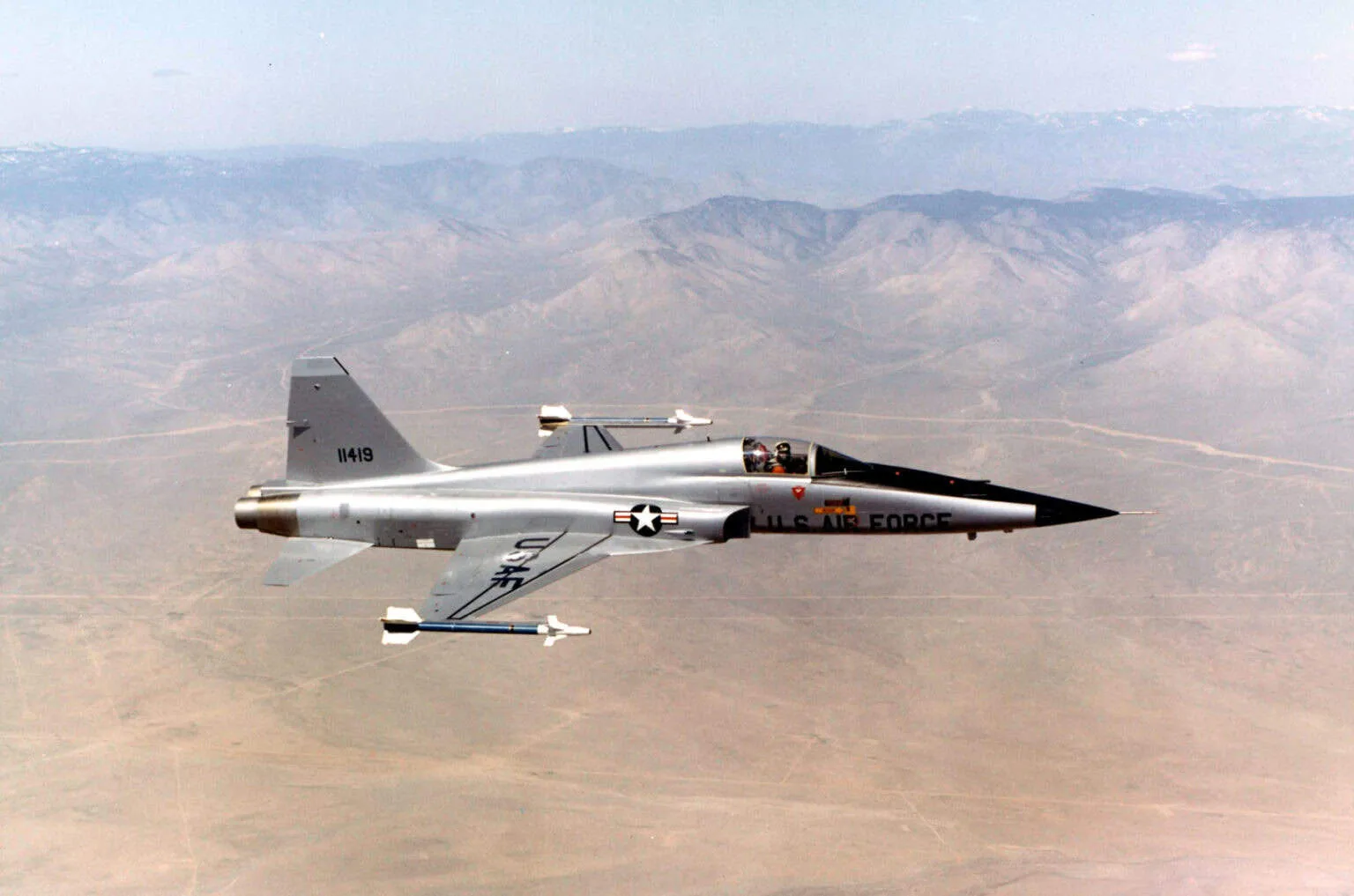
The F-5E Tiger II was the second major generation of Northrop's lightweight F-5 fighter family. The earlier F-5A had been conceived as a relatively straightforward jet for countries seeking modern combat aircraft without the infrastructure needed by larger types. Northrop then revised the design for the International Fighter Aircraft competition. The first F-5E flew on 11 August 1972. Its Tiger II name distinguished the updated aircraft from the original Freedom Fighter and signalled meaningful changes to its equipment and performance.
The F-5E kept the idea of a compact twin-engine fighter but gained more powerful engines, altered intakes, increased fuel capacity, and radar. These changes improved its ability to find and intercept aircraft, although its small size still limited range and payload compared with heavier fighters. Guns and short-range guided missiles formed part of its air-to-air armament, and it could also attack surface targets. Exact avionics and external loads differed among customers and changed during the aircraft's long service life.
The family extended beyond the single-seat F-5E. The two-seat F-5F supported training while retaining combat capability, and the RF-5E reconnaissance variant carried a different sensor installation in its nose. Production and local adaptations also took place outside the United States. Operators valued the aircraft's compact dimensions, manageable support requirements, and training utility. Those advantages did not make support automatic: readiness still depended on spare parts, maintenance skills, and the resources allocated to a particular fleet.
Tiger IIs served in many national air forces. In the United States, the type found a distinctive training role with adversary squadrons, where its size and flying characteristics helped create demanding air-combat exercises for crews of newer fighters. It was not a literal duplicate of a particular foreign aircraft; the point was to provide a useful tactical opponent. Other countries used F-5s in actual conflicts, under varied conditions and with different equipment. Service histories therefore cannot be reduced to a single combat record for every version.
Later fighters gained much more capable radar, missiles, and information systems. Operators responded differently as the Tiger II aged: some upgraded instruments, others shifted aircraft into training, and others replaced the type. Its significance is the successful export of a fighter built around a clear trade-off among price, performance, and ease of support. The F-5E also illustrates how a recognisable airframe can remain relevant by moving from a principal combat role toward specialised training and other missions.