
Fighter aircraft / JF-17
PAC/Chengdu JF-17 Thunder
The JF-17 Thunder is a Pakistani-Chinese light multirole fighter. Its prototype flew in 2003, and joint production in Pakistan has produced several successive Block standards.
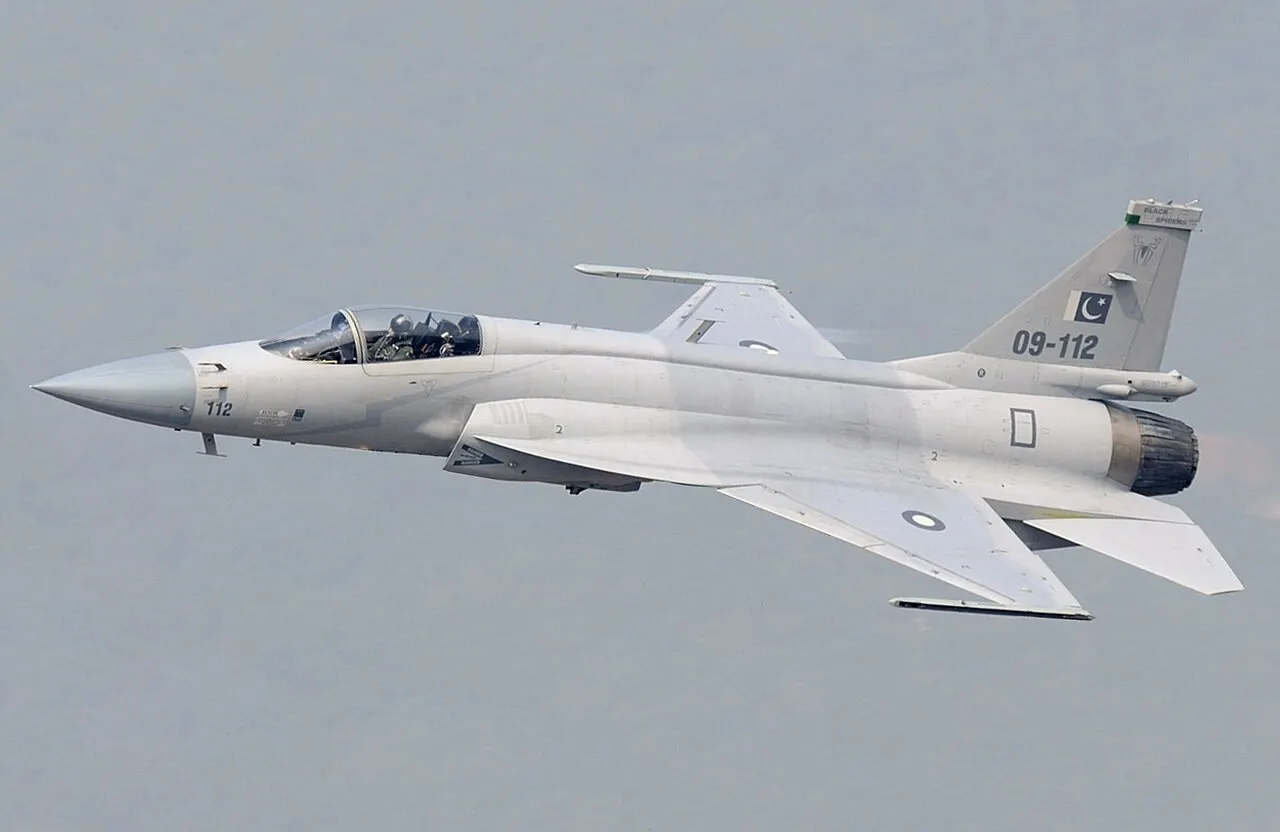
Development
History
The JF-17 Thunder resulted from a joint Pakistani-Chinese programme for a light multirole fighter. Chinese industry carried out a substantial part of the design work, while Pakistan Aeronautical Complex at Kamra became the manufacturing and assembly centre for the Pakistan Air Force. The aircraft is also known in China as the FC-1 Xiaolong. Its first prototype flew in 2003, but regular production required further testing and industrial preparation. Pakistani government accounts distinguish an early small batch from the later start of serial co-production.
The JF-17 has one engine, a compact airframe, and equipment intended for several kinds of mission. Maximum speed is only one aspect of such an aircraft. Avionics, communications, targeting systems, and weapons selection determine how it can be used. Load and range depend on the combination of fuel and external stores. General promotional tables cannot replace a check of the particular version's capabilities. One designation covers aircraft built in different years with different systems.
The early Block I helped establish production and service procedures. Later Block II and Block III standards represent further development of the structure and equipment. A two-seat version was also created for training and other tasks. Introducing a new Block does not automatically give every earlier aircraft the same systems. Radar, cockpit, and armament differences should be connected to a production series or a documented upgrade of an individual airframe.
Joint manufacturing is a central part of the JF-17 story. For Pakistan it involved producing airframe parts, assembling aircraft, flight testing, and developing avionics expertise. The factory had to support aircraft in service as well as deliver them to squadrons. Chinese and Pakistani responsibilities evolved as processes matured. It would be inaccurate to treat the programme as the work of only one country or to assume that every imported subsystem was developed locally.
The Pakistan Air Force is the principal operator. The Thunder is intended to defend airspace and perform other combat tasks within the capabilities of its installed equipment. Exports and additional production standards show the platform's continuing use, but individual customers can receive different configurations. Assessing employment requires knowledge of the variant, pilot preparation, and the rest of the operating force. Appearance in an exercise does not reveal every combat capability.
The JF-17 is a notable example of international cooperation progressing from a prototype to serial service and successive upgrades. Its history is as much about the industrial base at Kamra as about flight performance. An accurate account separates the first flight in 2003 from the start of production, distinguishes Blocks I, II, and III, and avoids assigning later aircraft's characteristics to the first batches.