
Fighter aircraft / J-11
Shenyang J-11
The Shenyang J-11 is a Chinese heavy fighter of the Su-27 family. Early aircraft were assembled under a Russian licence; later versions incorporated Chinese systems and equipment.
Development
History
The Shenyang J-11 is an important chapter in Chinese fighter aviation as a local branch of the Su-27 family. China first bought complete Russian aircraft and then arranged licensed assembly at Shenyang. An early J-11 should therefore be distinguished from later aircraft carrying more Chinese equipment. The family name covers several stages of production and modernization. Specifications for one stage cannot automatically be applied to another.
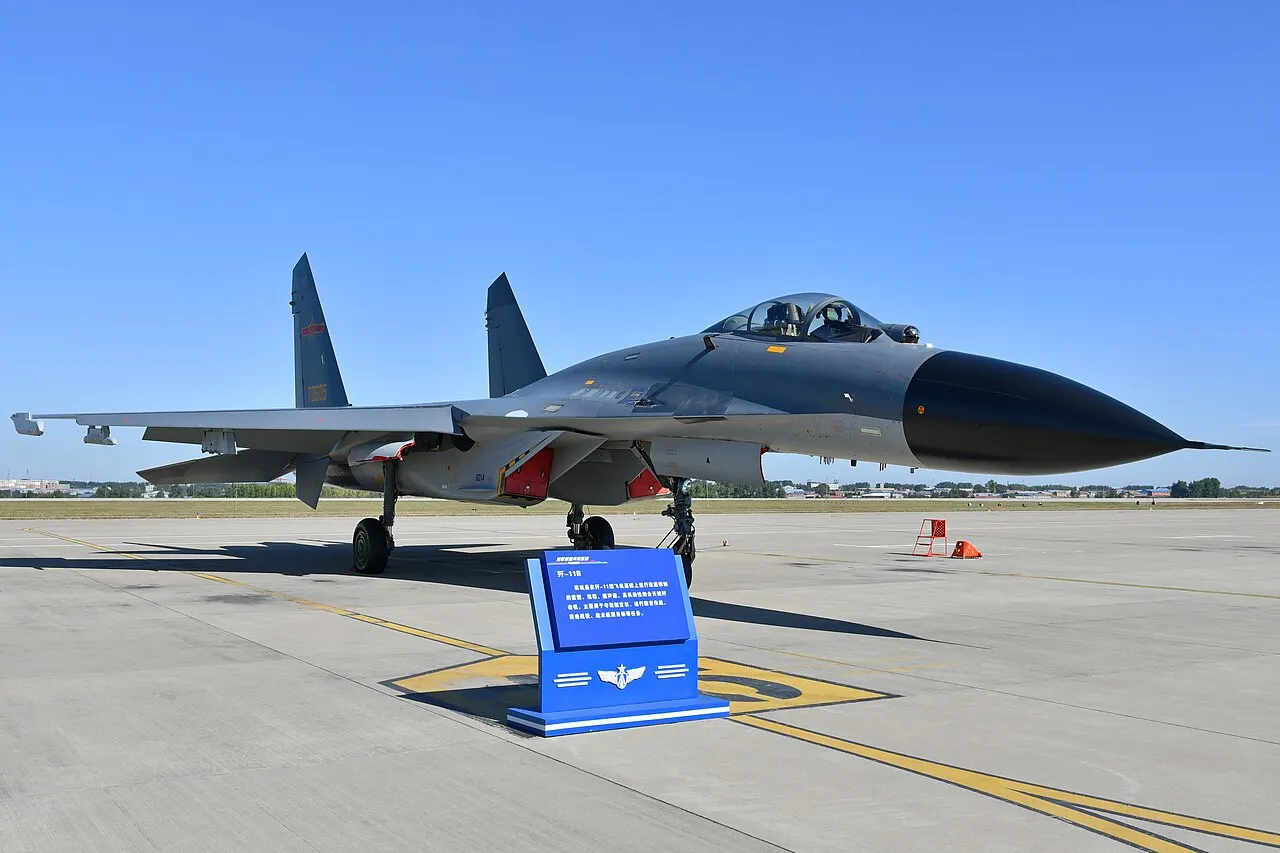
The Su-27 was designed as a large twin-engine fighter with considerable range and maneuverability. China's programme retained this basic layout: a broad blended airframe, widely spaced engines, and large control surfaces give the aircraft its familiar outline. An exterior view, however, cannot establish which radar, communications equipment, displays, or weapons are fitted to an individual aircraft. It is more useful to distinguish the J-11, J-11A, and J-11B by their equipment and production history than by a distant photograph.
Initial production helped Chinese industry learn to assemble, maintain, and support a complex combat aircraft. Developers subsequently increased the share of domestic components. Accounts of the J-11B describe Chinese avionics and weapons; different production batches are also associated with different engines. This transition did not replace every part of the aircraft at once. Suppliers, testing of new equipment, and maintenance training changed in stages. Comparisons of variants should consequently identify the exact version and the period in which it appeared.
The two-seat J-11BS expanded training possibilities and supported tasks that benefit from a second crew member. It looks close to the single-seat fighter, but another workplace changes the cockpit and the way duties are divided during a mission. Later Chinese developments in the same broad twin-engine lineage include the carrier-based J-15 and the multirole J-16. Each had its own programme and purpose; neither is merely a renamed J-11. The J-11 remains a distinct step in the development of China's fighter fleet.
The principal operator is the People's Liberation Army Air Force. Aircraft of this family have been used for air patrol and air-defence duties, although exact loads and capabilities depend on the version. Public estimates of fleet size, the state of individual batches, and their equipment do not always agree. Open sources clearly trace the progression from Su-27 purchases through licensed assembly toward a larger Chinese industrial contribution, but they do not document every aircraft in detail.
The J-11 story illustrates how learning to build and support an imported platform can lead to a broader domestic aircraft family. Aerodynamics and engines are only part of that story. Production organization, avionics upgrades, weapons integration, and crew training matter as well. When examining a photograph or a report about a flight, the variant must be identified and the evidence separated from assumptions. That approach avoids confusing the original licensed series with the later Shenyang developments.