
Fighter aircraft / Су-30
Sukhoi Su-30
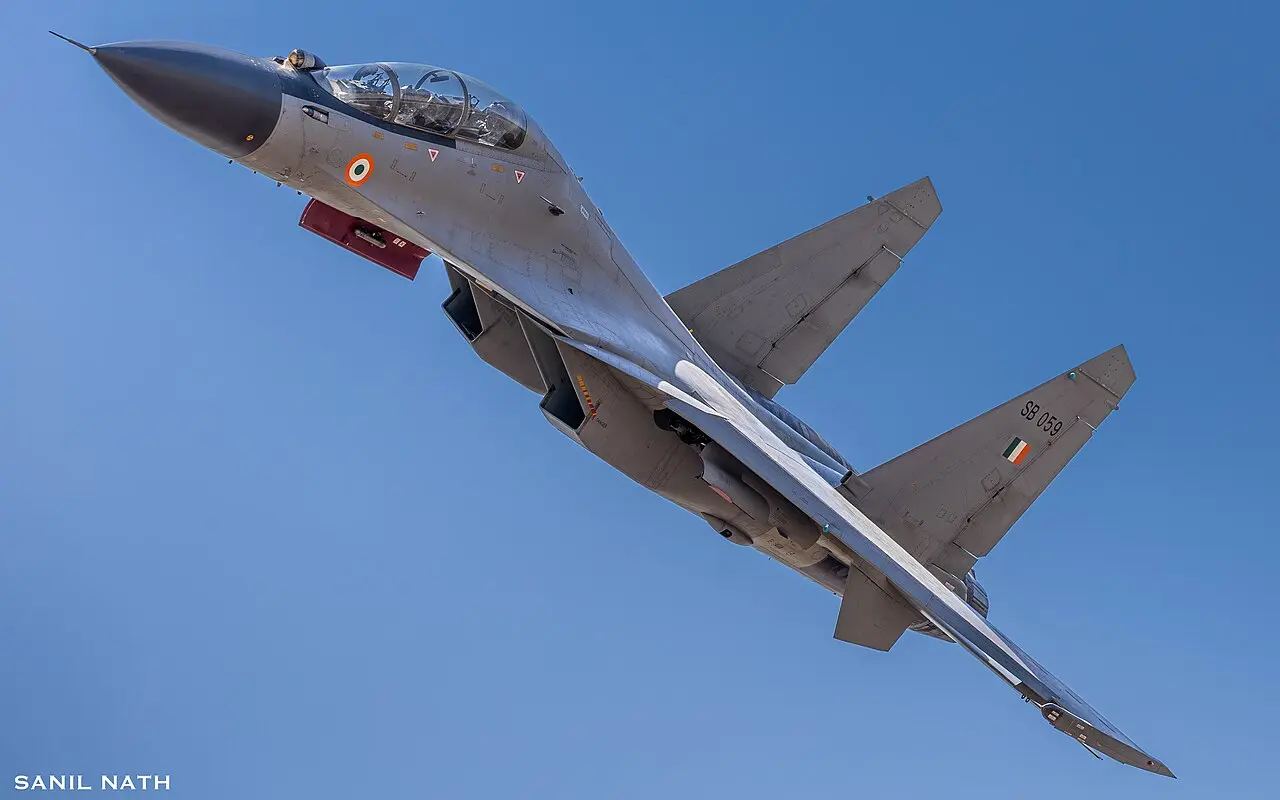
The Su-30 grew from the Su-27 family as a two-seat fighter for longer and more complicated missions.
Development
History
The Su-30 grew from the Su-27 family as a two-seat fighter for longer and more complicated missions. The Su-27UB combat trainer provided the starting point, but the new project assigned the second crew member a wider role in navigation, weapon employment, and the coordination of other aircraft. A prototype known as the Su-27PU first flew on 31 December 1989. The family subsequently moved toward multirole use and export versions tailored to different customers.
A large airframe and two engines provided range and useful payload, while aerial refuelling extended the reach of some variants. These advantages came with greater demands for fuel, suitable airfields, and maintenance. A two-person crew was particularly useful on long flights and when managing both aerial and surface targets. The benefit of sharing tasks, however, depended on crew training and the fitted systems, not merely on adding a second cockpit.
Several production branches carry the Su-30 name. India's Su-30MKI, China's Su-30MKK, and Russia's Su-30SM are not technically identical: avionics, engines, airframe details, and compatible weapons differ. Some versions gained canards or thrust-vector control, while others used different solutions. A comparison of specifications must identify the exact model and the stage of its upgrade programme.
Depending on configuration, the aircraft can fight other aircraft and attack land or maritime targets. Radar, electro-optical sensors, communications, and missiles shape its capabilities, but results also depend on intelligence, planning, supply, and opposition. The Su-30 was exported widely, and some customers established local assembly or support. For those operators, introducing the type was a long-term commitment to instruction and maintenance rather than a one-time purchase of aircraft.
The Su-30 story shows how a successful heavy-fighter foundation can become a family with different missions and national configurations. Two seats, range, and space for upgrades helped the platform evolve after the Cold War. At the same time, a shared name conceals substantial technical differences. Understanding a particular Su-30 requires attention to its variant, installed equipment, weapons, and operating conditions in a specific air force.