
Fighter aircraft / Су-35
Sukhoi Su-35
The Su-35 designation has been used for two stages in the development of the Su-27 family.
Development
History
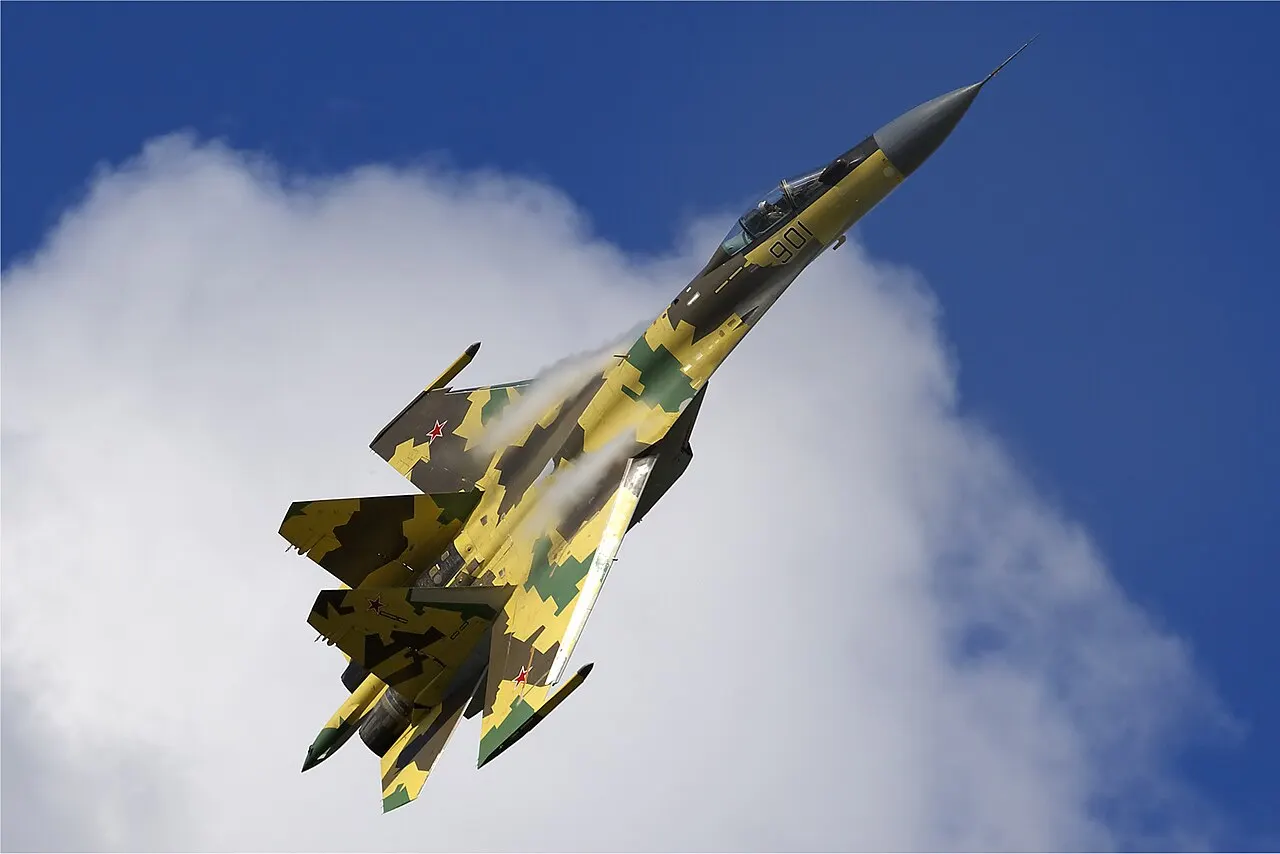
The Su-35 designation has been used for two stages in the development of the Su-27 family. In the late Soviet period, an upgraded Su-27M was tested and later shown as the Su-35. It introduced new equipment and canards but did not become a large production programme. Today's Su-35S belongs to a later, deeper redesign of the platform. Its prototype first flew on 19 February 2008. Keeping these lines separate prevents dates and characteristics from different development eras being mixed together.
The Su-35S retains the general twin-engine layout and large size of the Su-27, but uses substantially updated controls, cockpit systems, and weapons. Thrust-vectoring engines widen its manoeuvring options in some regimes. High manoeuvrability attracts attention at airshows, yet actual air combat also depends on radar, electronic warfare, missile range, communications, and support from other forces. One striking manoeuvre does not describe the effectiveness of the whole aircraft system.
The fighter is intended to engage airborne targets and perform some strike missions. Weapon choice depends on distance, detection conditions, and enemy opposition. Unlike a narrowly focused fighter of an earlier era, a modern member of the family must work with different weapons and exchange information. This increases the demands on software, ground preparation, and equipment updates throughout service. A particular aircraft's capabilities also depend on its fitted systems and the date of its latest upgrade.
The Su-35S entered Russian units, and export aircraft were supplied abroad. Public figures for fleet size and operational results can change quickly and need separate verification. Sustained operation of a large twin-engine fighter requires spare engines, trained technicians, suitable airfields, and functioning logistics. The cost of ownership and the readiness of the fleet matter at least as much as the purchase price of one airframe.
The Su-35 story shows the long development potential of the Su-27 design. This was not one uninterrupted series of identical aircraft: the early Su-27M and later Su-35S differ in mission requirements, electronics, and production circumstances. The type is best understood as a deep modernisation of a familiar platform in which aerodynamics, engines, and onboard systems must work together. That combination, rather than a single generation label, defines its role.