
Military helicopters / A129
AgustaWestland AW129 Mangusta
The A129 Mangusta is an Italian attack helicopter initially built for anti-tank warfare and later adapted for reconnaissance and escort.
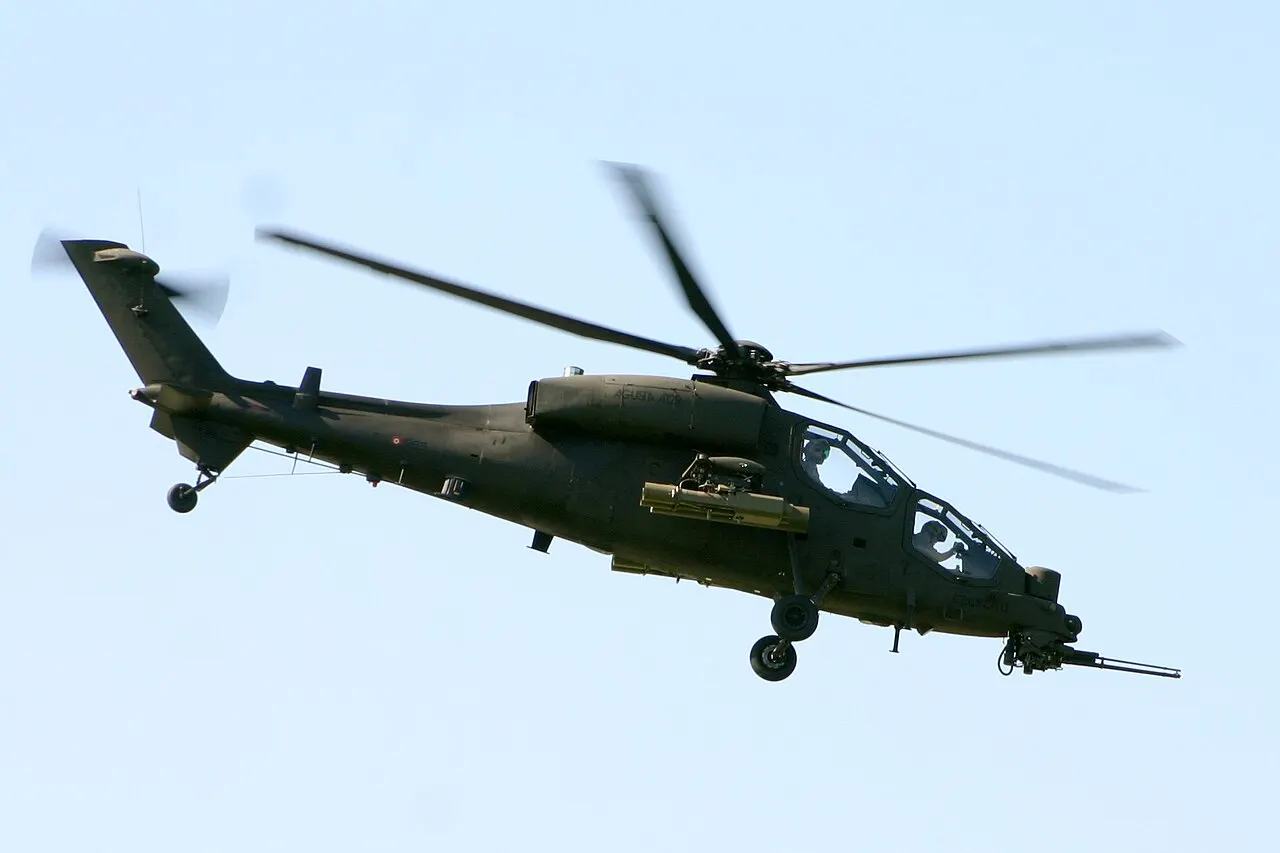
Development
History
The A129 Mangusta is an Italian combat helicopter originally conceived to counter armored vehicles. Agusta developed the project, whose history later continued under AgustaWestland and Leonardo. The card name may use AW129, while Italian Army material commonly calls relevant versions A129 or AH-129D. Those names are worth distinguishing when reading sources: they describe development within a family rather than aircraft with identical equipment at every stage.
Early requirements focused on anti-tank defense. A narrow fuselage, tandem crew seating, and wing-mounted weapon stations supported observation and guided-weapons employment. The Italian Army states that an early version carried TOW missiles and unguided rockets. The exact weapons fit changed with period, variant, and mission. A list of all possible weapons should not be presented as the permanent load of every individual helicopter.
Operational experience broadened the original concept. Italian Mangustas served in Somalia and later took part in operations in the Balkans, Iraq, and Afghanistan. Such campaigns demanded reconnaissance, escort, and support to ground troops as well as attacks on armor. In a complicated environment the crew must detect an object, identify it correctly, and coordinate action with other units. The presence of a helicopter in a theater does not tell us what happened on every sortie.
Later standards gained updated observation and targeting equipment. The Italian Army specifically mentions the Top Lite system and the integration of Spike missiles. These changes expanded detection and engagement options but also required training and maintenance. A reliable description separates the earlier anti-tank arrangement from later reconnaissance and escort standards. Their weapons and performance claims should not be merged into one imaginary configuration.
The Mangusta fleet also illustrates a long modernization path. Development of the new AH-249 attack helicopter reflects the need to replace the AH-129D with a platform offering greater range, protection, and weapons capability. The arrival of a successor does not erase the A129's importance. Experience gained through its service helped shape requirements for the next generation of Italian army aviation.
Mangusta history is particularly interesting because its role changed. The helicopter began as a specialized anti-tank aircraft and gradually became an instrument of reconnaissance and escort in varied operational conditions. An accurate profile identifies the variant, date, and verified equipment fit. That prevents later upgrades from being assigned to early aircraft and avoids reducing the crew's real work to a single type of attack mission.