
Military helicopters / OH-58
Bell OH-58 Kiowa
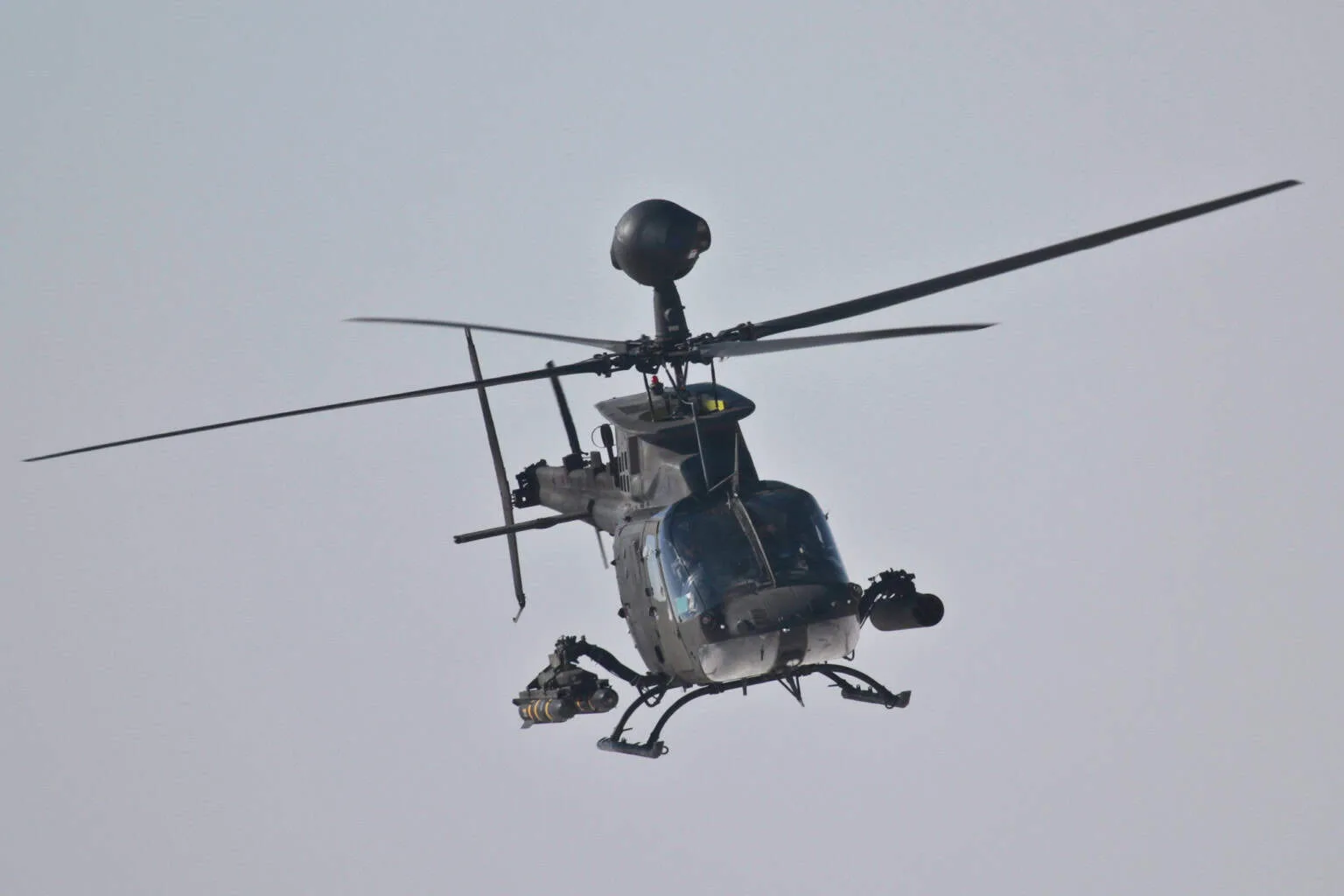
The Bell OH-58 Kiowa is a light reconnaissance helicopter; the later OH-58D Kiowa Warrior added a mast-mounted sight and weapons.
Development
History
The Bell OH-58 Kiowa was developed for observation and reconnaissance in support of US ground forces. A light helicopter let commanders inspect terrain quickly, check the position of units, and pass information to other participants in an operation. Its history includes several substantially different variants. The original OH-58A is not technically identical to the armed OH-58D Kiowa Warrior, even though both belong to the same family.
The aircraft emerged from the Army's search for a new scout helicopter in the 1960s. Bell developed its own light platform, and early Kiowas reached units toward the end of the decade. The initial purpose was mainly observation and liaison, not replacing a dedicated attack helicopter. Small size helped crews work near the forward area, but it also limited fuel, payload, and the margin available in difficult weather.
Experience changed what an aerial scout needed to do. Crews wanted to observe a target while exposing as little of the aircraft as possible. Engineers developed a sight assembly above the main rotor for the OH-58D. That position allowed the helicopter to use terrain cover and look over an obstruction, although it could never guarantee invisibility. The new variant had improved systems and later received weapons, becoming the Kiowa Warrior.
US Army accounts show that some older airframes passed through several rebuilding stages. One helicopter could start its career as an OH-58A, receive a C standard, and later become a D. The age of its original fuselage therefore need not match the date when a particular sensor was installed. Equipment, weapons, and mechanical condition also differed among aircraft, an important point when examining archive photographs.
Kiowa Warriors performed reconnaissance, escort, and support duties. A sortie's outcome depended on communication with ground units, observation quality, and careful route choice. Weapons broadened the aircraft's options but did not make a light scout a direct equivalent of the larger AH-64 Apache. The two types could complement one another within the Army system while handling different parts of a reconnaissance and attack task.
The US Army eventually began withdrawing OH-58s from its main units and assigning scout functions to other platforms. That transition does not erase the Kiowa's contribution to aerial observation. The family shows the progression from a relatively simple scout to an armed aircraft with more advanced sensors. Any account needs its precise variant: assigning the OH-58D's mast sight to an early OH-58A would be a factual mistake.