
Military helicopters / UH-1
Bell UH-1 Iroquois
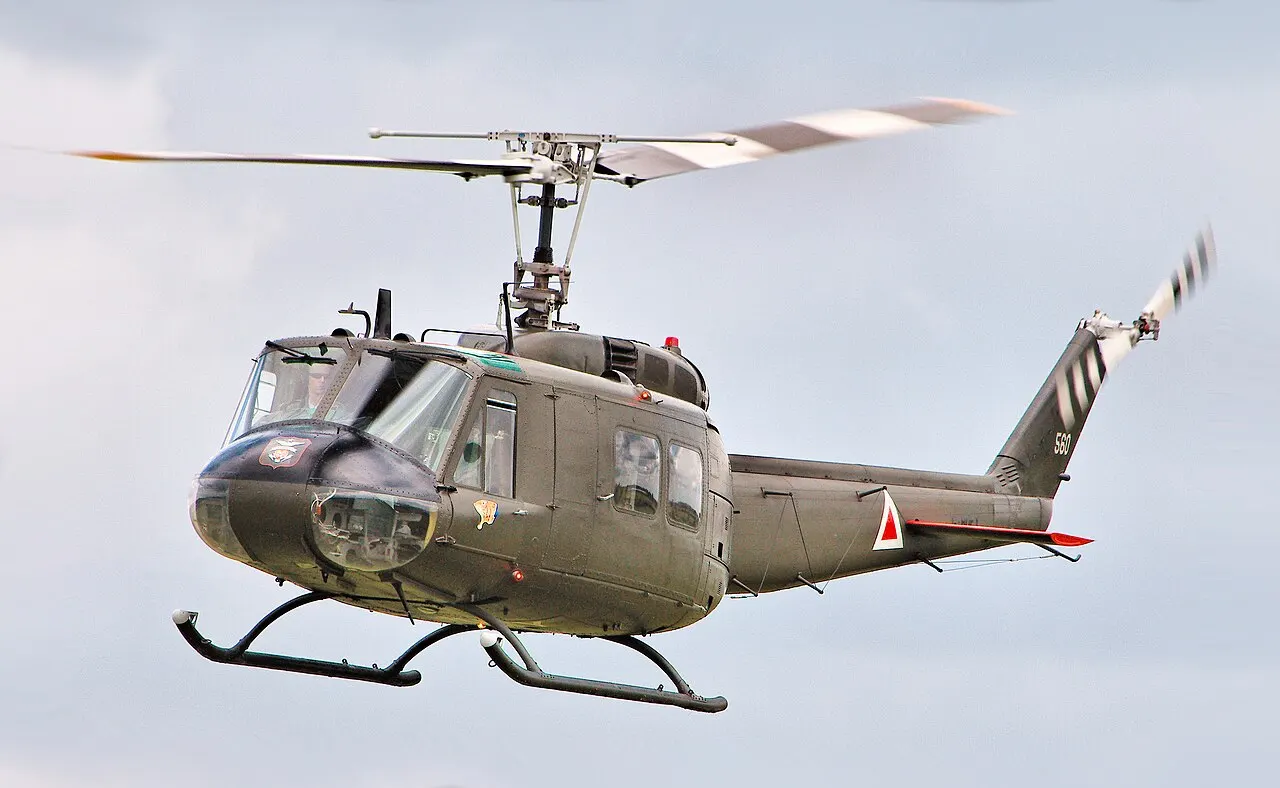
The Bell UH-1 Iroquois, widely known as the Huey, is a utility helicopter used for troop and cargo transport, medical evacuation, and support missions.
Development
History
The Bell UH-1 Iroquois, usually called the Huey, became one of the most recognizable military helicopters of the later twentieth century. Bell developed it for the US Army as a utility aircraft that could move people, equipment, and casualties when ground travel was unavailable or too slow. Its official Iroquois name existed alongside a nickname derived from the early HU-1 designation. The letters were later reversed to UH-1, but the familiar name remained.
The program began with the Army's search for a more useful helicopter for medical evacuation and general support. Bell was selected after a mid-1950s competition, and the XH-40 prototype flew in 1956. Early production aircraft differed from later versions in engine power, dimensions, and cabin capability. A payload or seating figure for one Huey version therefore should not be treated as a specification for the entire family.
The UH-1 used a single turboshaft engine and two-bladed main and tail rotors. Its practical strengths included access to the cabin, relatively rapid loading and unloading, and an interior that could be adapted for different missions. In medical configuration it carried patients and care personnel; in transport configuration it moved troops and supplies. Some aircraft carried weapons, although an armed Huey and the purpose-built AH-1 Cobra filled different roles.
The helicopter became particularly visible in Vietnam. It served as a troop carrier, air assault transport, liaison aircraft, and flying ambulance. Army crews delivered units to operating areas and removed wounded personnel from places difficult to reach by road. Those missions required coordination with ground forces and other helicopters. Huey operations helped establish practical airmobile tactics, but success depended on weather, terrain, hostile fire, and the condition of landing sites.
Service also exposed limits in the early variants. High temperatures and altitude reduced available engine power, a serious issue for medical flights carrying a full load. Bell developed the family through stronger engines, longer fuselages, and equipment changes. Designations such as UH-1B, UH-1D, and UH-1H mark different stages of that development; they are not interchangeable sets of performance figures.
The UH-1 remained in service with military and other operators after the Vietnam War. It was used for transport, rescue, and support, while replacement by the UH-60 Black Hawk in the US Army took place over time. The Huey's importance lies less in a single speed record than in making the utility helicopter a regular tool of military aviation. A description of an individual airframe must identify its actual variant and equipment: the familiar outline alone does not reveal every difference between helicopters built years apart.