
Military helicopters / CH-47
Boeing CH-47 Chinook
The CH-47 Chinook is a twin-engine, tandem-rotor transport helicopter built to move troops, equipment, and cargo.
Development
History
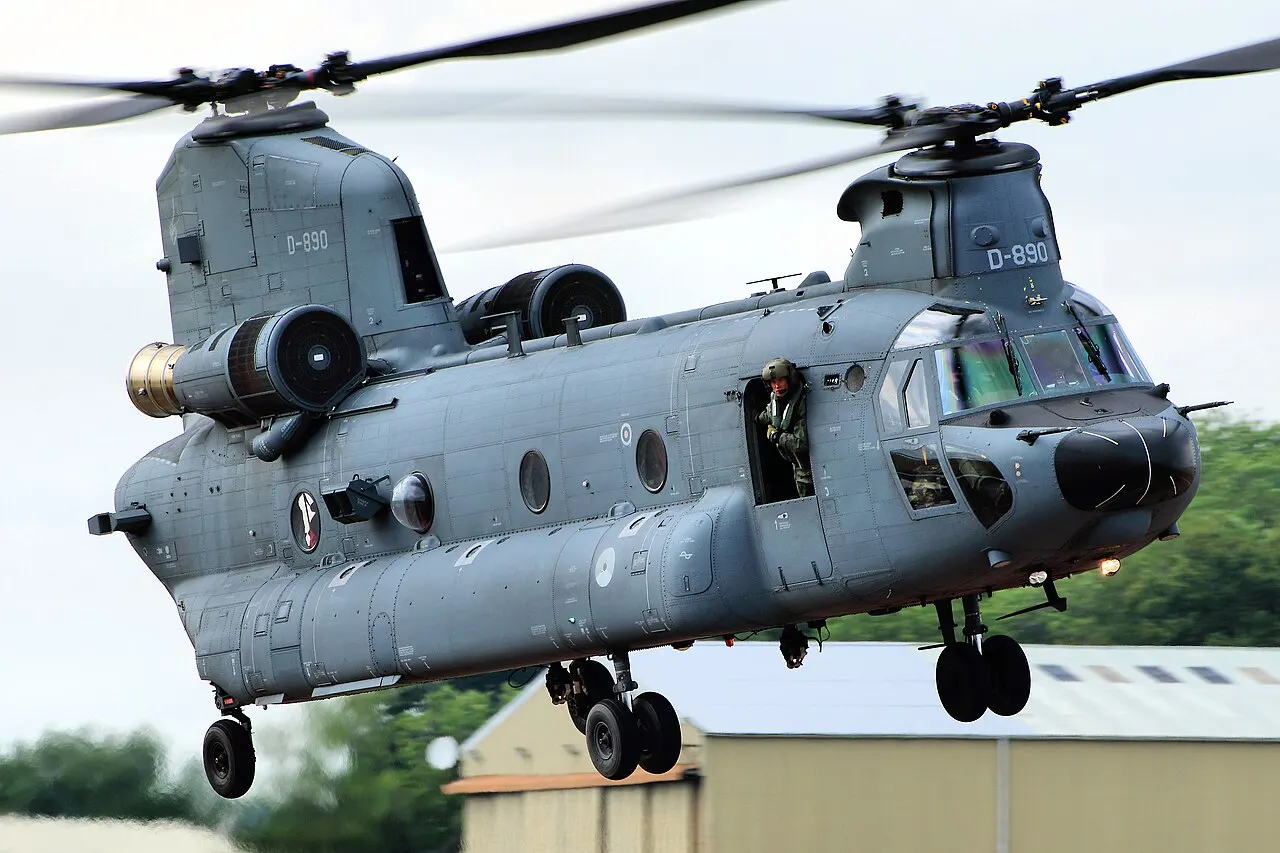
The CH-47 Chinook has a distinctive place among transport helicopters. Two large lifting rotors sit above its long fuselage, one at the front and one at the rear. This arrangement leaves room for a useful cargo cabin and allows the aircraft to move people or heavy equipment. It was developed for the US Army to carry supplies and units. The Chinook name now covers several generations with different engines, systems, and allowable loads.
The design has roots in Vertol, which joined Boeing in 1960. The early YHC-1B developed into the production CH-47A, which entered service in 1962. Even the first aircraft performed jobs beyond the capacity of lighter helicopters, bringing substantial loads to locations without an airstrip suitable for a fixed-wing transport. Later versions retained a recognizable shape but incorporated major structural and powerplant changes.
The CH-47 can be loaded through a rear ramp, while some cargo can be carried externally. This expands its uses to supply delivery, equipment movement, recovery of damaged items, and support for ground units. Tandem rotors remove the need for a separate conventional tail rotor. Crews must still account for load mass and balance, altitude, temperature, and fuel reserves. An advertised maximum lift is not a constant available at every point on every mission.
Chinooks were used in Vietnam from the mid-1960s. US Army history places transport helicopters within a wider system of airmobile operations. They delivered troops and supplies but needed protected routes and landing areas. Hostile action, weather, and aircraft condition could constrain a carefully planned sortie. The CH-47's value therefore depended on maintenance availability and operational organization as well as its lifting ability.
The B and C models received airframe changes and more powerful engines. After the war, a broad modernization of early machines produced the CH-47D. Rotors, transmission, hydraulics, flight controls, and external cargo handling were among the areas changed. Later came the F model and further updates. Figures for a 1960s CH-47A cannot be compared directly with those for a modern CH-47F without identifying the version and operating conditions.
The Chinook's long service reflects its large cabin, flexible loading methods, and continued modernization. It has supported military operations and relief missions where loads must arrive without a prepared airfield. An account of an individual helicopter should establish its actual variant and role. The twin-rotor outline connects the family, but does not make all of its aircraft identical.