
Military helicopters / HH-43
Kaman HH-43 Huskie
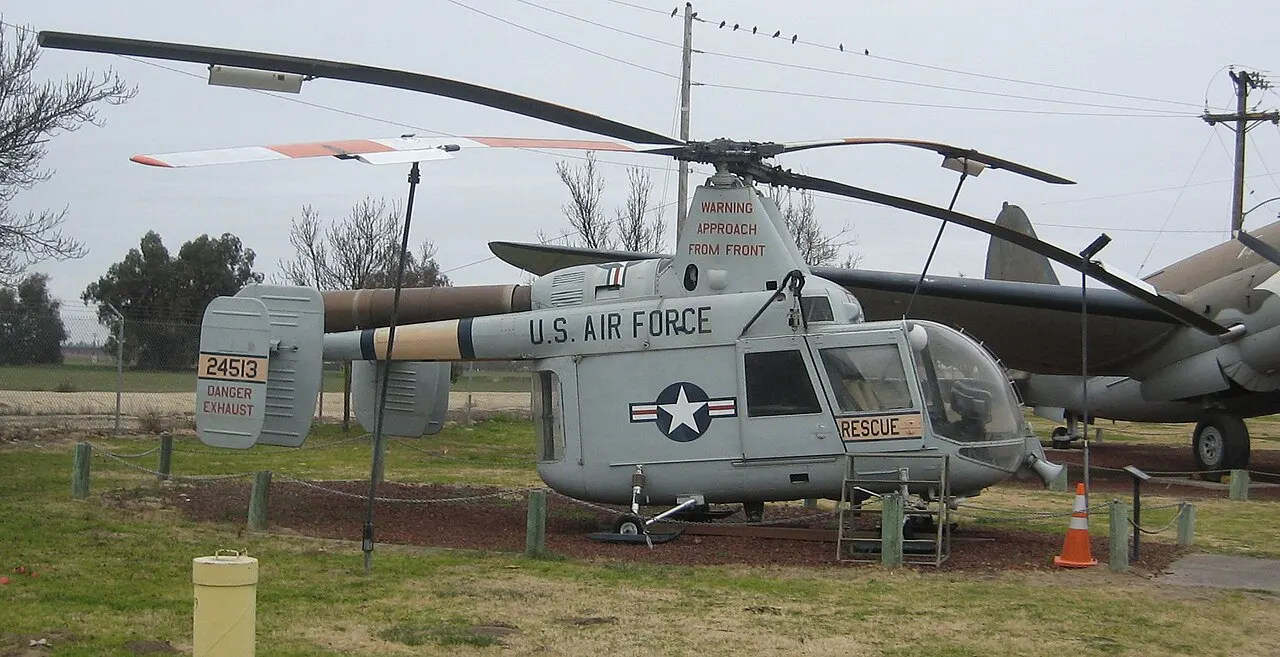
The Kaman HH-43 Huskie was a US Air Force rescue helicopter with intermeshing rotors, used for airfield firefighting and local recovery.
Development
History
The Kaman HH-43 Huskie was a US Air Force rescue helicopter distinguished by an unusual lifting system. Two rotors turned in opposite directions with their swept areas intermeshing, removing the need for a separate tail rotor. This arrangement set the Huskie apart from most military helicopters of its era. Its primary task was rapid response to accidents near an air base, including aircraft fires and aircrew recovery.
The first H-43As reached the Air Force in 1958, followed by B-series aircraft. In 1962 the designation changed to HH-43 to emphasize the rescue mission. This did not make every early H-43 a completely new aircraft after a change of letters. Variants had their own technical differences; the later HH-43F incorporated engine changes to improve performance.
Reaction time is critical in airfield emergency work. A Huskie on alert could launch soon after a call and carry firefighting equipment beneath its airframe. It might reach a crash site before road vehicles delayed by distance or obstacles. Foam and rotor downwash helped open a path for rescuers. Using that equipment safely still required training and an understanding of where casualties and burning fuel lay.
During the war in Southeast Asia, HH-43s also recovered people beyond the boundaries of an airfield. Crews operated in a more hazardous setting than the original local role had envisaged. The Air Force radio call sign Pedro became an informal nickname. Range and fuel limited possible routes, making the position of the base and support from other forces important.
The National Museum of the US Air Force records a substantial contribution by HH-43 crews to rescue operations. Statistics for a particular period should not, however, be treated as a specification of every individual helicopter. The type's usefulness came from rapid readiness, the ability to hover over a difficult site, and specialists aboard. Recovery resulted from pilots, medical personnel, and firefighters working together, not just the rotor design.
Longer-range and roomier rescue helicopters eventually replaced the Huskie. Its history remains that of a specialized air-base support machine that also found a place in combat conditions. An HH-43 description should identify the A, B, or F series and avoid assigning it the range or equipment of later rescue types.