
Military helicopters / Ка-25
Kamov Ka-25
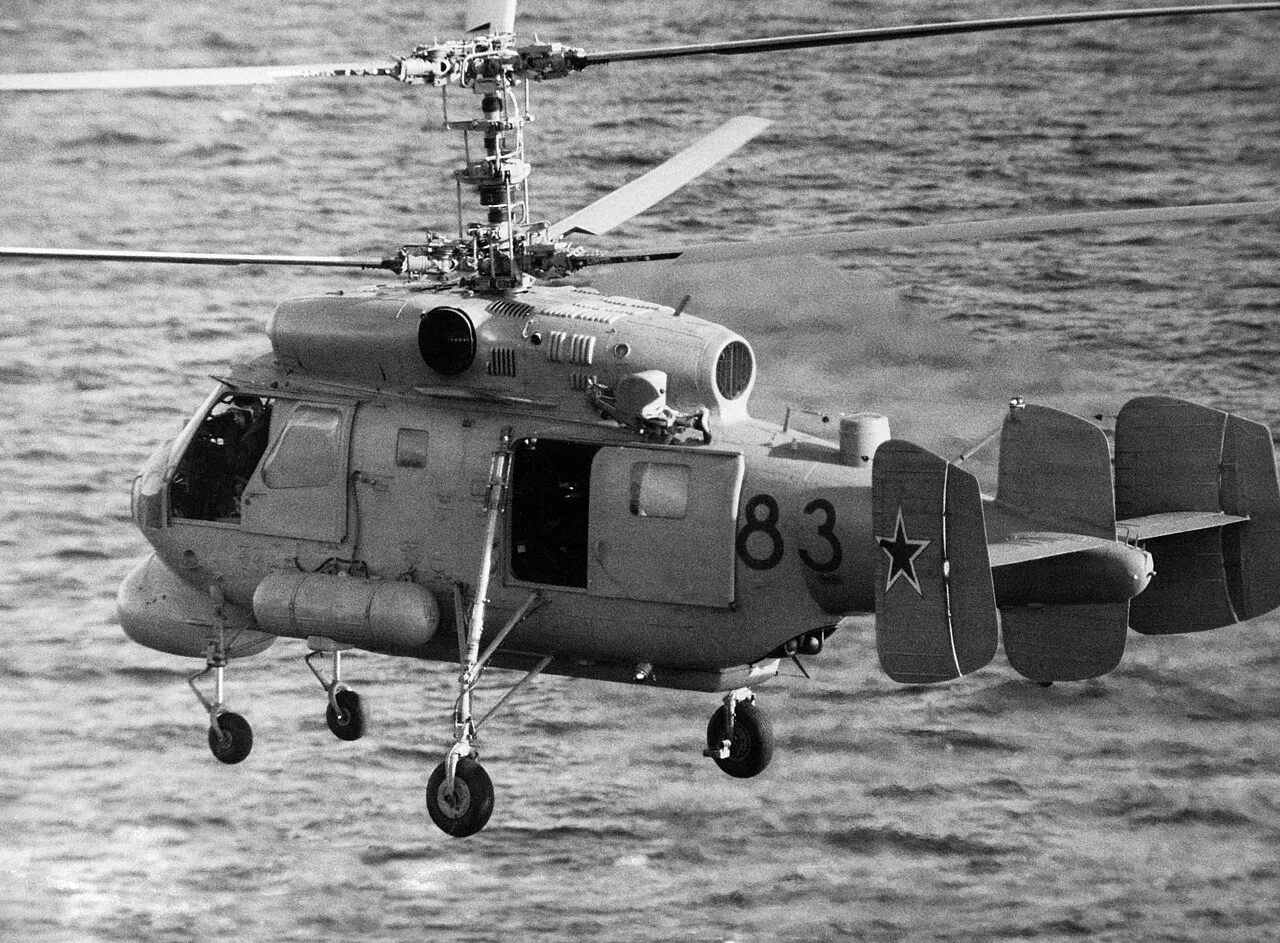
The Ka-25 was an early Kamov coaxial shipboard anti-submarine helicopter and predecessor to the Ka-27.
Development
History
The Ka-25 was the first purpose-built shipboard anti-submarine helicopter produced by Kamov's Soviet design school. It had two coaxial main rotors and no conventional tail rotor, an arrangement helpful on a restricted ship deck. Compared with the earlier Ka-15, it could carry a more substantial system for finding underwater targets. The Navy's mission shaped its form, crew work, and use of interior space.
Ka-25 development began around the turn of the 1960s. The helicopter was part of a broader expansion of shipborne anti-submarine aviation. After testing, aircraft operated from ships, including purpose-built helicopter cruisers. Aviation increased the search area around a naval group, but required a full support structure of deck crews, stowage, fuel, and maintenance.
The anti-submarine Ka-25PL used sensors to investigate the sea. Crews had to combine their own observations with ship information and the conditions of the search area. A submarine does not become automatically visible when a helicopter takes off. Results depend on time, underwater acoustics, and data quality. The aircraft's main advantage was working beyond a ship's immediate field of observation.
The family also had other roles. The Ka-25PS was intended for rescue, while the Ka-25Ts supported information relay and targeting. Their equipment fits differed. Not every Ka-25 should be described as an anti-submarine aircraft with identical sensors. Similar-looking helicopters could have different workstations and assignments.
Shipboard service imposed special demands on landing aboard a moving vessel, resisting a marine environment, and maintaining launch readiness. Compact size helped, but also limited fuel and equipment mass. The need for a more capable search system eventually led to the Ka-27. That succession does not make the Ka-25 an irrelevant copy. In its own period, it considerably expanded naval capability.
The Ka-25 remains historically important as an example of a helicopter and ship working as one search system. Its strengths and limits make sense in the context of 1960s technology. A precise account of a specific airframe should identify variant, operator, and service period. That prevents anti-submarine, rescue, and targeting versions from being merged into one imaginary configuration.