
Military helicopters / Ка-31
Kamov Ka-31
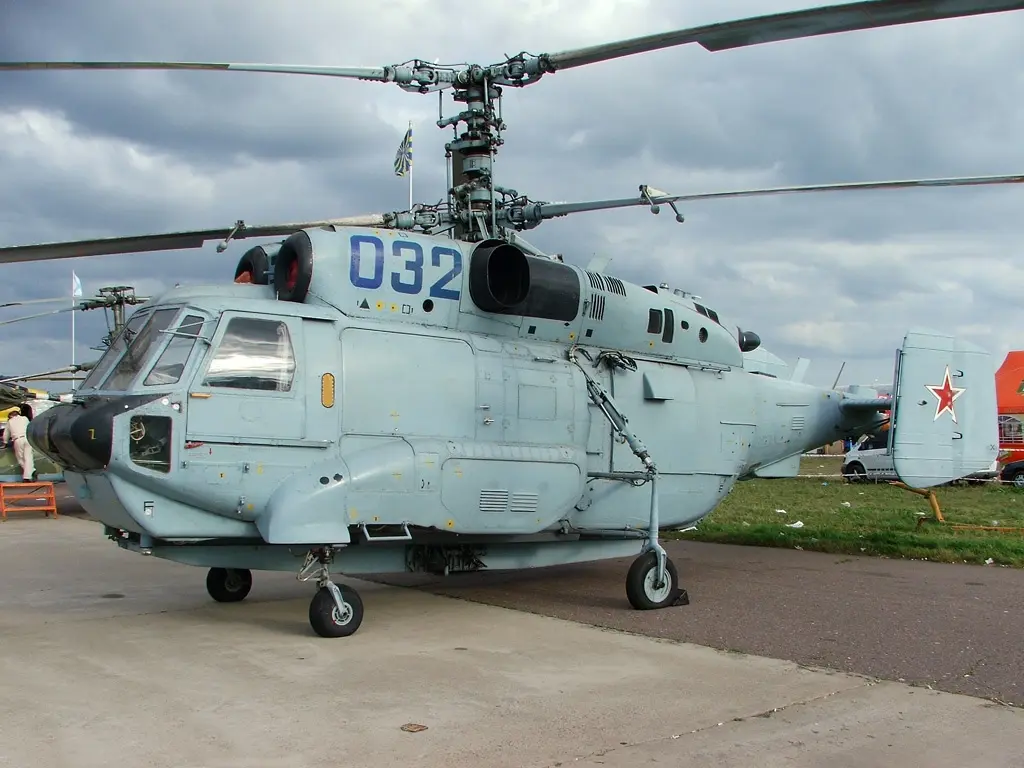
The Ka-31 is a Kamov shipboard airborne early-warning helicopter with a large folding radar antenna beneath the fuselage.
Development
History
The Ka-31 is a specialist airborne early-warning helicopter designed by Kamov for naval aviation. It has a coaxial arrangement with two main rotors, but its purpose differs substantially from the anti-submarine Ka-27 and combat transport Ka-29. Its most visible feature is a large radar antenna beneath the fuselage. The antenna folds close to the aircraft for transit and operates in a deployed position during surveillance.
The requirement came from a need to detect air and surface contacts early around a ship group. A ship radar is constrained by the horizon and its mounting position. A sensor raised into the air has a different field of view, and its information can be passed to ship or shore command points. The helicopter does not replace an entire air-defense system. It provides one part of the information on which that system works.
The Ka-31 drew on Kamov's shipboard helicopter experience, but a large antenna and electronic suite required their own layout. While the radar operates, crews must account for handling and electrical demands. Detection depends on height, conditions, target characteristics, and interference. A published range for one test mode is not a universal result in every environment.
The prototype was tested in the late 1980s. The later program reflected not only Russian naval requirements but also export orders. Aircraft were delivered to India, among other operators. A profile of an individual helicopter should distinguish an early prototype, production machine, and equipment upgrades. The basic designation alone does not reveal those details.
Airborne radar watch is different from anti-submarine search. The Ka-31 monitors air and surface space and transmits information so ships can assess a situation earlier. It is not principally intended to transport a group of people or attack a target alone. Crew systems and the antenna consume mass and space used differently in other aircraft of the family.
The Ka-31 illustrates how a helicopter platform can carry a powerful sensor. Coaxial rotors helped retain a compact shipboard arrangement, but the defining feature is the combination of radar, communications, and integration with a vessel. A precise profile identifies it as an early-warning aircraft rather than an ordinary Ka-27 with another number. That explains both its real purpose and its limits.