
Military helicopters / Ми-2
Mil Mi-2
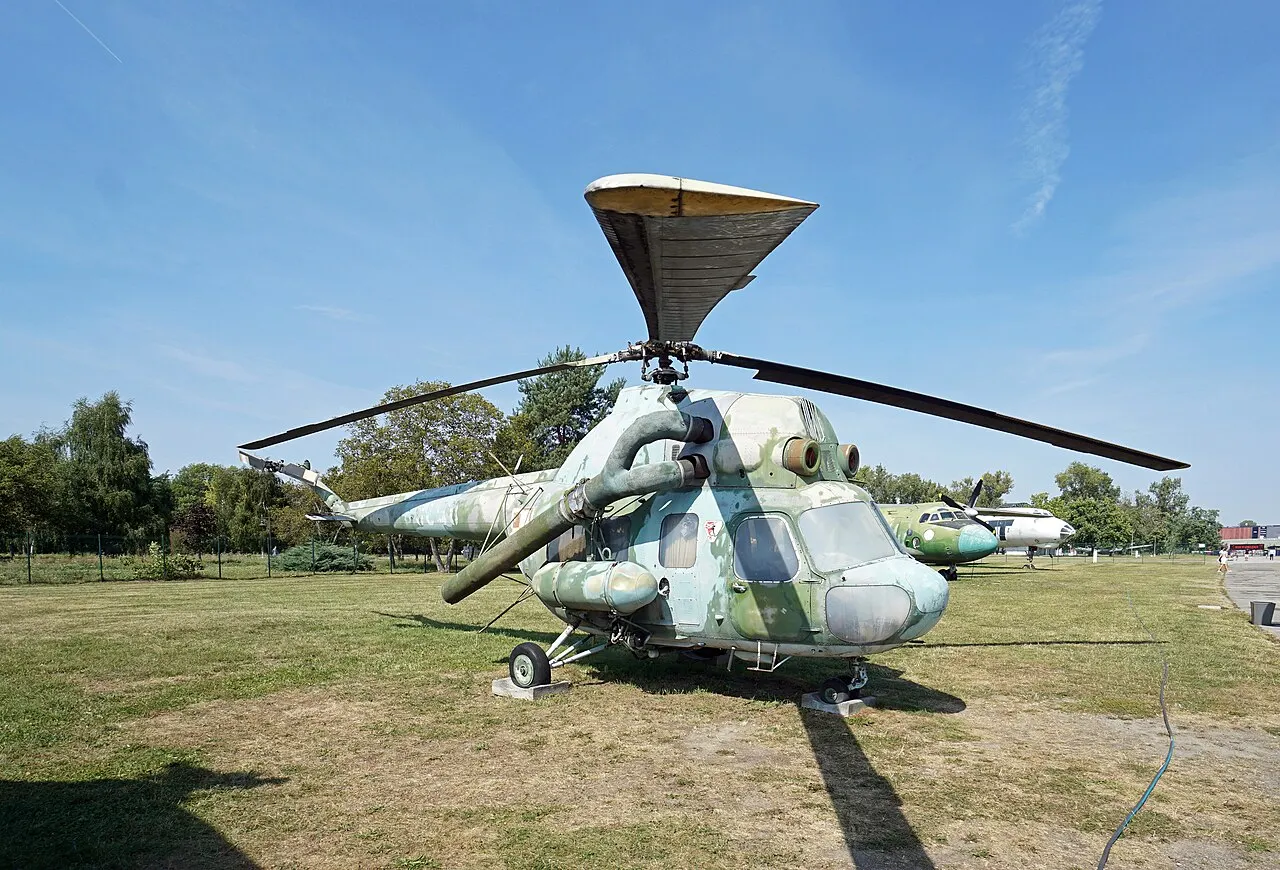
The Mi-2 is a light twin-turboshaft helicopter designed by Mil and produced in series by Poland’s PZL-Świdnik.
Development
History
The Mi-2 is a light utility helicopter developed by Mikhail Mil's design bureau as a successor to the Mi-1. One of the main changes was a twin-turboshaft powerplant in place of a single piston engine. The design remained compact and suitable for various support jobs, but offered a different operating standard. Its production history is especially important: the project began in the Soviet Union, while series aircraft were built in Poland.
The prototype first flew in 1961. After testing, production was assigned to PZL-Świdnik. Polish industry built Mi-2s for many years and developed its own equipment variants. The design country and the manufacturing country of a particular helicopter may therefore differ. For a museum airframe, it is useful to identify its plant, year, and modification separately.
Two turboshaft engines expanded capability compared with the earlier Mi-1, but did not make the light aircraft a heavy transport. Its small cabin could carry people, instruments, or medical equipment. Operators used the helicopter for liaison, observation, training, ambulance duties, and moving specialists. Military users adapted some variants to reconnaissance or support needs, but no single equipment fit applied to every Mi-2.
The Mi-2 spread widely because it combined a compact platform with a fairly flexible cabin. An operator could assign one type to several units and tasks. Actual useful load still depended on altitude, temperature, and fuel carried. Twin engines provided redundancy, but did not remove the need for maintenance and prepared crews.
Training, medical, and specialized versions appeared during decades of service. Poland's PZL Kania further developed the underlying idea, but should not be treated as another name for every Mi-2. Reference works sometimes give figures for one variant as if they described the entire family. That can misrepresent an early or later aircraft. Engines, instruments, and intended work could differ.
Mi-2 history joins a Soviet design organization with long-running Polish manufacture. The aircraft became a familiar light helicopter to civil and military operators in several countries. Its significance lies less in one record number than in varied and durable service. An account of a specific machine should identify its production origin and role. A basic utility Mi-2, a specialist version, and a later Polish development have different histories.