
Military helicopters / Ми-24
Mil Mi-24
The Mi-24 is a Soviet combat helicopter combining attack weapons with a small troop compartment.
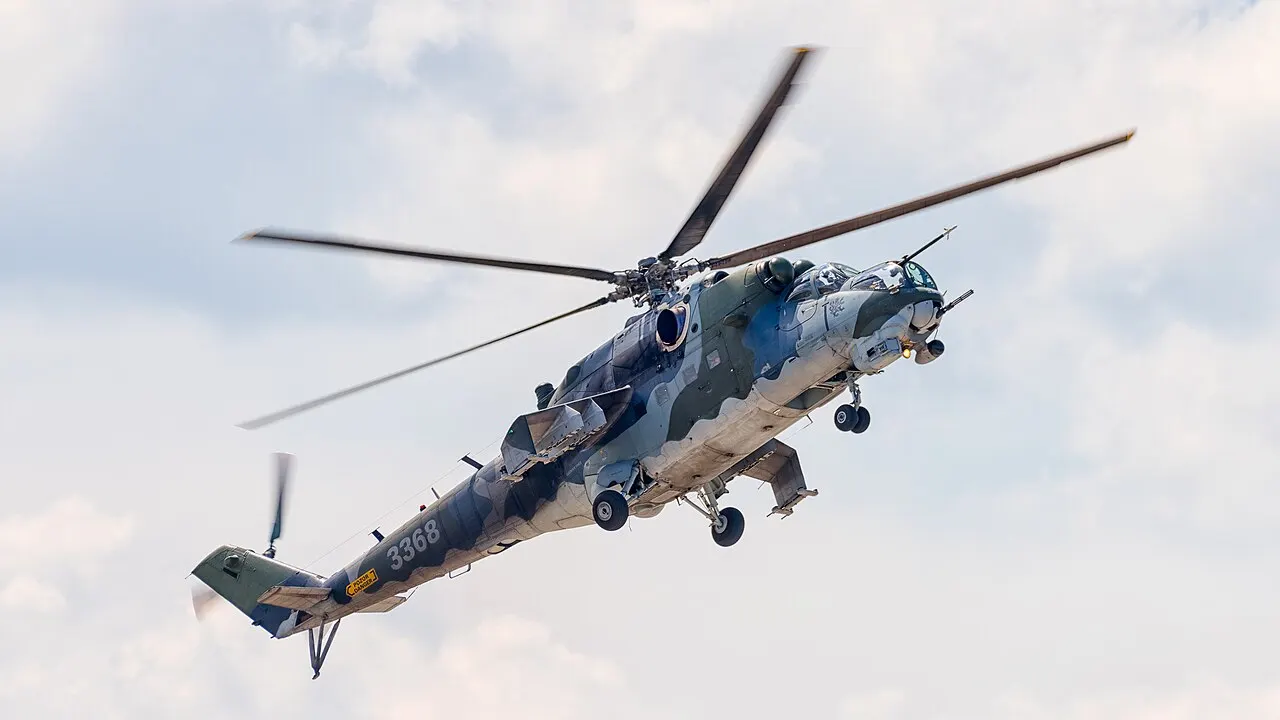
Development
History
The Mi-24 is a Mil combat helicopter that combines attack capability with a small cabin for carrying people. This feature set it apart from many dedicated gunships. It was conceived to support ground troops, escort other aircraft, and work near combat areas. The type cannot be described with one permanent set of weapons, however. Numerous variants appeared over decades of service.
The prototype first flew in 1969. Production began in the early 1970s, including at the Rostov plant. Early aircraft had a crew cabin different from the well-known later tandem arrangement. Designers changed crew positions, sighting equipment, and weapons as the program developed. A familiar photograph of an Mi-24D or Mi-24V therefore does not show exactly what the first Mi-24A looked like.
The helicopter has two turboshaft engines, main and tail rotors, short wings for external stores, and a cabin behind the pilots. Space for troops broadened possible uses but created a trade-off among passengers, fuel, and weapons. Payload, range, and handling depended on the actual load and flight conditions. One should not assume that an aircraft always carried both its maximum rockets and a full passenger complement.
Mi-24s supported ground units, escorted transport helicopters, and attacked targets. The result of a sortie depended on crew training, reconnaissance, communications, and opposing defenses. Aircraft worked in different environments during different conflicts, so a single episode cannot settle the effectiveness of the entire type. Maintainers and supply systems also mattered to the repeated use of a complex combat helicopter.
Well-known versions include the Mi-24D, Mi-24V, and Mi-24P. They differ in systems and, in some cases, their principal gun or machine-gun installation. Later upgrades improved night and poor-visibility operation. Export aircraft could have other equipment fits. Precise figures should be tied to a version suffix and period rather than assigned to the whole family.
The Mi-24 spread beyond its country of origin and remained in use for decades. Its historical place is linked to the unusual attempt to combine an attack role with limited troop-carrying ability in one aircraft. A profile of a particular helicopter should specify its variant, operator, and date. That separates the early concept from later standards and avoids confusing the Mi-24 with the deeply updated Mi-35M.