
Military helicopters / Ми-26
Mil Mi-26
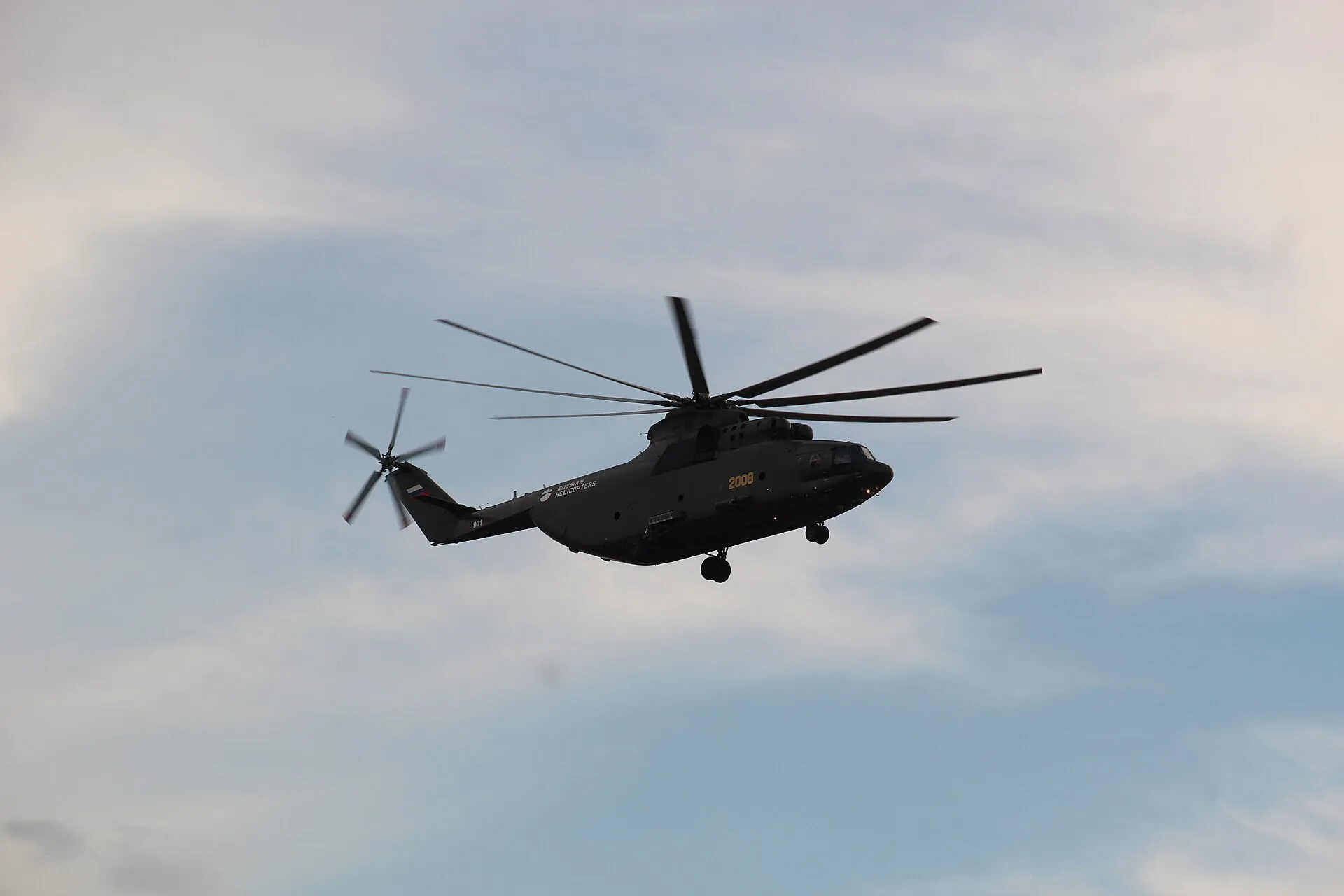
The Mi-26 is a heavy Mil transport helicopter for moving large equipment and cargo internally or on an external sling.
Development
History
The Mi-26 is a heavy transport helicopter developed by Mil's bureau to move large equipment, people, and cargo. It followed the Mi-6 with the aim of carrying more useful load in a more modern design. A huge cabin and external sling capability made it valuable where a heavy item had to arrive without an aircraft runway. The military Mi-26 and civilian Mi-26T share a foundation, but differ in purpose and some equipment.
The prototype Mi-26 first flew on December 14, 1977. Tests demonstrated the design's potential, and production later developed at the Rostov plant. The aircraft uses two powerful turboshaft engines and a very large main rotor. Components of this scale demanded substantial work on transmission and maintenance. The prototype flight should not be confused with the start dates of civilian versions or later upgrades.
Cargo can be placed inside the cabin or suspended outside when its shape or dimensions prevent internal carriage. A maximum achieved on a record flight is not the routine load for every journey. Allowable mass changes with altitude, temperature, fuel, and distance. Moving a large object also requires loading specialists, secure attachment, and a safe receiving site.
For an army, a heavy helicopter can deliver equipment and supplies quickly to a unit despite damaged roads or the lack of an airfield. In medical or rescue configurations, the large interior can accommodate people and equipment. The Mi-26 cannot replace every transport system, however. It needs trained personnel, fuel, spare parts, and room to maneuver.
The civilian Mi-26T line performed construction, firefighting, and other tasks. Later variants, including the Mi-26T2, received new instruments and operating changes. These features cannot automatically be assigned to an early production helicopter. Crew arrangements and systems may differ even when the silhouette looks similar. A reference entry should identify the version to which its specifications apply.
The Mi-26 story combines high lifting capacity with flexibility on a heavy platform. Its capability is impressive, but a precise description separates design figures, records, and real transport conditions. The variant, operator, and service date matter for an individual airframe. They explain why one helicopter is an Army transporter while another is a civilian skycrane or rescue aircraft.