
Military helicopters / Ми-6
Mil Mi-6
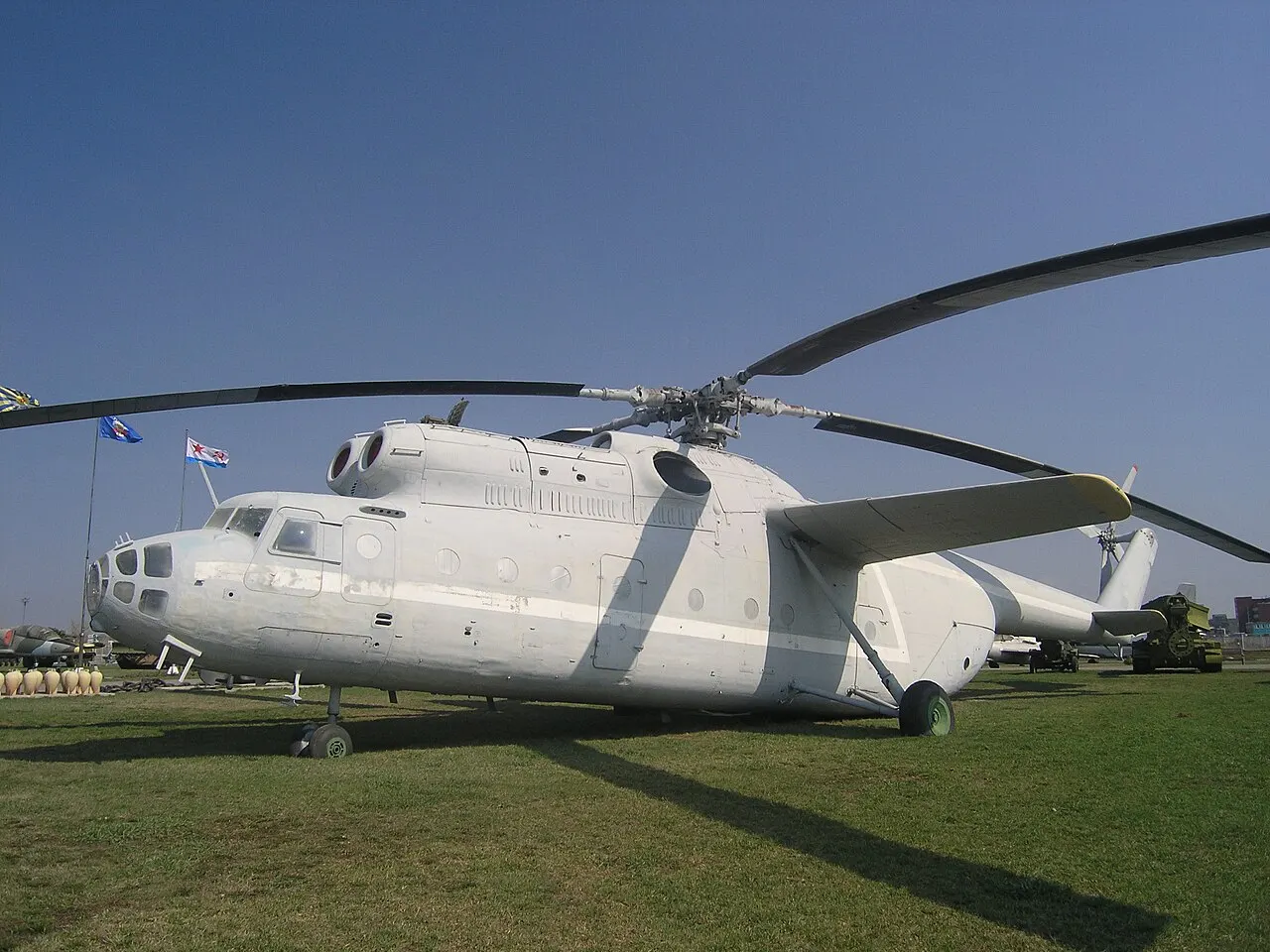
The Mi-6 was a heavy Mil turboshaft helicopter developed to carry large cargo, equipment, and troops.
Development
History
The Mi-6 was among the first truly heavy helicopters able to move equipment and large loads without an airfield runway. Mikhail Mil's bureau began development in the mid-1950s, when both military and civilian users wanted such an aircraft. Unlike the light Mi-1 and medium Mi-4, the Mi-6 was planned around much greater mass. Its dimensions and powerplant brought helicopter transport to a new scale.
The Mi-6 first flew on June 5, 1957. Production at the Rostov plant began near the end of the decade. The design combined two turboshaft engines, a large main rotor, and a capacious cargo cabin. Some aircraft had small wings that helped unload the rotor during forward flight. Those surfaces did not turn the Mi-6 into an airplane. It retained vertical takeoff and landing, and the wings assisted only in particular flight regimes.
The heavy helicopter could carry people, vehicles, and equipment inside or lift certain objects externally. The choice depended on an item's size and character. Record lifts for which the Mi-6 became known must not be confused with an ordinary service load. In actual flying, fuel, distance, altitude, and temperature constrained the weight carried. Their combination determined how useful the aircraft would be on a given route.
Military employment required more than lifting power. It needed a suitable landing site, loading equipment, and communication with the receiving unit. A Mi-6 could deliver heavy materiel where building a runway was impossible or would take too long. A large helicopter nevertheless required substantial maintenance and supply support. Its capacity mattered especially when one flight could replace several trips by smaller aircraft.
Civilian users also demonstrated the type's potential. Mi-6s took part in construction and installation work, carrying infrastructure components and machinery. Special versions were developed, including command and technical aircraft. The shared outline did not mean identical equipment. A transport helicopter and a specialist Mi-6 could have different cabin arrangements and systems.
More powerful helicopters appeared later, but the Mi-6 remains an important step in heavy aviation. It showed that a large rotorcraft could become a regular transport tool rather than only an experiment. A trustworthy profile must separate a production transport aircraft, a specially prepared record flight, and a mission-specific modification. Only then do payload figures and accounts of its work retain their meaning.