
Military helicopters / HH-60
Sikorsky HH-60 Pave Hawk
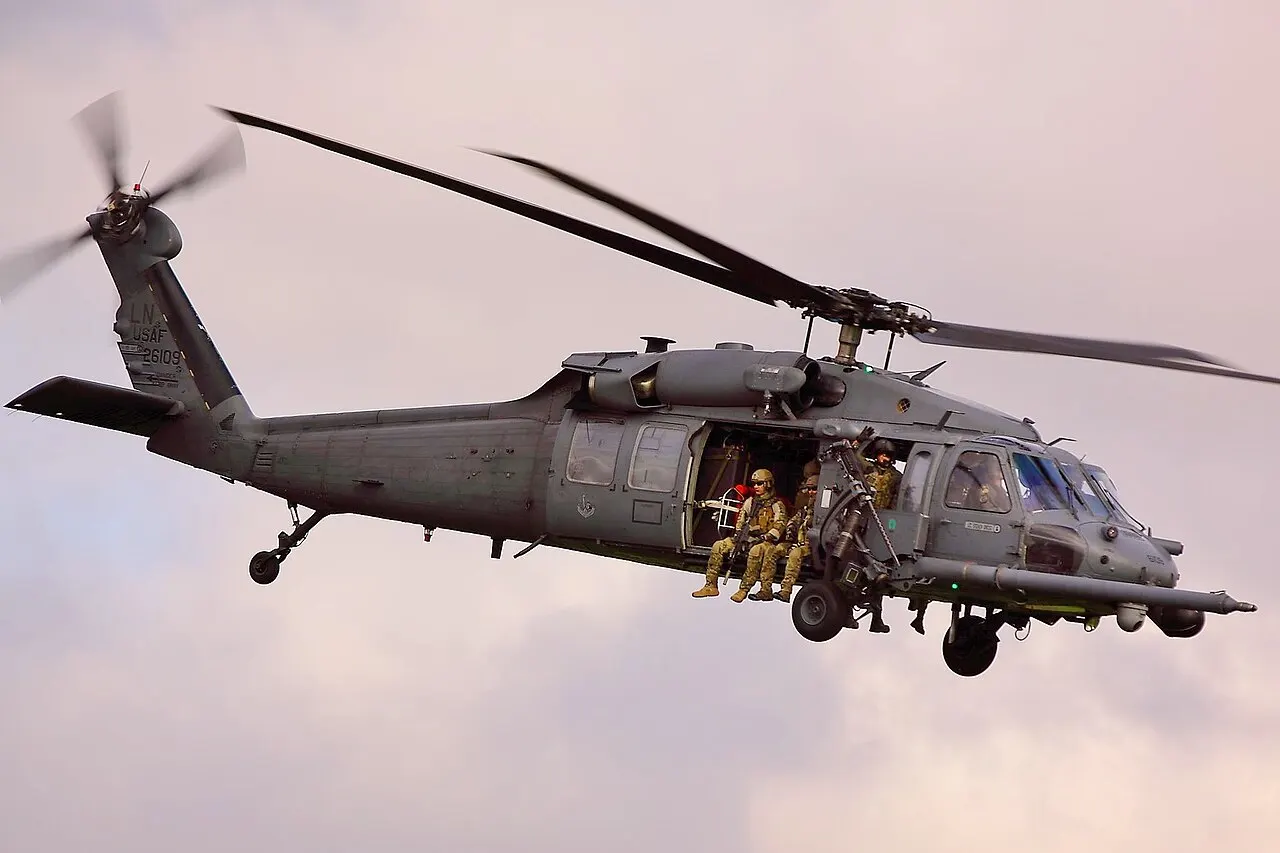
The HH-60G Pave Hawk is a US Air Force H-60-family rescue helicopter equipped to locate and recover personnel in demanding conditions.
Development
History
The Sikorsky HH-60G Pave Hawk is a US Air Force rescue helicopter based on the Black Hawk family. Its principal military task is to locate and recover people isolated or endangered in a combat area. That mission calls for navigation, communications, search equipment, and a crew trained for difficult conditions, not merely speed and passenger space. The Pave Hawk name should not be confused with the later HH-60W.
The underlying H-60 platform provided twin engines and a transport cabin. The rescue version gained additional systems suited to its special role. The US Air Force lists satellite and inertial navigation, secure communications, night observation equipment, and weather radar. A hoist allows a person to be lifted where landing safely is impossible. Auxiliary fuel tanks also matter because a recovery site may be far from an airfield.
Air-to-air refueling extends operational reach, but it does not remove the need to plan fuel and routing. The retractable probe makes Pave Hawk part of a wider rescue system involving the helicopter, tanker aircraft, ground forces, and command center. Each mission requires information about the people to be recovered and the conditions of approach. A published range for one helicopter does not automatically describe the whole path of a rescue package.
HH-60G crews use night vision and infrared systems in low light. The aircraft carries protective equipment and crew-served weapons because the recovery point may be threatened. Yet those systems do not make every flight safe. Weather, terrain, mechanical condition, and hostile activity still matter. Medical care and bringing rescued people aboard require separate specialist work.
Beyond combat search and rescue, Pave Hawks performed civilian rescue, medical, and humanitarian duties. The Air Force fact sheet describes its participation in operations and disaster response. Such flexibility comes from combining a hoist, transport cabin, and communications equipment. An account of an individual event must still distinguish a peacetime search from extraction in a dangerous military area.
The HH-60G served for decades, while gradual replacement by the newer HH-60W reflects changing requirements for reach, communication, and crew support. Pave Hawk history shows that a rescue helicopter is a specialized system, not simply a transport aircraft with medical litters. An accurate description ties equipment and capability to the exact version rather than assigning the successor's features to an HH-60G.