
Military helicopters / MH-53
Sikorsky MH-53 Pave Low
The MH-53 Pave Low was a heavily upgraded US Air Force helicopter for long-range special operations in darkness and difficult weather.
Development
History
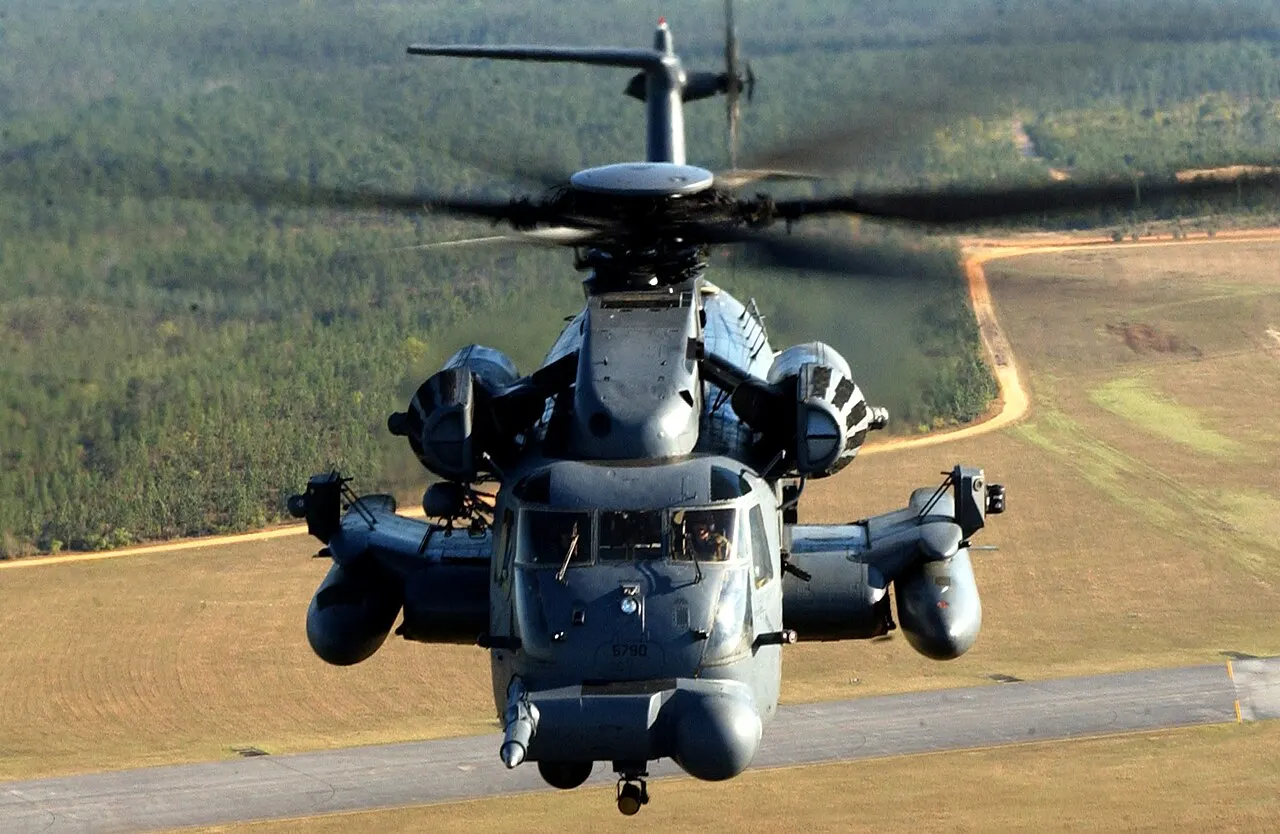
The Sikorsky MH-53 Pave Low was a heavy helicopter adapted by the US Air Force for long-range special operations. It descended from earlier HH-53 rescue aircraft used in Southeast Asia, but gained a new role and substantially changed equipment over time. Pave Low names a modernization program, not an unchanged 1960s airframe. The later MH-53J and MH-53M should be distinguished from one another and from the Navy's CH-53.
The original need was long-range recovery of personnel. Experience showed that a large cabin alone was insufficient for entering a dangerous area. Crews needed navigation over difficult terrain, the ability to work at night and in poor visibility, and communication with other mission participants. Pave Low upgrades added infrared observation, inertial and satellite navigation, and radar systems to support flight near terrain.
Modernization extended beyond instruments. The National Museum of the US Air Force notes that some helicopters received new skin, engines, and rotors during their long service. The age of an original fuselage therefore does not describe the later aircraft's technical standard. A single airframe could pass through successive rebuilds and receive a new designation after many years. Comparing an early HH-53 directly with an MH-53M without a date would be misleading.
Some Pave Low helicopters were transferred to special operations forces in 1980. They carried units, removed personnel, resupplied forces, and supported long-distance missions. Low-level flight in darkness demanded prepared crews and careful planning. Sensors helped orientation but did not remove limits from weather, fuel, or ground threats. The heavy helicopter was one element of a complex operation rather than an answer to every task by itself.
MH-53s participated in US operations from the late 1980s onward. Official accounts describe service in Panama, the Middle East, and Afghanistan. Individual episodes demonstrate the range of missions, but should not be turned into a claim that every aircraft had the same configuration. Electronics fits, mechanical condition, and mission requirements varied.
Pave Low service ended in 2008. That ending is part of the type's story: deep upgrades extended the usefulness of an older platform, while maintenance grew more demanding and costly. The MH-53 left a substantial mark on long-range helicopter operations. Its distinctive strength was the combination of a large aircraft, advanced navigation, and a trained crew. Together they enabled work that would have been more difficult for an ordinary transport helicopter.