
Military helicopters / T129
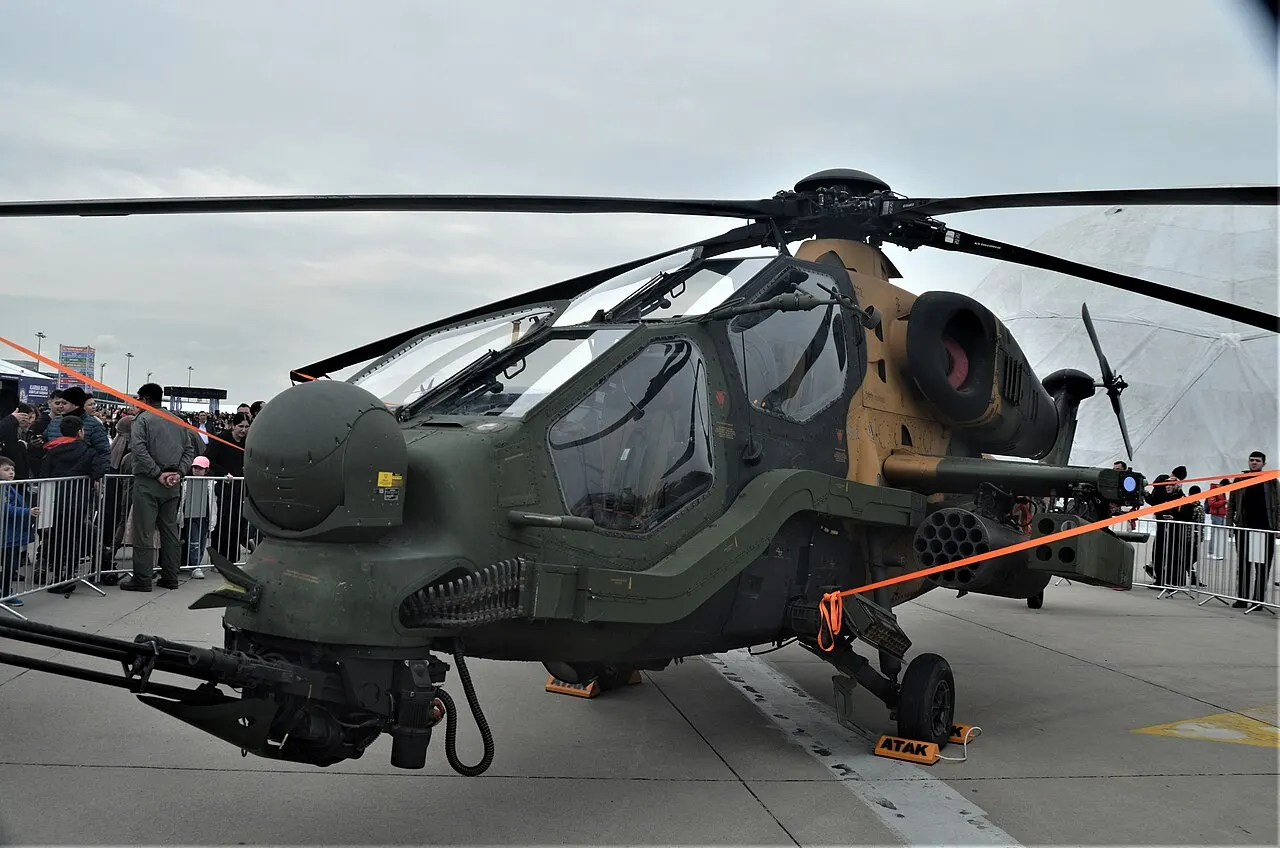
TAI T129 ATAK
The T129 ATAK is a Turkish attack and reconnaissance helicopter developed for national armed forces from the A129 program.
Development
History
The T129 ATAK is a Turkish combat helicopter developed for reconnaissance and support to land forces. Its program drew on the Italian A129 Mangusta, but the Turkish version gained its own system integration and production history. Turkish Aerospace became prime contractor under a 2007 agreement and took responsibility for platform development, testing, serial manufacture, and support. T129 should therefore not be described as a repainted A129 with identical equipment.
Army aviation needed an aircraft able to work in Turkey's demanding climate and geography. An attack helicopter requires more than engines and weapons: crews need communications, observation systems, and coordination with people on the ground. A narrow fuselage and tandem workstations help divide flying and weapons duties. Success on a particular mission still depends on training and circumstances.
T129 performs reconnaissance and attack tasks. During reconnaissance, crews seek and identify objects and pass information to other forces. Fire support requires selecting an appropriate weapon, coordinating with troops, and considering risks to others. Possible missiles, guns, and sensors belong to particular standards. An entire promotional weapons list must not be treated as a permanent simultaneous load on every aircraft.
Turkish land forces have used T129 since 2014, according to a government catalogue. Service experience created opportunities to develop equipment and operational procedures. Later upgrades were not available to the first production aircraft on delivery day. Performance descriptions should name the period and variant. This is especially important for export aircraft, whose customers may choose their own configuration.
The connection with A129 explains the design's development, but differences between the programs matter to industrial history. Turkish organizations built their own test, assembly, integration, and support chain. Spare parts and technician training are as important to long-term service as a handbook speed figure. A dramatic exercise photograph cannot show all this work.
T129 sits between a foreign design foundation and a Turkish national combat system. A precise profile identifies the manufacturer, operator, and equipment standard. Readers can then see which missions are supported by evidence and avoid confusing it with the Italian Mangusta or a later Turkish heavy attack-helicopter project.