
Military helicopters / Lynx
Westland Lynx
The Westland Lynx is a compact British helicopter that served both army units and naval ships.
Development
History
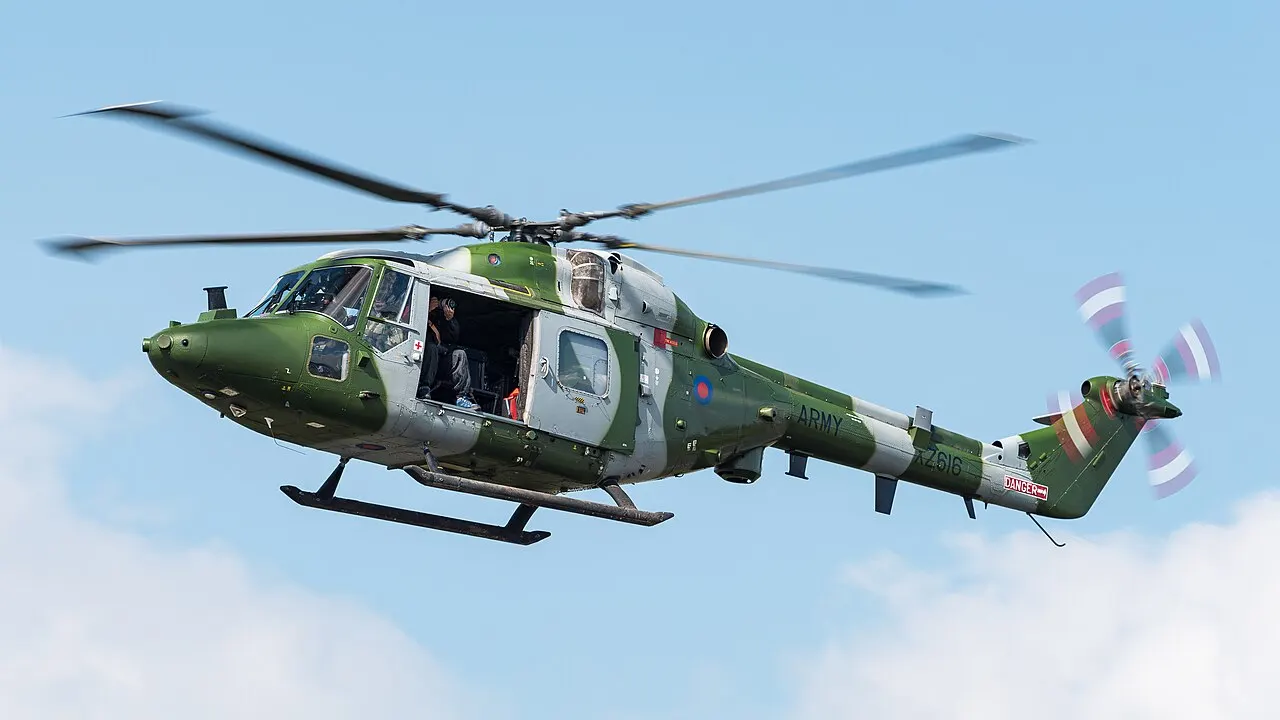
Westland Lynx is a British family of compact twin-engine helicopters developed for army and maritime tasks. Work began in the 1960s, when forces wanted a maneuverable aircraft suitable for operations close to ground units and from restricted ship decks. Lynx versions later diverged substantially. A land reconnaissance helicopter and a shipborne aircraft with maritime sensors cannot be treated as one equipment standard.
The Royal Navy brought its maritime Lynx into service in the late 1970s. Embarked on frigates and destroyers, it extended a ship's ability to observe beyond the horizon. It helped find vessels, pass information to the ship's crew, and perform other maritime duties. Certain versions could employ weapons against surface targets. Weapons, radar, and communications nevertheless depended on the variant and period of service.
Compact size helped with shipboard stowage but demanded careful use of cabin space. Crews prepared the helicopter for flight amid a moving deck, wind, and limited room. Maintenance and storage at sea imposed their own requirements. A list of possible family missions does not tell us which equipment was fitted to an individual aircraft during a specific deployment.
Army Lynx versions supported reconnaissance, liaison, movement of small groups, and other land operations. They worked in a different environment from naval helicopters and could carry different sensors or weapons. A common development line provided British forces with a familiar platform for two aviation services, but operational conditions differed. Speed, useful load, and combat capability therefore need comparison by precise variant designation.
Lynx was upgraded more than once during its long career. The Royal Navy records its use in climates ranging from the cold South Atlantic to the heat of the Gulf region. The last naval Lynx left British service in 2017, passing its duties to the AW159 Wildcat. That successor retained the compact-helicopter concept but introduced new systems; it is not simply a renamed Lynx.
Westland Lynx matters because it combined a size suited to smaller ships with useful surveillance and support capability. It made the helicopter a regular part of many British warships' operations. A historically accurate profile identifies whether an army or naval version is under discussion, its variant and period, and the operator that actually used the equipment described. These details prevent the long and varied Lynx history from being flattened into one generic aircraft.