
Military transport aircraft / Ан-12
Antonov An-12
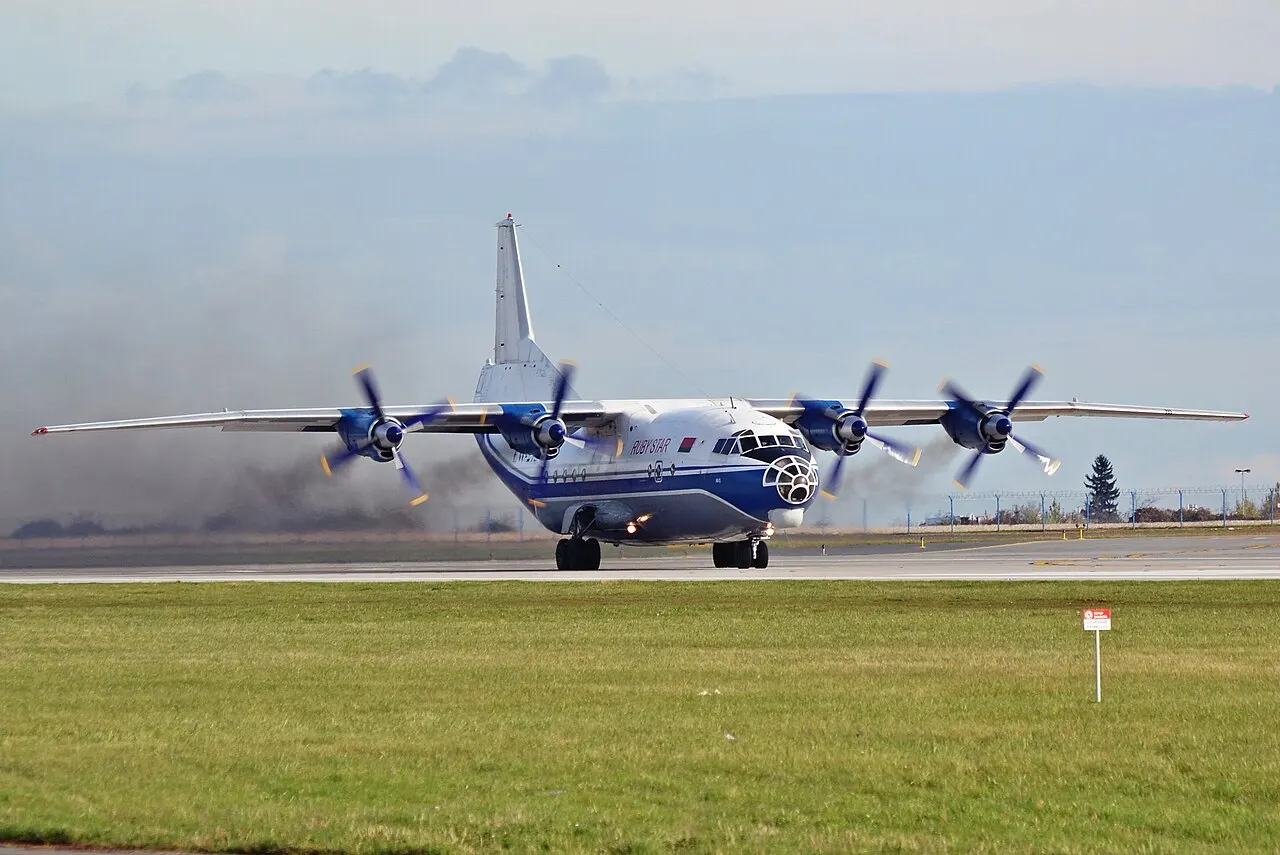
The Antonov An-12 is a Soviet four-engine military transport. It carried troops and equipment, supplied remote airfields and supported airdrop operations.
Development
History
The Antonov An-12 became one of the aircraft that changed Soviet military airlift. It was built to move cargo, equipment and people to places where a conventional passenger aircraft would be of little use. Its high wing, four turboprop engines and raised rear fuselage give it a distinctive shape, but each feature serves a practical purpose. Freight has to be loaded, secured and then unloaded or dropped near its destination. The An-12 was not designed for one narrow mission. Over time it served military units, commercial freight operators, rescue work and test programmes. Its story therefore extends beyond any single transport regiment or conflict. Understanding the aircraft means looking at the way its airframe supported a complete chain of transport operations.
Oleg Antonov's design bureau developed the An-12 in the 1950s alongside the passenger An-10. The two programmes shared design ideas, yet their rear fuselages and interior layouts reflected very different priorities. A transport needed a workable cargo hold and a way to handle large equipment; an airliner needed a cabin for passengers. The An-12 first flew at Irkutsk on 16 December 1957, and deliveries to the Soviet air force began in 1959. Factories at Irkutsk, Voronezh and Tashkent built production aircraft. This distributed programme helped the type become common, while successive batches acquired changes to their systems and structure. When comparing two An-12s, it is therefore important to identify the variant and date of manufacture. A specification taken from one aircraft cannot automatically describe every member of the family.
The working heart of the An-12 is its cargo compartment. Raising the tail made room for an opening at the rear through which vehicles and bulky freight could be brought aboard. The high wing leaves useful space around the fuselage during ground handling. Tie-down points in the floor secure loads, while onboard loading equipment helps crews move heavier items. The flight deck is pressurised, but the cargo area of production aircraft is generally unpressurised. That distinction matters when considering the conditions experienced by a crew and by anyone travelling in the hold. Early military aircraft could also have a rear gunner's position. Civilian operators often removed the associated equipment. As a result, aircraft that look similar from a distance may have quite different interiors. The layout explains both the versatility of the type and some of its operational limits.
An-12 operations were not confined to major paved airports. With suitable conditions, its landing gear and airframe allowed use of unpaved, snowy and icy airfields. For armed forces, that meant supplies could be brought closer to the area where they were needed. The aircraft carried troops, military vehicles and general freight, and it could deliver loads by parachute. One loading arrangement accommodated two BMD-1 airborne combat vehicles. Figures for parachute troops commonly refer to a capacity of up to 60, while the number of soldiers carried without parachute equipment differs. These numbers describe different cabin configurations rather than interchangeable limits. Actual payload, range and crew requirements also varied with the aircraft version, fuel load, runway and weather. A transport profile makes sense only when its operating conditions are stated.
Published figures for the An-12BK list four AI-20M turboprops, a wingspan of about 38 metres and a length a little over 33 metres. Reference data for that variant give a maximum commercial payload of up to 21 tonnes. A cruise speed around 570 kilometres per hour and a range near 3,600 kilometres with the maximum load convey the scale of the aircraft. They do not mean that every mission could combine maximum fuel, maximum payload and every runway option. A lighter load or different fuel plan could change the achievable route. The turboprop powerplant and large wing formed a compromise between carrying capacity, reach and the ability to operate from airfields that were not open to every heavy jet. These figures are useful only when tied to a specific version.
The An-12 family developed as operators asked it to perform new jobs. The An-12B incorporated structural and fuel changes; later versions carried additional tanks below the cargo floor. The An-12BK brought updated equipment and modifications to the cargo compartment. Beyond basic transports, the family included electronic warfare aircraft, search and rescue versions and flying laboratories. Individual airframes were used to test navigation equipment, airdrop systems, communications and scientific instruments. Polar aircraft were adapted for difficult routes and airfields. A long list of designations should not be read as a list of equally large production runs. Some ideas remained proposals, while others were built only once or created by converting an existing aircraft. That distinction prevents a test programme from being mistaken for a standard fleet configuration.
The An-12 had a particular influence on airborne forces because it could move people and equipment together and deliver them by parachute. It also flew supply and evacuation missions. Accounts of its military use cover the events in Czechoslovakia, the war in Afghanistan and conflicts in parts of Asia and Africa. Its role was not identical in every episode. Most often the aircraft supported logistics, although some operators adapted it for additional purposes. Civilian users valued the roomy hold and practical loading arrangements for freight work. The type's movement between military and commercial service is a familiar story in transport aviation, but the length and geographical spread of An-12 operations make it especially notable. The aircraft was a working tool rather than a single-purpose exhibit.
The design influenced aviation beyond Soviet production. China's Shaanxi Y-8 grew from the An-12 and acquired its own series of variants. The later Y-9 belongs to a further stage of that Chinese transport line. It would nevertheless be misleading to treat all Y-8s and An-12s as identical: equipment, production periods and missions vary. The relationship shows how an airlift design can become the starting point for a much longer technical evolution. To compare the families properly, readers should look at the role of a particular version, its airframe, engines and installed systems. A shared ancestry does not replace a precise model description.
The importance of the An-12 cannot be reduced to speed or payload. Effective military airlift depends on every part of the cargo journey, from ground preparation and airfield selection to securing a vehicle and unloading it after landing. The high wing, rear opening and airdrop equipment addressed those practical demands. The aircraft left a mark as a mass-produced transport, a base for specialist conversions and a starting point for later developments. When examining a surviving example today, it is worth separating its original production standard from subsequent modifications and the history of that particular airframe. Only then does the An-12's place in a given period of service become clear.