
Military transport aircraft / Ан-26
Antonov An-26
The Antonov An-26 is a light twin-turboprop transport with a rear loading ramp. It carried freight and personnel and served in airdrop and medical missions.
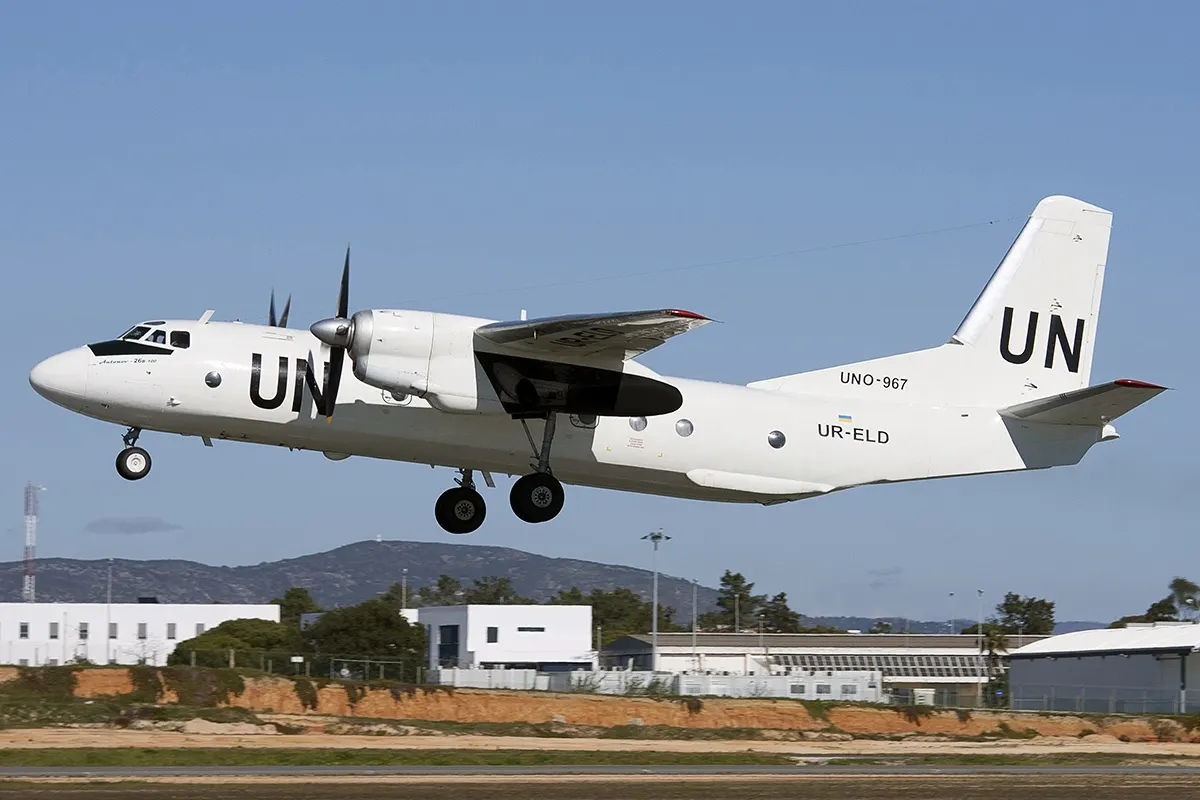
Development
History
The Antonov An-26 is a light transport aircraft developed to move cargo and people over short and medium routes. Its high wing, two turboprop engines and rear loading opening make it readily recognisable. The design addressed a practical problem: how to load useful freight when an airfield has little specialised ground equipment. Military and civil operators used the aircraft for supplies, personnel, medical evacuation and other transport duties. It is more than a passenger An-24 with the seats removed. A redesigned rear fuselage and a versatile loading ramp made the An-26 a substantially more capable freighter than the earlier regional airliner from which the family grew.
The project built on the An-24 and its cargo derivatives. An established airframe offered a familiar aerodynamic arrangement and experience from regional service, but a conventional side door restricted the size and handling of freight. Antonov's designers reworked the rear fuselage to create a wide opening. Cargo could be brought directly to the tail, transferred from a vehicle and moved into the hold without the same dependence on a high loading platform. The change also supported parachute operations. It affected much more than the outside shape: the floor, structure, handling equipment and balance of the aircraft all had to suit freight that might be heavy or awkwardly shaped.
Development proceeded during the 1960s. A formal Soviet decision on the An-26 programme was signed in March 1968. The prototype flew on 21 May 1969, and the first production aircraft emerged from the assembly shop later that year. Those are distinct milestones. A successful first flight demonstrated that the design could fly, while a useful transport type also needed tested loading systems, production tooling and procedures for service crews. Antonov's own history records 1,398 aircraft built at Kyiv between 1969 and 1986. The size of that production run helps explain why An-26s later appeared with many operators, colour schemes and equipment fits.
The rear ramp is the feature that defines the An-26's transport role. It can lower toward the ground for loading or move beneath the fuselage to leave the opening clear. That arrangement allows a vehicle to approach the tail and makes it easier to move freight across the hold floor. The same opening can be used when cargo or people are released in flight. At about 2.4 metres wide, it can accept objects that would not pass through a typical side doorway. The ramp is therefore not simply a visual distinction from the An-24. It shapes how a ground team prepares the load and how the crew carries out a delivery.
Equipment inside the aircraft complements the opening at the back. Handling and securing devices help move cargo into place and keep it there during flight. Before departure the load must be positioned so that the aircraft remains within its centre-of-gravity limits; restraints must also cope with take-off, manoeuvres and landing. A large door does not mean that every vehicle will fit. Height, floor strength, dimensions and mass still set limits. The Polish Aviation Museum lists a load of up to 5.5 tonnes, or an arrangement for about 30 paratroopers, or a medical layout with stretchers. These are different configurations, rather than capacities that can all be combined on one sortie.
The high wing leaves room around the fuselage for loading and places the propellers well above the ground. Two AI-24 family turboprops provide the aircraft's main power. A small RU-19A-300 jet unit is installed in the right engine nacelle. It assists with starting and can provide additional thrust in selected conditions, including demanding departures. This does not make the An-26 a conventional three-engine jet aircraft. The turboprops remain its main propulsion system, while the auxiliary unit serves a more limited purpose. Descriptions of the type should not combine the power rating of the turboprops with the thrust of the jet unit as if they were the same measurement.
The An-26 cabin was laid out for transport flexibility rather than for the largest possible number of airline seats. Depending on its equipment, an aircraft could carry goods, troops, patients or passengers. A military freighter filled with equipment would feel very different inside from an aircraft converted for passenger work. That difference matters when photographs or specifications from one example are used to describe the whole fleet. Pressurisation and onboard systems also allowed missions beyond the shortest local hops. Yet a particular aircraft's useful load, crew arrangement and interior fittings depended on its variant, operator and later modifications.
Antonov gives a cruising speed of about 440 kilometres per hour, an operational range around 1,100 kilometres and an operating ceiling near 9,000 metres. Such figures belong to stated test or operating conditions. They are not a promise that the aircraft can carry its maximum load over the listed range in every kind of weather. Fuel reserves, wind, altitude of the departure field and the need for an alternate landing site all affect a transport mission. The An-26's real advantage was not exceptional speed. It could move a moderate load with comparatively straightforward loading arrangements and then be adapted to a different cargo or passenger task.
The aircraft served in the Soviet Union and was exported widely. Antonov's history records deliveries to countries including Poland, Hungary, Romania and Czechoslovakia, while other operators used it across Asia, Africa and Latin America. Missions differed between fleets: military logistics, supply flights to remote places, training and civil freight all appear in the type's history. It would be misleading to describe those experiences as identical. Maintenance resources, spare parts, runway networks and the intensity of use shaped what an An-26 could achieve for each operator. The variety of its service is evidence of a flexible design, but each national fleet has its own history.
Special-purpose aircraft and conversions emerged from the basic transport. Some received communications or observation equipment; others were adapted for medical work or passenger carriage. The An-32 is a related later development with different performance aims and a more powerful propulsion arrangement. It should not simply be treated as a set of parts fitted to every An-26. Markings on a photograph may also be an unreliable guide to an aircraft's precise configuration after years of repair and modification. A careful profile distinguishes the basic freighter, a factory variant and a later conversion carried out for a particular customer.
The most useful way to understand the An-26 is to follow a load through an entire mission. Freight must reach the aircraft, pass through the rear opening, be secured, travel safely and then leave the aircraft at its destination. The ramp, cabin and handling equipment make each of those steps more practical. A speed or range figure alone cannot show that operational benefit. Long service with many different operators demonstrates why a compact transport with flexible loading remained valuable well after newer designs appeared. The An-26's place in aviation history rests on this everyday utility and on the way Antonov turned an established regional-aircraft family into an effective military and civil freighter.