
Military transport aircraft / Ан-72
Antonov An-72
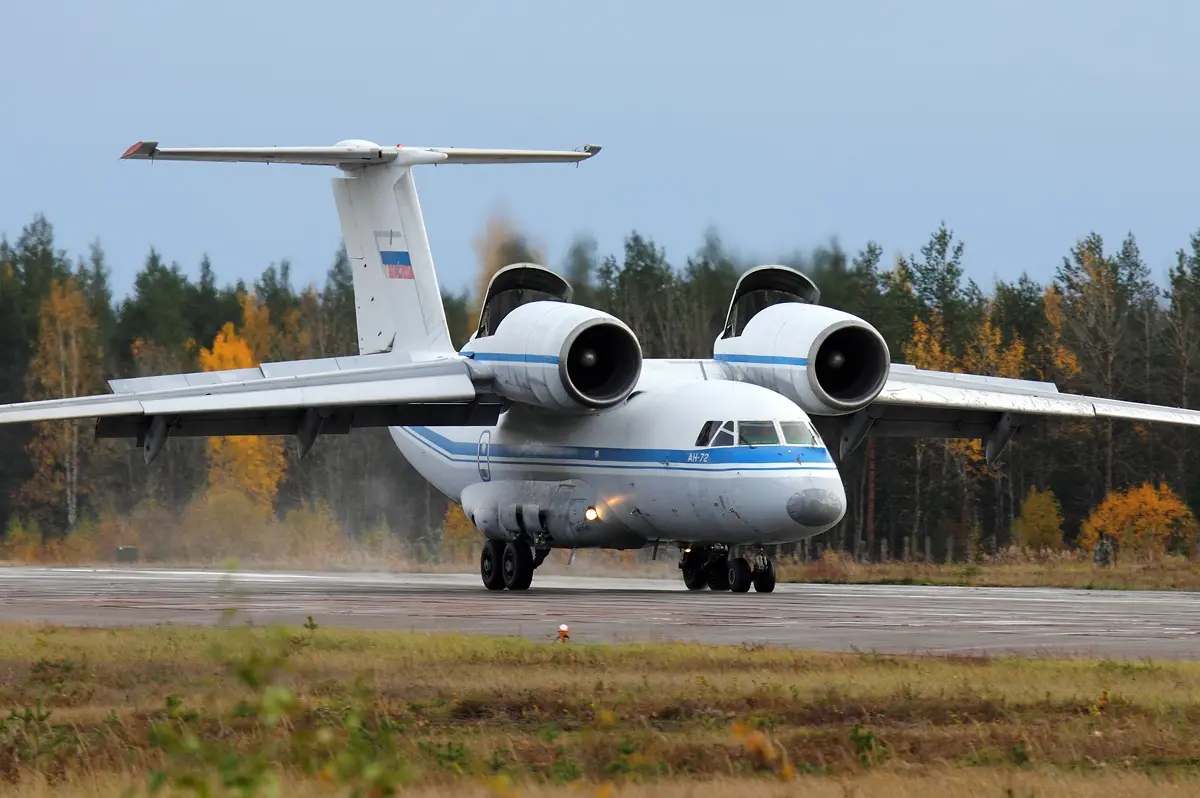
The Antonov An-72 is a jet transport developed for short and poorly prepared runways. Its engines above the wing help generate additional lift during take-off and landing.
Development
History
The Antonov An-72 is a jet transport designed for routes on which a conventional freighter might need a longer, better prepared runway. Its two engines sit high above the forward part of the wing, while a rear ramp gives access to the cargo hold. The arrangement was driven by a practical aim: carrying people and freight to airfields with limited facilities. The An-72 was conceived as a faster successor to earlier light transports, but its usefulness cannot be captured by a single take-off distance. Payload, runway condition, weather and the crew's procedures all influence what an aircraft can do on a particular mission.
During the 1970s Soviet aviation needed a transport able to support units and supply airfields close to the area of operations. The desired combination was challenging. Jet speed would be valuable between destinations, while short-field capability would widen the range of places the aircraft could reach. Antonov's designers treated the problem as a whole. A shorter run would mean little if the landing gear could not tolerate rough ground or if the cargo could not be unloaded promptly. The project therefore brought together the wing, engines, high-lift devices, undercarriage and freight cabin. Early development material referred to the programme as aircraft 200 before the An-72 designation became familiar.
The first prototype flew on 31 August 1977. That flight began a long process of testing the aircraft's unusual aerodynamic arrangement. Antonov's company history says that production An-72s were built at Kharkiv from 1984 to 1992 and gives 114 aircraft for that run. Other reference works sometimes report different totals for the wider family because they count prototypes, pre-production aircraft and related An-74 variants in different ways. The distinction is important. The date of a prototype flight is not the date at which a transport enters routine service, and figures for an entire family should not automatically be attached to one specific model.
The An-72's defining technical idea is the use of engine exhaust to help the wing generate lift. Two D-36 turbofan engines are mounted forward of and above the wing. Their airflow passes over the upper wing surface and the extended flaps, contributing to lift in suitable flight conditions. The principle is often discussed in connection with the Coandă effect. For a crew, the aim was to make lower-speed take-off and landing more practical than might be expected from a jet transport of this size. The effect is not an independent feature that can be switched on without the rest of the aircraft. It depends on engine setting, wing geometry and the position of the high-lift devices.
Slats, flaps and spoilers form part of that system. The flaps help the wing at low speed, while spoilers contribute to control and to shedding lift on landing. Thrust reversers and the brakes also help manage the ground run. A short take-off is therefore not the product of one clever device. Engines, wing, landing gear and stopping systems have to work together. On the same runway, an aircraft's available payload changes with air temperature, altitude, wind and surface condition. Published take-off figures are useful only when the conditions under which they were measured are understood.
Placing the engines above the wing has a further operational consequence. Their intakes sit farther from the ground and from some of the loose material that can be thrown up on a poorly maintained strip. That does not eliminate foreign-object risk, but it affects how the aircraft can be used away from major airports. The An-72's undercarriage was also developed with uneven and soft surfaces in mind. Wheels and struts have to absorb landing loads, and the aircraft must remain controllable while slowing down. Such details matter particularly for transports, which spend much of their working life at airfields where ground support is limited.
A loading ramp occupies the rear fuselage. It provides access for equipment and freight and can also be used for airborne delivery. The hold floor and securing equipment are intended for different kinds of load, but each item still has to be checked for weight, dimensions and its effect on the aircraft's balance. A ramp does not mean that any vehicle will fit: the opening, hold geometry and floor strength impose limits. The ability to arrange the cabin for personnel, freight or specialised equipment gives the An-72 flexibility. Exact seating and cargo figures depend on the version and should be tied to a particular configuration rather than treated as universal.
The high T-tail and the raised cockpit help create the aircraft's distinctive outline. The tail surfaces are positioned clear of much of the airflow around the wing and rear cargo opening. From a distance the engine nacelles look like two projections ahead of the wing, an appearance that gave the aircraft a popular nickname in Russian. Behind that memorable shape lie engineering trade-offs. The designers wanted extra lift at low speed, a useful freight opening and enough structural strength for repeated operation from restricted fields. A photograph can show the silhouette, but the reasons for it become clear only when the aircraft's mission is considered.
Reference sources give different speed and range figures for members of the An-72 family and for different payloads. A maximum speed by itself says little about the value of a transport. The available runway, turnaround time, fuel reserve and ability to deliver the intended cargo all matter. In 1983 An-72 aircraft made record-setting altitude flights in their class. Those achievements showed that the design had considerable performance potential, but a record flight does not represent a routine supply sortie with a useful load. The distinction between demonstration conditions and everyday operations is essential when interpreting any technical table.
The An-72 has served military and civil operators. The wider family also developed in specialised directions. The An-74 was adapted for work in cold regions, while some An-72 versions were configured for patrol or other particular duties. These designations should not be merged without explanation. Equipment fitted to a patrol aircraft is not automatically part of every cargo aircraft. Family resemblance explains the broad layout, but each variant's role, systems and performance require their own checks. The same caution applies to photographs: a familiar wing and engine arrangement do not always establish the exact model index.
The An-72's place in transport-aircraft history rests on an attempt to combine jet speed with access to constrained airfields. It illustrates how the position and airflow of an engine can become part of a wing's high-lift system. It also shows why a transport must be judged across an entire mission, from preparing the runway and load to unloading at the destination and bringing the crew home. The combination of an unusual aerodynamic idea, rugged undercarriage and a useful rear ramp explains the aircraft better than its nickname or any one number in a specification sheet.