
Military transport aircraft / Ан-74
Antonov An-74
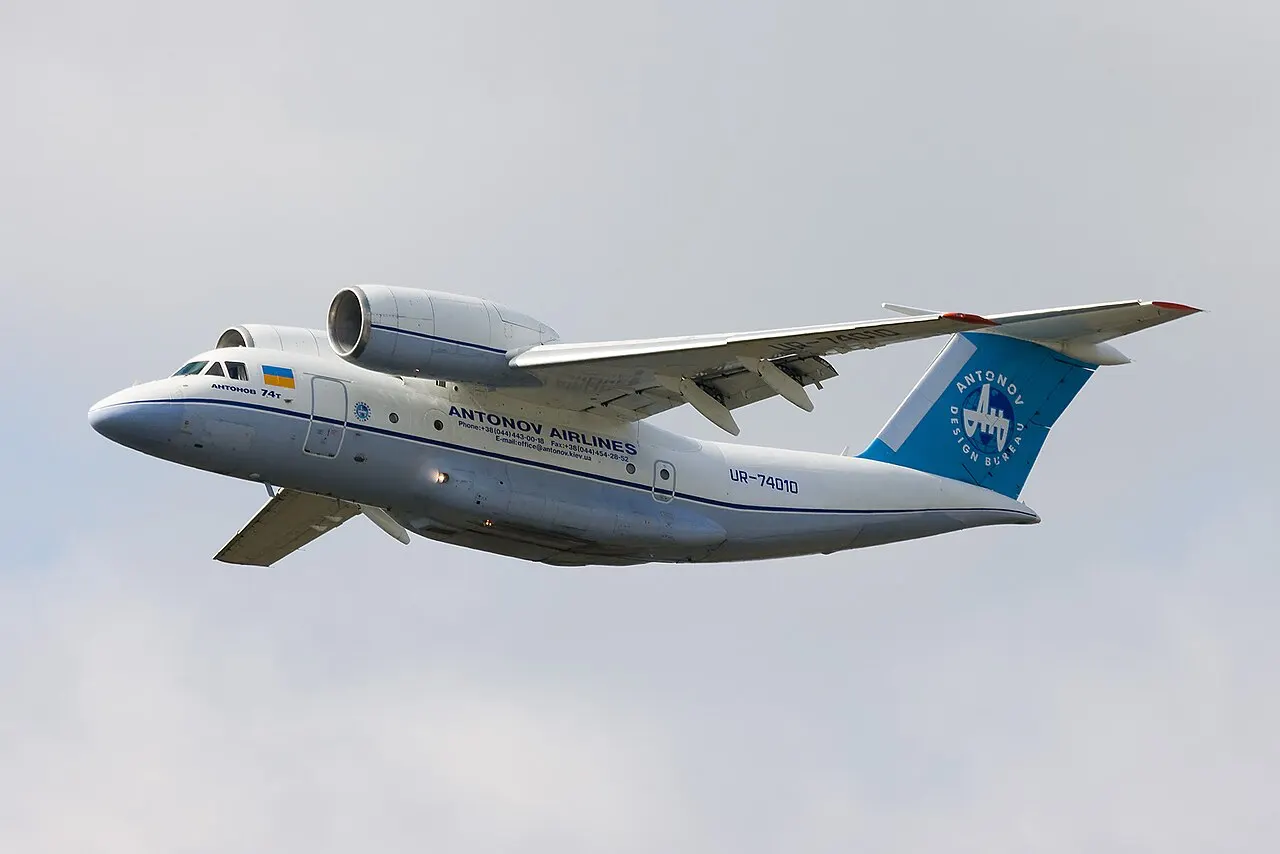
The Antonov An-74 is an An-72-derived transport adapted for remote and Arctic routes; some variants were offered for military transport.
Development
History
The Antonov An-74 is a transport aircraft derived from the An-72 and adapted for demanding climates. Its history differs from that of many military airlifters in this catalogue. The original concept focused largely on Arctic and civilian supply missions, scientific expeditions and remote communities. Later versions were offered to government and military customers. It would therefore be misleading to describe every An-74 as a military aircraft: its role depends on the specific variant and operator.
The most distinctive feature is the pair of engines mounted above the wing close to the fuselage, an arrangement inherited from the An-72. The raised intakes reduce exposure to debris on rough surfaces. Airflow over the wing also supports low-speed lift. Together with the aircraft's other design features, this allowed access to relatively short or less developed airfields, subject to loading, weather and runway limitations. It did not remove the hazards of polar flying, but it widened the range of locations that a cargo service could consider.
The aircraft was developed with cold-weather operations and high-latitude routes in mind. Different versions could be fitted with navigation and weather equipment, de-icing systems and, for particular missions, wheel-ski gear. A rear loading ramp made it practical to handle supplies where a large freight terminal was unavailable. Personnel, expedition equipment and essential cargo could share the same transport network. The ability to change the cabin arrangement was as important as headline payload, because remote operators often needed one aircraft to perform several kinds of task.
The An-74 family evolved into cargo and combined passenger-cargo versions. Some configurations were promoted for military transport and export use. Similar names can obscure a useful distinction: the An-74 grew out of the An-72, but its equipment and operating history deserve separate treatment. Specifications from one version should not be applied to every An-74. Range, crew arrangement and useful load all depend on the aircraft's particular configuration and mission.
The type illustrates how a transport platform can span civilian and state responsibilities. Remote northern regions need regular delivery of equipment, rotation of expedition teams and a way to evacuate people when circumstances change. The same attributes can support military logistics, but they do not make the whole family exclusively military. The An-74's lasting interest lies in its adaptation of a jet transport to difficult climates and airfields rather than in any single combat assignment.