
Military transport aircraft / Do 228
Dornier 228
The Dornier Do 228 is a light turboprop aircraft used for short-route transport and patrol missions.
Development
History
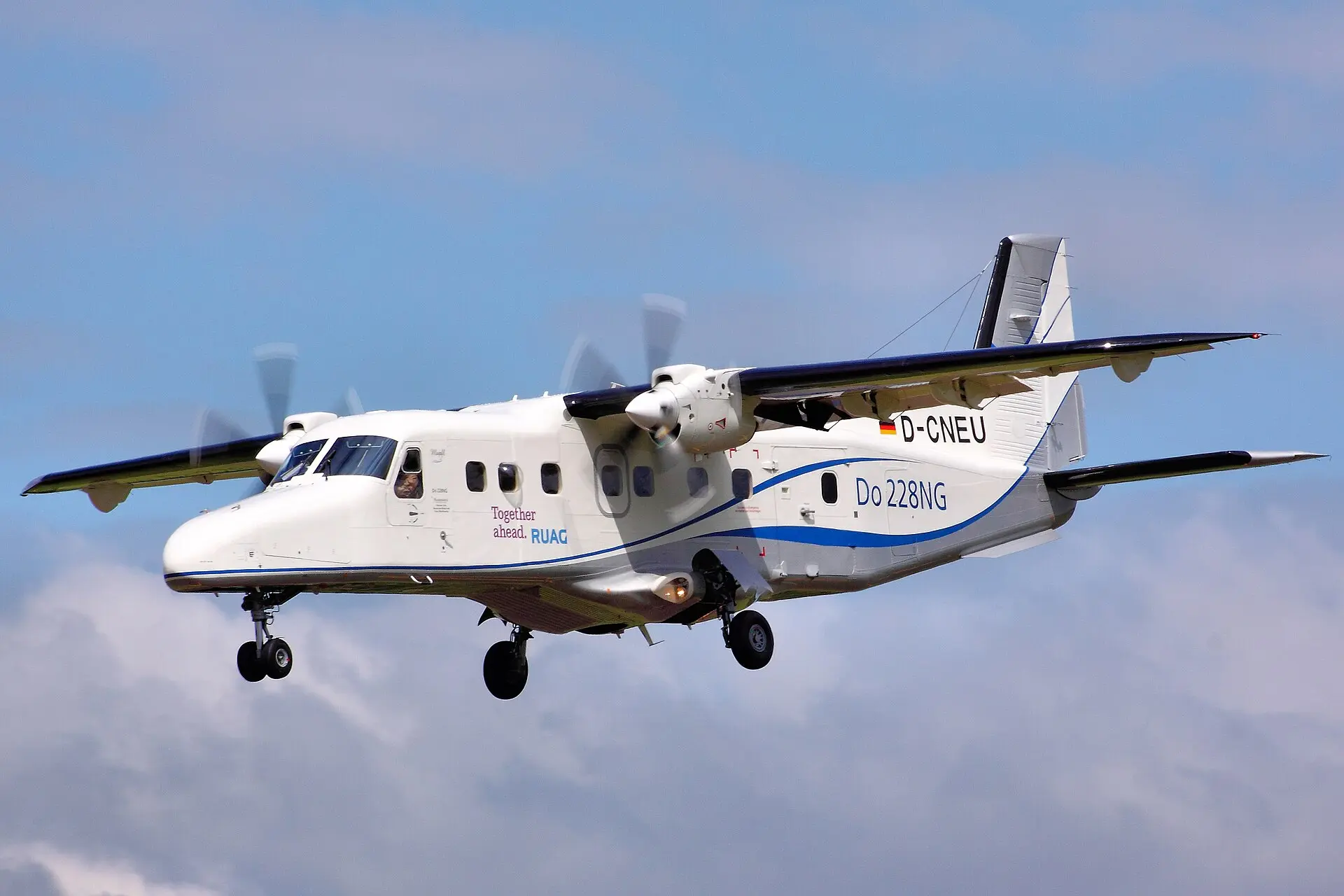
The Dornier Do 228 is a light twin-turboprop aircraft intended for short routes and restricted runways. Germany's Dornier developed it as a flexible utility machine for civil and government users. It first flew in 1981. The design was not exclusively military, yet its ability to work in remote regions made it valuable to armed forces and border agencies as well. In a military aviation catalogue it represents a small multipurpose transport rather than a heavy freighter.
A high wing and relatively boxlike fuselage make good use of the internal space for passengers, cargo or mission equipment. Two turboprop engines support economical operation on regional routes. The wing and its high-lift devices were intended to give useful takeoff and landing performance. That matters when moving people and materials to airfields with short strips. Suitability still depends on the surface, surrounding terrain, weather and actual load. A short-field designation does not remove those practical limits.
Do 228 aircraft have flown passenger and freight services, coastal surveillance, search and rescue, border patrol and environmental monitoring. Patrol versions carry sensors, communications equipment and operator stations. Those installations occupy space that would otherwise be available for ordinary freight. Published passenger capacity for a civil cabin should therefore not automatically be assigned to a surveillance aircraft. Military users valued a small fleet that could connect bases while also covering specialist assignments.
Manufacture began in Germany, while India's Hindustan Aeronautics later became an important producer. Modernized versions have appeared with updated systems and equipment. Indian Do 228 aircraft have served government and maritime organizations. The later variants preserve the broad concept of the original aircraft, but cockpit equipment, systems and mission installations differ. A precise description of an individual aircraft needs its series and role.
The Do 228's historical interest lies in the combination of routine transport and observation work. It never competed with giant military airlifters in payload. Its niche is to carry a small group of specialists, deliver urgent freight or remain over a search area where using a large aircraft would be inefficient. That pattern explains the design's long life and its presence in both civil aviation and state services.