
Military transport aircraft / C-47
Douglas C-47 Skytrain
The Douglas C-47 Skytrain was a US military transport derived from the DC-3. In World War II it carried cargo and airborne troops, towed gliders and evacuated casualties; Allied services also called it the Dakota.
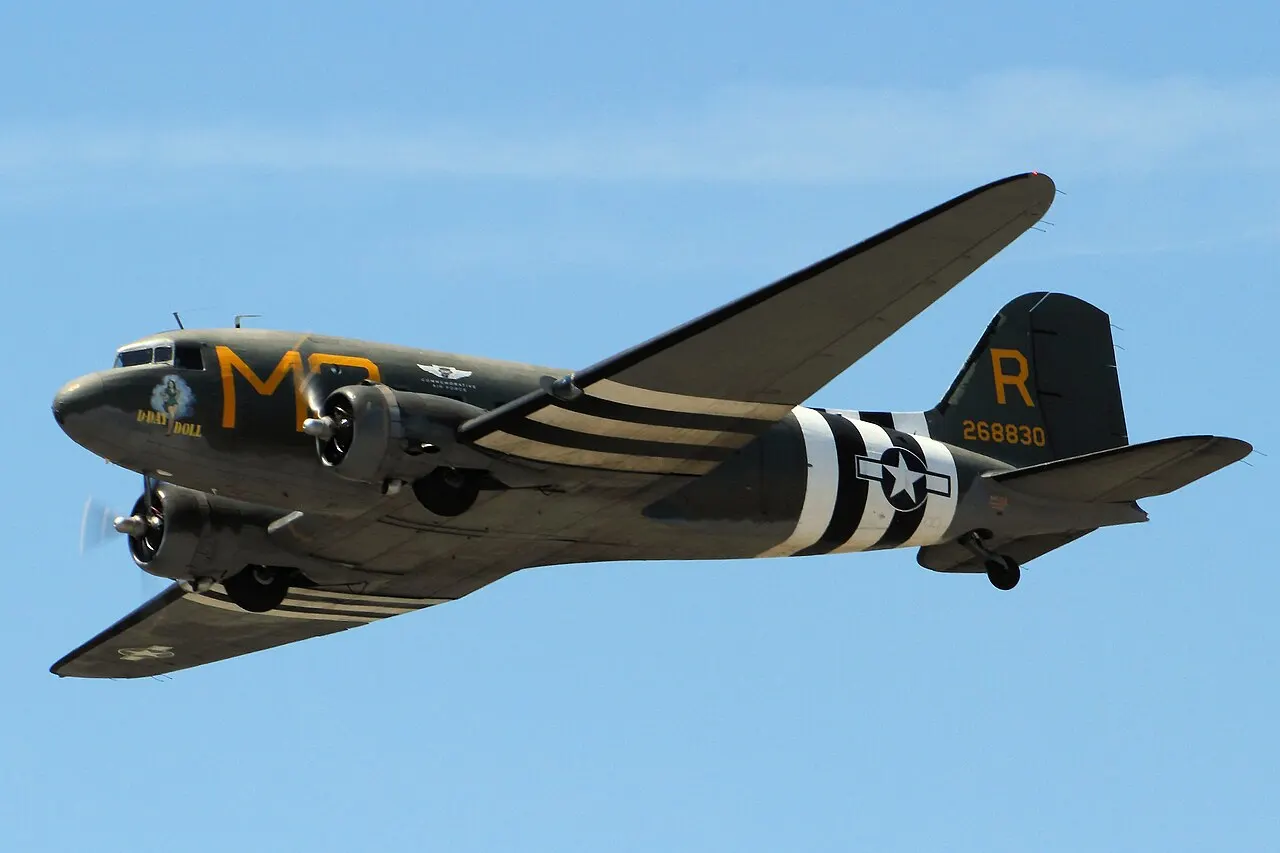
Development
History
The Douglas C-47 Skytrain was an American military transport developed from the DC-3 passenger airliner. British and other Allied services commonly called it the Dakota. The two aircraft have a clear family resemblance, but the military version was adapted to carry freight and troops. Its interior arrangement, access for loading and mission equipment differed from those of an ordinary airline aircraft. The C-47 became a central part of Allied air transport in the Second World War. It moved supplies and personnel, dropped parachutists, towed gliders and brought wounded people away from operational areas. Its importance came from dependable versatility across a very large network of airfields rather than from a single outstanding performance figure.
The DC-3 had already proved itself in civil service before the war. For military planners, a known airframe offered a quicker route to building transport capacity than a wholly new design. Carrying crates and equipment, however, is not the same as carrying ticketed passengers. Freight needs a practical opening and secure restraint; paratroopers need a cabin and exit arranged around a timed jump. The C-47 was therefore more than a DC-3 with different paint. Douglas adapted the fuselage and its fittings for loading and military use. The familiar low wing, two piston engines and tailwheel landing gear remained, while the working space inside became useful for a wider range of missions.
During the Second World War C-47s served in many theatres. They moved personnel and stores between bases, supplied forward units and reached destinations where surface transport was slow or disrupted. Airborne operations became one of their best-known tasks. A crew had to bring a group to the correct drop zone, maintain the required flight conditions and coordinate the exit of fully equipped paratroopers. In June 1944 C-47s participated in the Normandy invasion by carrying airborne troops and towing gliders. Those flights formed one part of an enormous coordinated operation. The aircraft's contribution was substantial, but no single transport type could deliver the entire invasion on its own.
Glider towing required different preparation from a routine cargo flight. A C-47 lifted a loaded glider on a towline and carried it towards the intended release area, after which the glider crew continued independently. Route planning, performance and crew coordination all changed. The National Museum of the United States Air Force describes a particular C-47A later used to retrieve gliders from France. Such an example illustrates the variety of work undertaken by transport units. It should not, however, be treated as the history of every C-47. Individual airframes and squadrons performed different combinations of missions in different places.
The C-47 also served as an air ambulance. With an appropriate interior arrangement it could carry litter patients together with medical personnel. That was a distinct task from delivering freight: patient care required space, careful loading and a different cabin layout. The US Air Force museum lists alternative capacities for passengers, paratroopers, cargo and stretchers. They are not figures to be added together for one flight. A crew selected a configuration to suit the mission and the limits of the aircraft. The ability to change the cabin in this way made the broad DC-3-derived fuselage valuable during a war in which transport demands changed rapidly.
The Skytrain's service did not end when the Second World War did. C-47s remained in American and other fleets and took part in postwar airlift, including the effort to supply Berlin. During the Korean War they again carried people and stores, evacuated wounded personnel and flew other support missions. An older transport was not ideal for every item of newer, heavier equipment. It nevertheless remained useful where its size, availability and familiar operating procedures mattered more than maximum payload. Continued service also depended on maintenance, repairs and crews who knew how to operate an aircraft designed before the war.
In Southeast Asia, members of the C-47 family were adapted for further roles. Alongside ordinary transport flights there were versions for reconnaissance, psychological operations and armed support. The AC-47 was equipped as a gunship. It must be distinguished from an unarmed transport C-47 even though both share an airframe lineage. The conversion demonstrates the design's flexibility, but it does not mean every Skytrain carried weapons or performed the same combat mission. A useful account of the family identifies a specific designation, equipment fit and period of service instead of merging every specialised variant into the original transport.
The type's long career reflected both the scale of production and the practicality of its layout. The National Museum of the US Air Force reports that American forces had procured many thousands of C-47s by the end of the Second World War. A large fleet supported a supply of spare parts, experienced mechanics and trained crews. The aircraft worked in varied climates and locations, although every successful trip still depended on weather, runway condition, load planning and ground support. Its reputation for toughness should not be turned into a claim that it could fly safely without limits. Longevity resulted as much from the people and organisation around the aircraft as from the airframe itself.
The C-47 Skytrain remains a defining example of a widely used military transport. Its DC-3 ancestry shows how a successful civil platform could be adapted to urgent military needs. Wartime service combined supply flights, airborne operations, glider towing and medical evacuation; later decades brought additional missions and specialist versions. The aircraft was never a universal answer to every payload or distance requirement. It was especially valuable where people and relatively modest loads had to be moved repeatedly over many routes. Such everyday transport work attracts less attention than a fighter sortie, yet large campaigns could not have functioned without it.