
Military transport aircraft / C-119
Fairchild C-119 Flying Boxcar
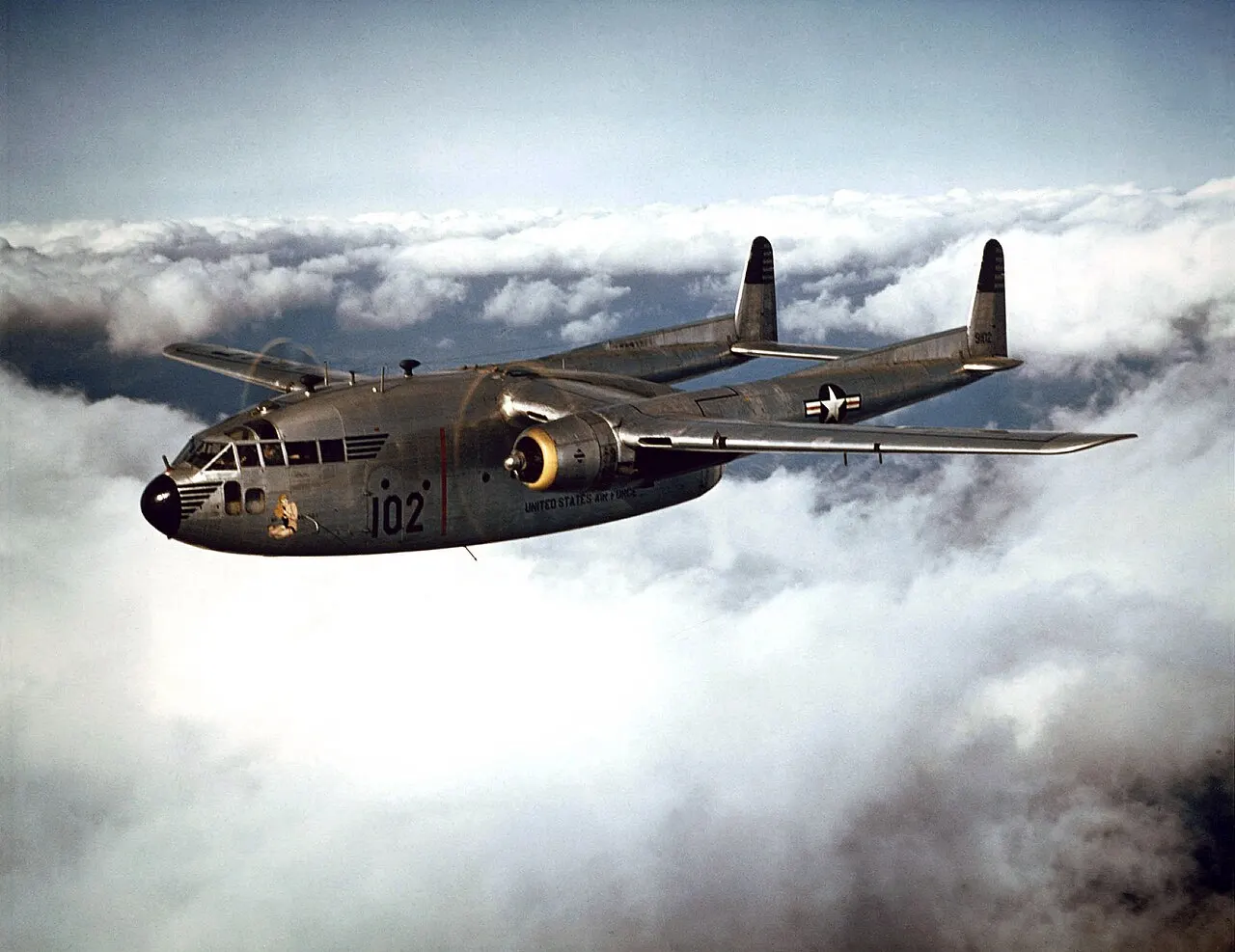
The Fairchild C-119 Flying Boxcar was an American transport with twin tail booms and a broad rear cargo opening. First flown in 1947, the family served in airlift, airdrop and specialised missions.
Development
History
The Fairchild C-119 Flying Boxcar was an American transport designed after the Second World War to move freight, parachutists and medical patients. Its unusual appearance came from two tail booms flanking the rear opening of the central cargo fuselage. That layout made access to bulky items practical and supported airdrop operations. Fairchild developed the roomy transport concept from the earlier C-82 Packet. The C-119 first flew in 1947. Its nickname captured the aircraft's cargo role, but it does not describe the full range of tasks that followed. Like other tactical transports, its value lay in moving useful loads to the right place under the constraints of an actual mission.
A military transport needs to load and unload efficiently, sometimes at a field where time and handling equipment are limited. The Flying Boxcar's broad rear doors and fuselage attitude on the ground helped crews bring in larger objects. It could carry equipment rather than only passengers and their personal bags. A large opening did not make every object suitable for carriage. Weight, dimensions, floor loading and aircraft balance still had to be checked. The loading team also needed to secure each item for takeoff, flight and landing. A successful sortie was planned around a specific load and route, not around a maximum-payload number considered in isolation.
The C-119 became a prominent transport during the Korean War. It delivered personnel and stores and could drop supplies from the air. A well-known mission took place in the winter of 1950, when C-119Bs dropped bridge sections to American forces near the Chosin Reservoir after an existing crossing had been destroyed. The episode shows how an unarmed aircraft could affect an operation. The bridge components had to be prepared for release, flown to the correct area and recovered on the ground in a condition that allowed assembly. Aircrew, load specialists and the receiving force all had to coordinate. The aircraft alone could not solve the logistical problem without that wider organisation.
Paratroop missions made different demands on the cabin. Instead of cargo, the aircraft carried equipped soldiers who needed safe positions and an organised exit. When releasing pallets, crews had to consider their placement, restraint and sequence of movement through the rear opening. Air Force histories describe both airlanded deliveries and airdrops by C-119 units. These methods are not interchangeable in every situation. Landing allows more controlled handling of a heavy object but requires an acceptable strip. An airdrop can reach a force without such a strip, although it places greater demands on packaging, release accuracy and recovery on the ground.
The twin-boom arrangement makes a C-119 easy to recognise. The central fuselage holds the cargo cabin, the two piston engines are mounted on the wing, and the booms carry the tail surfaces on either side of the rear access area. This was more than styling: the layout was related to moving large loads and getting them out of the aircraft. The Flying Boxcar was nevertheless a product of its generation. Operation required maintenance of its engines, trained crews and suitable airfield support. Later turboprop and jet transports took over many of the same tasks, but the C-119 had already expanded the practical options for tactical airlift.
Different versions of the family were adapted to specialised missions. The National Museum of the United States Air Force displays a C-119J associated with mid-air recovery of a returning satellite capsule. In August 1960 an aircraft of this version caught the parachute of the Discoverer XIV capsule and hauled the film container aboard. It is a striking part of aviation history but not a typical mission of the whole fleet. Most Flying Boxcars were used to move people or goods. Identifying the J variant matters: the special recovery gear and its crews should not be attributed to an ordinary cargo C-119.
Another branch was the armed AC-119 used in Southeast Asia. Its role was ground support, with equipment and procedures distinct from those of a standard transport. The roomy fuselage and availability of airframes helped make a conversion possible, but a gunship was not simply a freighter carrying an incidental weapon. It needed a different mission system and crew training. The basic Flying Boxcar remained a logistics aircraft. Separating the C-119 transport, the satellite-recovery C-119J and the AC-119 gunship prevents their histories and performance figures from being mixed into one misleading description.
C-119s also served beyond the United States. Air Force historical material describes examples supplied to allies and later used by other countries. Each operator received particular versions and maintained its own service schedule. A photograph of one national aircraft cannot establish the equipment of all the others. A long service life also means changing maintenance standards, installations and duties. A family-level account is most useful when it explains the shared design and principal mission while attaching exact capacities, engines and dates to a specified series. This distinction matters especially for an aircraft that was repeatedly modified.
The Flying Boxcar is a clear example of form following the requirements of cargo handling and airdrop. Its fuselage, large rear opening and twin booms addressed problems that a normal passenger aircraft could not solve as easily. Korea demonstrated the value of urgent delivery, while later special versions showed how far the design could be adapted. It was never a universal transport for every generation or every payload. It was an effective response to the needs of its period: move troops, equipment and patients, supply forward forces and deliver freight when a surface route was too slow or unavailable.