
Military transport aircraft / C-2
Grumman C-2 Greyhound
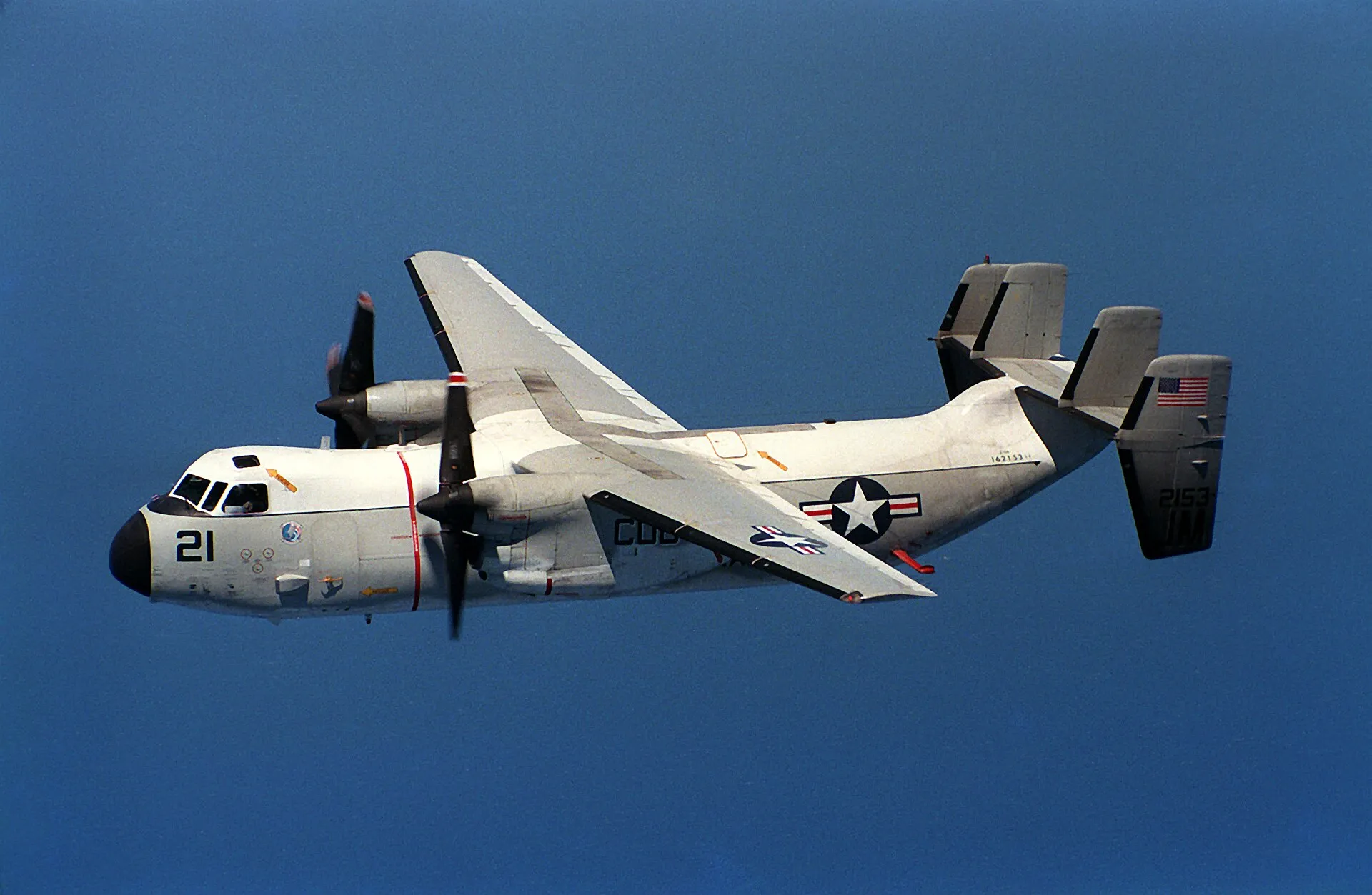
The C-2 Greyhound is a twin-engine carrier onboard delivery aircraft for urgent freight, mail and passengers between shore and aircraft carrier. It derives from the E-2 Hawkeye with a wider fuselage and rear ramp.
Development
History
The Grumman C-2 Greyhound was a US Navy transport designed to connect shore bases with aircraft carriers at sea. Unlike a large land-based freighter, it belonged to the carrier aviation system. It could be launched from a ship's catapult, land using arresting gear and clear a crowded flight deck for other aircraft. Its routine cargo was often less conspicuous than combat equipment, yet no less important to the ship: spare parts, mail, specialist tools and personnel had to arrive on time. The C-2 is best judged not simply by its maximum payload but by its ability to maintain a dependable logistical link between an operating carrier and the shore.
The need for such an aircraft grew as carriers and their air groups became larger and more complicated. More aircraft and specialists meant more frequent requirements for parts and urgent replacement equipment. The earlier C-1 Trader no longer fully met the Navy's needs for capacity and range. Grumman drew on its experience with the E-2 Hawkeye airborne early warning aircraft to create a transport for a different mission. The shared design reduced some development risk, but the Greyhound was not merely a Hawkeye without its radar. A useful cargo aircraft needed a wider fuselage, a rear loading opening and a cabin arranged around freight and passengers.
The first Greyhound prototype flew on 18 November 1964. Following testing, the aircraft entered the Navy's carrier supply system. In the 1980s a new group of C-2A aircraft was ordered to replace ageing early airframes. That procurement is often identified as C-2A(R), with the suffix referring to reprocurement rather than to a new operational role. A history of the type should distinguish the prototype's first flight from the delivery of a particular production group or the later modernisation of an older aircraft. Equipment, maintenance standards and life-extension work changed over decades of service even though the basic mission remained recognisable.
The C-2A has a high wing and two Allison T56-A-425 turboprop engines. NAVAIR explains that it shares a wing with the E-2C Hawkeye but has a widened fuselage and a rear cargo ramp. The family resemblance is visible, yet the transport did not inherit the Hawkeye's airborne surveillance role. Its cabin had to make room for cargo and the people accompanying it rather than a large radar installation and its operators. The high wing also helps keep the lower fuselage available for a useful freight space and provides practical access to the ramp on a carrier deck or an airfield apron.
The rear ramp allows urgent freight to be loaded without keeping a carrier aircraft on the ground or deck for longer than necessary. Passengers, mail, spare parts and litter patients can be carried in suitable cabin arrangements. NAVAIR notes that priority aviation components, including engines, could be moved when their size and weight met the aircraft's limits. A cargo restraint system is essential. Loads during a catapult launch and an arrested landing differ from those of an ordinary flight between airports. Securing the freight and distributing it correctly are therefore not minor details; they are part of making the mission safe and possible at all.
US Navy material gives the C-2A a payload of up to 10,000 pounds, approximately 4.5 tonnes, under appropriate conditions. That number indicates the aircraft's class but does not mean that every object of that weight can be brought aboard and placed inside. Dimensions, balance and restraint must also be checked. Passenger seating, litter accommodation or a mixed load changes the available space. For the crew and the supply organisation, the practical objective is rarely to reach the largest figure in a table. It is to deliver a particular item to a particular ship on time while respecting the limits of the aircraft and the flight deck.
A carrier flight imposes demands that a conventional freighter never encounters. Space on deck is limited, while landing requires a precise approach followed by rapid deceleration when the arresting wire is caught. Before departure the Greyhound is positioned on a catapult. After arrival it has to be moved without obstructing the rest of the air group. Weather and the motion of the ship complicate the operation. Airframe strength, landing gear, cargo restraints, crew preparation and coordination with deck personnel form a single system. Speed between shore and ship matters, but speed alone cannot deliver a load successfully.
The role is known as Carrier Onboard Delivery, usually shortened to COD. It is more than a single flight to a ship; it is a continuing logistics channel for the carrier group. When an important aircraft component fails, its replacement may be needed far sooner than a shipment by sea can arrive. The aircraft can also return specialists, carry mail and help move a patient who needs treatment ashore. Each type of trip has its own constraints. Useful load must be calculated for the route and the conditions of launch and recovery, while patient transport requires suitable space and support. The Greyhound's value lay in making these varied tasks part of a regular service.
After many years in use, the Navy maintained and extended the service lives of its C-2A fleet. For an aircraft operating from carriers, flight hours are not the only measure of wear. The number of catapult launches and arrested landings also matters because those events place distinctive loads on the structure. Navy maintenance organisations have described inspections of the airframe, wiring and other systems needed to keep aircraft in service. Extending life is not the same as designing a new type. It allows an ageing fleet to perform its mission while a replacement is prepared, but it requires continuing assessment of each airframe and respect for its approved limits.
The US Navy began replacing the C-2A in the carrier logistics role with the CMV-22B Osprey tiltrotor. That transition does not make the older transport a failure. The newer aircraft approaches part of the logistics problem with a different design and operating pattern. Navy accounts of the end of C-2 training and the gradual change of squadrons show that withdrawing a type is an organisational process, not a single date on a calendar. The status of every individual aircraft cannot be inferred from the year in which a replacement programme was announced. A careful account separates the Greyhound's long service from the phased introduction of its successor.
The C-2 occupies a distinctive place among military transports. It was never intended to carry heavy armour across an ocean or to replace a large airfield-based freighter. Its task was narrower and, in its own way, more demanding: take a relatively small but urgent load directly to a moving carrier. Its Hawkeye ancestry explains part of its engineering, while the wider fuselage, ramp and cargo arrangement show how that design was adapted to a new job. The Greyhound's history is a reminder that the effectiveness of a carrier air group depends not only on the aircraft flying combat missions, but also on timely supplies, repairs and the people who keep the fleet operating.